



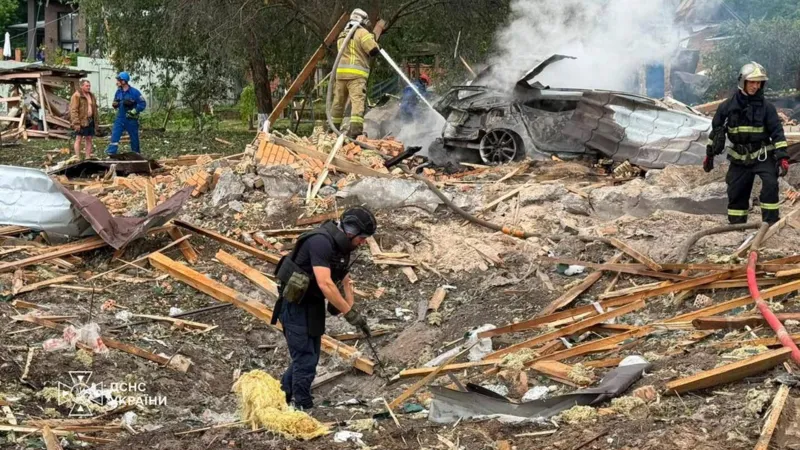

Kyiv Oblast: Ukraine witnesses deadly Russian missile strikes as renewed cross-border attacks deepen the ongoing regional conflict
At least 15 people have been killed in a series of Russian attacks across Ukraine, including 10 victims in a devastating ballistic missile strike on a drone technology exhibition near Kyiv. The attack also left about 100 people injured, marking one of the deadliest assaults on Ukraine’s defence sector in recent months.
According to Ukrainian President Volodymyr Zelensky, the daytime strike targeted an exhibition attended by prominent figures from Ukraine’s defence industry. The event showcased drone technologies that have become increasingly important to Ukraine’s military operations since Russia launched its full-scale invasion in February 2022.
Emergency services rushed to the scene as rescuers searched through damaged buildings and debris for survivors. Medical teams treated dozens of wounded people, many of whom sustained serious injuries from the powerful missile explosions and collapsing structures.
The missile strike near Kyiv was part of a broader wave of Russian attacks carried out across Ukraine. In the eastern city of Sloviansk, Russian glide bombs killed five people and caused widespread destruction to residential neighbourhoods and civilian infrastructure.
Earlier on Saturday, Ukrainian military officials also confirmed the deaths of two men in the northern city of Sumy after another Russian attack. Authorities continued assessing damage while emergency crews worked to restore essential services in affected communities.
President Zelensky said intelligence reports indicated Russia could launch another large-scale missile strike within the next 48 hours. He warned that Ukrainian air defence units remained on high alert as officials prepared for the possibility of further attacks on cities and critical infrastructure.
The Ukrainian Air Force reported that Russia fired three ballistic missiles during the attack near Kyiv. Air force spokesman Yuri Ihnat said only one missile was successfully intercepted, allowing the remaining projectiles to strike their intended target with devastating consequences.
Russia’s Defence Ministry acknowledged carrying out the strike, stating that high-precision long-range weapons had been used against a facility where drones intended for attacks on Russian territory were allegedly being demonstrated. Moscow claimed the exhibition included drone manufacturers, members of Ukraine’s drone forces, and security officials involved in planning strikes against Russia.
The attack has sparked significant public criticism within Ukraine over the organisation of the exhibition. Many questioned why such an event, involving key defence personnel and military technology, had been publicly advertised despite the constant threat of Russian missile attacks.
President Zelensky ordered an immediate investigation into the circumstances surrounding the exhibition. Ukraine’s prosecutor general also launched an inquiry to determine who authorised the public event and whether appropriate security measures had been implemented to protect attendees.
Following the strike, initial reports raised concerns over the safety of several well-known figures in Ukraine’s defence technology community. Defence Ministry adviser Serhiy Beskrestnov, widely known as “Flash,” and military technology developer Lyuba Shypovych were both feared to have been caught in the attack.
However, both individuals later confirmed through social media that they were unharmed. Beskrestnov revealed that he had deliberately avoided attending the exhibition because of concerns about possible Russian attacks on publicly announced defence-related gatherings.
The latest strike marks at least the third occasion since Russia’s full-scale invasion began that an exhibition showcasing military or drone technology has been targeted. The repeated attacks have intensified concerns over operational security and the protection of defence-related events.
While Ukraine dealt with the aftermath of the attacks, its armed forces carried out long-range strikes deep inside Russian territory. Ukrainian officials said a major military-industrial facility in the Russian city of Kirov had been successfully targeted.
President Zelensky described the facility as one of Russia’s most important military production sites, supplying components used in aircraft and missile systems deployed against Ukraine. Russian authorities reported that six people were killed and 26 others injured in the Ukrainian strike.
Ukraine also launched attacks against warehouse facilities operated by Wildberries, Russia’s largest online retailer. The warehouses, located near St Petersburg, have become increasingly significant targets as Kyiv seeks to disrupt Russian military logistics rather than focusing solely on oil infrastructure.
Ukrainian officials argue that logistics hubs and commercial distribution centres can indirectly support Russia’s military by facilitating the purchase and transportation of equipment used by the armed forces. The attacks reportedly disrupted operations affecting thousands of small and medium-sized businesses across Russia.
Meanwhile, diplomatic developments continue alongside the military escalation. President Zelensky is expected to travel to the United States next week, where he is scheduled to meet President Donald Trump as Washington attempts to revive stalled peace negotiations between Ukraine and Russia.
The planned meeting comes during a period of heightened military activity, with both sides continuing to exchange long-range strikes despite international efforts to encourage renewed diplomatic dialogue aimed at reducing hostilities.
Separately, regional security concerns extended beyond Ukraine’s borders. Romanian President Nicușor Dan announced that a Romanian Air Force F-16 fighter jet had shot down a Russian drone after it entered Romanian airspace on Friday.
Romanian authorities had earlier issued public alerts across several eastern and south-eastern regions as the drone approached national territory. The incident highlighted the continuing risk that the conflict poses to neighbouring NATO member states.
As fighting intensifies and both countries expand the range and scale of their operations, civilians continue to bear the greatest cost. The deadly missile strike near Kyiv, combined with ongoing retaliatory attacks inside Russia, illustrates how the conflict remains far from resolution despite renewed diplomatic initiatives.
With investigations under way, air defence systems on heightened alert, and international leaders preparing for fresh diplomatic discussions, the coming days are expected to be critical in determining whether the conflict moves toward further escalation or renewed attempts at negotiation.