




Hungary | Central Hungary: Record-low Danube water levels force Hungary’s only nuclear power plant offline, raising fears over electricity supply and regional energy security
Hungary has shut down its only nuclear power plant after the River Danube fell to record-low levels, marking an unprecedented disruption to the country’s electricity generation and highlighting the growing impact of extreme weather across Europe.
Prime Minister Péter Magyar announced that the Soviet-era Paks Nuclear Power Plant would be forced to cease operations entirely because the Danube’s water level had dropped so dramatically that the plant’s cooling water intake system could no longer function safely.
The Paks Nuclear Power Plant is Hungary’s sole nuclear electricity producer and supplies a significant share of the country’s power demand. Its complete shutdown represents the first such event caused by insufficient river water since the facility began operating decades ago.
Magyar warned that Hungary’s electricity supply could enter a “critical” phase beginning Monday if weather conditions fail to improve. Authorities are now preparing emergency measures to maintain grid stability during one of the country’s hottest summers on record.
The government has appealed to households and businesses to reduce electricity consumption during peak demand between 5:00 p.m. and 10:00 p.m. Citizens have been asked to postpone charging electric vehicles and limit the use of air conditioning wherever possible.
Officials also indicated that a rotational electricity shutdown regime remains under consideration if voluntary conservation measures prove insufficient. Authorities are preparing a list of major electricity and water consumers whose usage could be temporarily restricted to protect the national grid.
Hungary is among several European nations experiencing prolonged drought and exceptional heat. Rainfall has remained well below seasonal averages throughout much of the summer, while temperatures are expected to remain close to 37 degrees Celsius for at least another week.
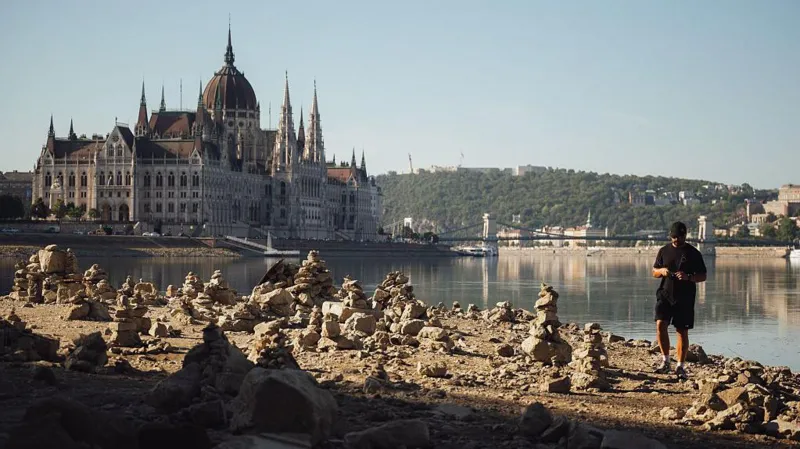
The River Danube, Europe’s second-longest river, has fallen to its lowest levels in decades across multiple countries. Large sections of the riverbed have emerged in Budapest as water continues to recede under persistent heat and limited rainfall.
The crisis is not confined to Hungary. Romania has also experienced severe disruptions to its nuclear energy sector after water levels along the Danube dropped dramatically near the Cernavoda Nuclear Power Plant.
Romania has already shut down one of the two 706-megawatt reactors at the Cernavoda facility, which normally generates around one-fifth of the country’s electricity. State-owned operator Nuclearelectrica is working to keep the remaining reactor operational, although continued declines in river levels could force an additional shutdown.
Hydrological authorities in Romania reported that average Danube flow entering the country during July normally reaches around 4,700 cubic metres per second. Recent measurements, however, showed the flow had fallen to approximately 1,600 cubic metres per second, with forecasts predicting an additional decline in the coming days.
Scientists have increasingly linked Europe’s more frequent and intense heatwaves to climate change. According to climate experts, Europe is warming approximately twice as fast as the global average, placing increasing pressure on rivers, agriculture, energy systems and water supplies.
Reduced river levels pose particular challenges for nuclear power plants because reactors require large volumes of water for cooling. When water becomes too shallow or excessively warm, operators must reduce output or suspend operations to maintain safety standards.
Beyond energy production, the Danube’s shrinking waters are disrupting transportation and exposing remnants of history buried beneath the river for decades.
In Serbia, the remains of German World War II river warships have resurfaced near Prahovo after exceptionally low water levels revealed long-submerged wrecks. Authorities say such conditions have not been observed for half a century.
Elsewhere along the Danube, the remains of a sunken Hungarian cargo vessel have reappeared in Croatia, while archaeologists in Bulgaria identified mammoth bones discovered by a local resident on the exposed riverbed near the city of Ruse.
The Danube stretches nearly 2,900 kilometres across 19 European countries, making it one of the continent’s most important waterways for transportation, trade, tourism and industry. Persistent drought is now affecting nearly every section of the river.
Commercial shipping has already been severely disrupted in Bulgaria, where navigation has become increasingly difficult because of shallow channels. Earlier this week, border police evacuated 186 passengers from the Viking Ullur cruise ship after it became stranded near Vidin.
Passengers reportedly faced dwindling food and water supplies because rescue vessels were also unable to approach the grounded ship due to extremely shallow conditions. Maritime officials described the situation as unprecedented in recent decades.
Hydrologists across the Balkans believe the current crisis reflects not only extreme summer temperatures but also unusually low rainfall during the spring, leaving rivers without sufficient reserves before the hottest months arrived.
Serbian hydrologist Dejan Vladiković said Danube water levels had dropped to values not recorded for between 50 and 60 years. Forecasts suggest meaningful improvement is unlikely before mid-September unless substantial rainfall reaches the region.
Serbia is also experiencing critically low levels along the Sava and Tisa rivers, both major tributaries of the Danube. Meteorologists expect temperatures in parts of the country to climb as high as 40 degrees Celsius, further intensifying evaporation.
Across southern Europe, extreme weather continues to fuel destructive wildfires. Greece and Turkey remain among the countries facing elevated fire risks, while France and Spain have recently endured some of the largest wildfire outbreaks in living memory.
The combination of extreme heat, drought, declining river flows and growing pressure on energy infrastructure has underscored the increasing challenges facing European governments as climate-related events become more frequent and severe.
For Hungary, the shutdown of the Paks Nuclear Power Plant represents an extraordinary moment in the nation’s energy history. Officials are now racing to stabilise electricity supplies while hoping that cooler weather and meaningful rainfall arrive before the country’s energy reserves face further strain.
As Central and Eastern Europe continue to battle prolonged drought, the Danube’s historic decline has become both a warning sign and a visible reminder of how climate extremes are reshaping critical infrastructure, transportation networks and everyday life across the continent.
This article was created using automation technology and was thoroughly edited and fact-checked by one of our editorial staff members