



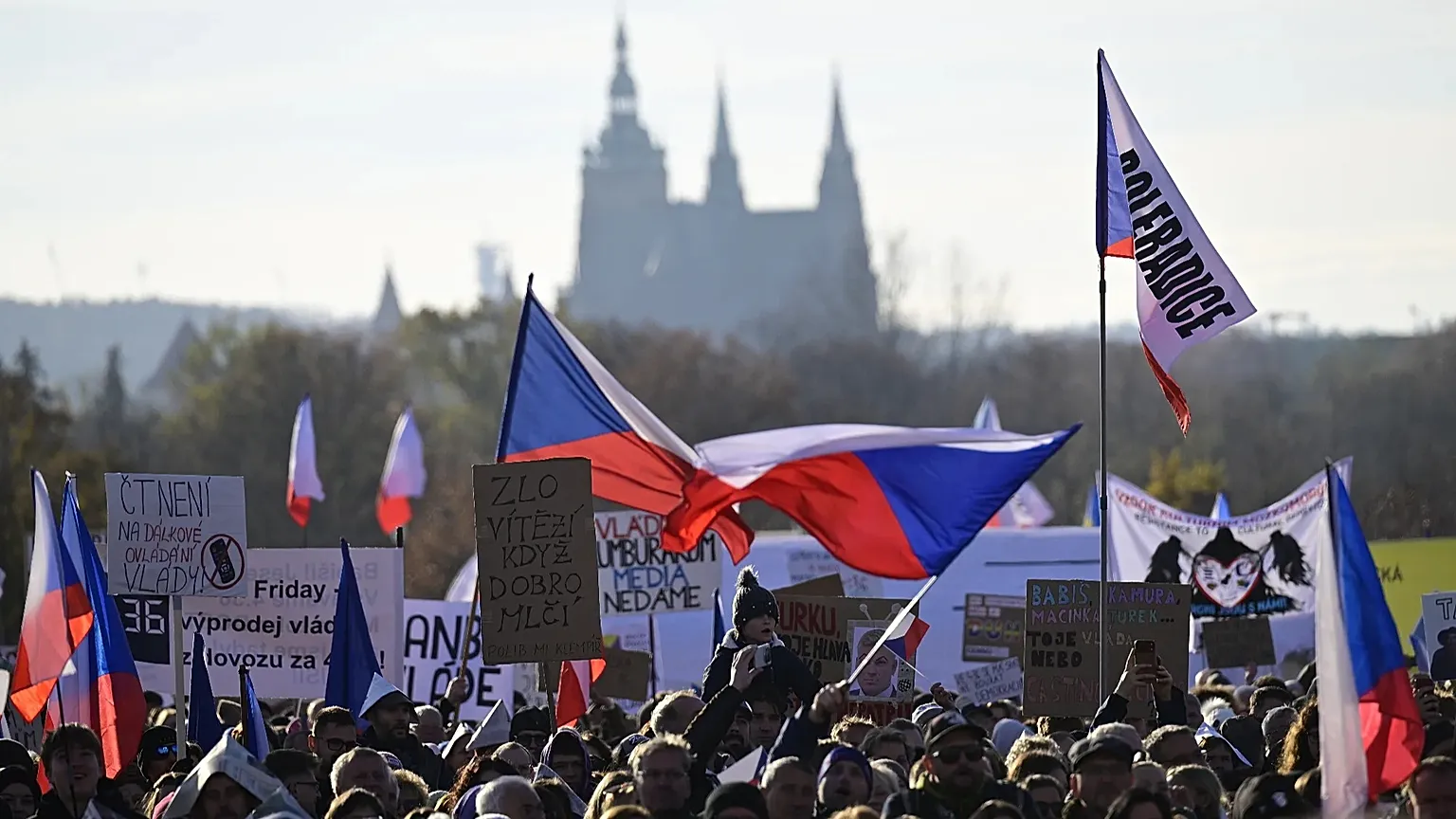

Czech Republic: Massive Prague Demonstration Challenges Government Proposals to Change Public Television and Radio Funding
Hundreds of thousands of people gathered in Prague on Sunday, November 15, to protest against the government’s proposed changes to the funding system of Czech public television and radio, making it the largest demonstration against Prime Minister Andrej Babis’s three-party coalition government so far.
The demonstration took place at Letná, one of Prague’s largest public squares, where an estimated 350,000 to 400,000 people assembled to defend the independence of public service broadcasters. The rally was organised by the civic organisation Million Moments for Democracy.
Protesters travelled from different parts of the Czech Republic, carrying banners and expressing concerns about the government’s proposed reforms. Many warned that replacing the existing broadcasting licence-fee system with direct state funding could make public television and radio more vulnerable to political influence.
The demonstration’s central slogan, “Never again 4:36”, referred to the time when the governing majority advanced a controversial amendment to broadcasting legislation during an overnight parliamentary session in October. The slogan became a symbol of opposition to the government’s legislative approach.
The parliamentary vote took place during the early hours of Saturday, October 24, after the governing coalition shortened the plenary debate. More than 60 opposition lawmakers were reportedly prevented from delivering their planned speeches before the legislation passed its first reading.
Organisers and demonstrators criticised the circumstances surrounding the parliamentary proceedings, arguing that significant changes to public broadcasting legislation required wider consultation and meaningful parliamentary discussion. The controversial vote subsequently became a major source of public dissatisfaction.
One of the principal demands raised during Sunday’s demonstration was the withdrawal of the coalition party Freedom and Direct Democracy (SPD) from the government. The party, led by Tomio Okamura, currently holds a position within the governing coalition.
Okamura, who also serves as speaker of the Chamber of Deputies, faced criticism from protesters who questioned the government’s policies and its approach towards democratic institutions. Demonstrators called for greater accountability and stronger protections for independent public broadcasting.
At the centre of the controversy is the government’s proposal to abolish compulsory household television and radio licence fees. Under the existing system, Czech households pay monthly charges that directly finance the country’s two major public service broadcasters.
Currently, households owning television or radio equipment are required to pay 150 Czech koruna monthly for television and another 55 koruna for radio. Together, the charges amount to 205 koruna per month for both services.
The government wants to replace this arrangement with direct funding from the national state budget. Under the proposed system, Czech Television and Czech Radio would receive financial allocations through government budgetary arrangements instead of relying on compulsory household payments.
However, critics argue that the proposed replacement would provide substantially less funding than the broadcasters currently receive. Concerns have also emerged that annual budget decisions could create opportunities for political authorities to influence the financial independence of public media organisations.
According to publicly available figures, Czech Television is expected to generate approximately 6.73 billion koruna through licence fees this year. Czech Radio is projected to receive another 2.47 billion koruna through its existing funding arrangement.
The proposed changes have therefore raised questions about how both broadcasters would maintain their existing operations if their revenues were reduced. Media organisations fear that insufficient funding could affect journalism, programme production, staffing and the availability of public information.
Opposition politicians, journalists and representatives of civil society have strongly criticised the government’s plans. They argue that public broadcasting should operate independently of political authorities and remain capable of reporting on government activities without financial pressure.
The government, however, has defended its proposal and rejected accusations that the reforms are intended to undermine editorial independence. Prime Minister Andrej Babis has maintained that the proposed changes will not result in political control over broadcasting content.
The debate has consequently developed into a wider disagreement about the relationship between government financing and independent journalism. While state-funded broadcasting exists in several European countries, critics argue that effective safeguards are necessary to prevent political interference.
Sunday’s demonstration attracted support from a broad range of organisations and professional communities across the Czech Republic. Student organisations from universities and colleges joined representatives of dozens of theatres, writers, leading athletes, churches and healthcare workers.
Representatives of international journalists’ organisations also expressed solidarity with the demonstrators. Their participation highlighted concerns extending beyond the country’s domestic political debate, particularly regarding the importance of protecting independent journalism and public service broadcasting across Europe.
Speakers addressing the crowds repeatedly emphasised that public television and radio should not belong to politicians, government officials or individual political parties. Instead, they argued that these institutions must serve the entire population and represent different perspectives within society.
They also stressed that public broadcasters must retain the freedom to scrutinise government decisions, report on controversial political developments and provide reliable information without interference. Maintaining editorial independence was presented as the central objective of the demonstration.
The organisation Million Moments for Democracy has played a prominent role in mobilising opposition to the proposed reforms. Its latest demonstration followed earlier public gatherings and growing criticism of the government’s handling of broadcasting legislation.
The controversy had also prompted employees of Czech Television and Czech Radio to organise a one-day strike on November 3. Their protest reflected concerns among broadcasting professionals about the potential financial and institutional consequences of the proposed changes.
The funding dispute has attracted attention from European media organisations and institutions. The European Broadcasting Union and other press freedom organisations have raised concerns about the importance of maintaining adequate, predictable and independent funding arrangements for public service broadcasters.
Meanwhile, representatives of the governing ANO party have criticised the organisers of Sunday’s demonstration. Radek Vondráček, a senior party representative, described Million Moments for Democracy as an association of professional agitators during a television debate programme.
His comments added another dimension to the political disagreement, with organisers defending their right to demonstrate and express opposition to government policies. The exchange reflected the increasingly sharp divisions surrounding the future of public broadcasting in the country.
The demonstration was covered live by Czech public news television, the Czech News Agency (CTK) and several independent media organisations. Its extensive coverage allowed audiences across the country to follow the gathering and hear arguments presented by protesters.
Despite the enormous turnout and strong political criticism expressed throughout the afternoon, the demonstration remained peaceful. According to police reports, there were no significant disturbances or incidents during the gathering until early evening.
The scale of Sunday’s protest has placed renewed attention on the Babis government’s proposed broadcasting reforms and the future of Czech public media. The legislation has passed its first parliamentary reading, but further debate and legislative procedures remain ahead.
With opposition parties, journalists, students and civic organisations continuing to question the proposal, the funding dispute is likely to remain a significant issue in Czech politics. The central challenge will be balancing government budgetary decisions with meaningful protections for independent public broadcasting.
This article was created using automation technology and was thoroughly edited and fact-checked by one of our editorial staff members