



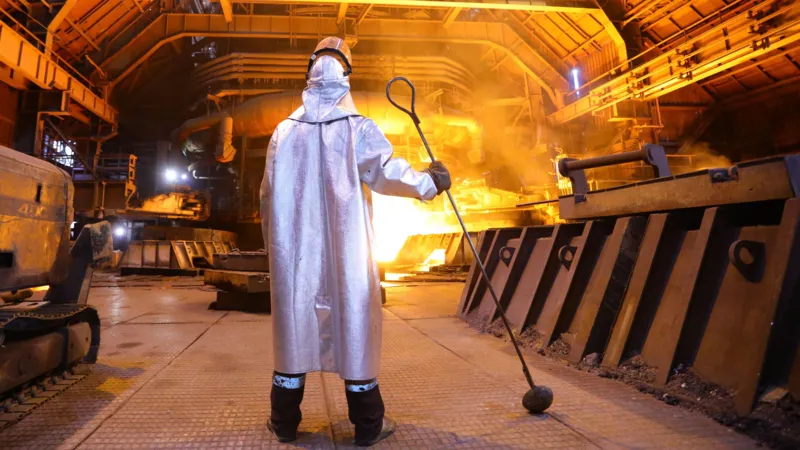

Ukraine’s Zaporizhzhia Oblast faces deep economic uncertainty as Russian strikes cripple a major steelworks employing thousands of workers
Zaporizhzhia’s industrial identity has been shaken after repeated Russian missile strikes forced Zaporizhstal, one of Ukraine’s most important steelworks, to shut down indefinitely, leaving thousands of workers uncertain about their livelihoods and the city’s economic future.
For generations, the sprawling plant has stood at the centre of life in Zaporizhzhia, providing employment, wages and business for communities across the city. Its closure therefore represents far more than another wartime industrial disruption.
Denys Maksyshko, who spent years working at Zaporizhstal, described the factory as the city’s heart, reflecting its enormous importance to generations of families. That heart, he says, has effectively stopped beating after four devastating waves of attacks.
According to the company, the factory was struck during two waves of Russian attacks in August and another two in September. Seventeen missiles were fired at the site, according to Metinvest chief operating officer Oleksandr Myronenko.
The attacks caused extensive destruction across the complex, with production equipment heavily damaged, windows shattered and roofs punctured by explosions. Blast furnaces, among the most important structures in any integrated steelworks, were also reported to have suffered severe damage.
Eight workers were killed and 31 others wounded in the attacks, according to Myronenko. The human cost has compounded the physical destruction, while the company has begun clearing debris and assessing what would be required for any eventual recovery.
For now, however, there is no timetable for restarting production. The scale of the damage, continuing security risks and enormous reconstruction requirements mean that Zaporizhstal’s future remains uncertain even as workers begin clearing the site.
The shutdown comes as Russia’s campaign against Ukrainian metallurgical facilities has intensified. Since August, steel and mining sites across the country have repeatedly come under attack, adding pressure to an industry already weakened by years of war.
Metallurgy and mining were vital pillars of Ukraine’s economy before Russia launched its full-scale invasion in 2022. Together, they accounted for roughly 10% of gross domestic product and about one-third of the country’s exports before the war.
The sector also supported employment on a vast scale, directly and indirectly providing work for more than half a million people. The industry’s decline has therefore carried consequences beyond factories, affecting families, suppliers, transport companies, cities and public finances.
Ukraine’s steel industry has already contracted dramatically since the war began. The country had 12 metallurgical plants before losing parts of its industrial heartland following the outbreak of fighting with Russia in 2014, beginning a long period of industrial decline.
By 2018, the number of operating metallurgical plants had fallen to nine. Three years into the full-scale war, in 2025, only six remained, highlighting how territorial losses, disrupted logistics and repeated attacks have transformed the sector.
Among the most significant losses were the Azovstal and Illich steel plants in Mariupol. Both became symbols of the devastation surrounding the southern Ukrainian city, which was eventually captured by Russian forces after a prolonged siege.
The latest attacks have now placed another major industrial centre under severe pressure. Zaporizhzhia has long been associated with heavy manufacturing, and Zaporizhstal has been among its largest employers, making the shutdown particularly significant for local communities.
The economic consequences could extend well beyond the factory gates. A prolonged closure would reduce household incomes, weaken demand for local businesses and cut associated tax revenues, while suppliers and contractors could also face declining activity.
Metinvest, which owns Zaporizhstal, is now focused on recovery planning rather than production. Crews are clearing rubble and examining damaged infrastructure, but rebuilding a major steel complex would require substantial investment, engineering and long-term security.
The company’s assessment comes amid a broader decline in Ukrainian steel output and exports. Industry figures show production falling sharply compared with pre-war levels, while the value of steel and iron exports has also dropped significantly.
The closure illustrates the vulnerability of large industrial facilities during prolonged conflict. Steel production requires complex equipment, uninterrupted energy supplies, transport links and extensive maintenance, making recovery difficult when surrounding infrastructure and supply chains remain exposed to attack.
That contraction matters because Ukraine depends heavily on exports to generate foreign currency and sustain economic activity during wartime. Industrial companies also contribute taxes and wages, meaning damage to major plants can affect public finances, local services and individual households.
Another major blow came in Kryvyi Rih, the hometown of President Volodymyr Zelensky. On 25 September, ArcelorMittal Kryvyi Rih announced that it could not safely reopen after repeated attacks over five weeks.
The plant praised the bravery of its employees after five workers were killed. Its shutdown further demonstrated how repeated strikes can turn damage to industrial infrastructure into prolonged interruptions that affect workers, communities and Ukraine’s wider economy.
Russia has said its military strikes target strategic and industrial infrastructure connected to Ukraine’s war effort. Ukrainian officials and industrial leaders, meanwhile, have argued that the attacks are also damaging economic capacity and undermining employment.
The competing claims underline the broader significance of Ukraine’s industrial sites during the war. Steelworks are not only production facilities; they are major employers, export generators and anchors for cities whose economies have developed around heavy industry.
For workers such as Maksyshko, however, the debate over strategy is overshadowed by uncertainty. The destruction of familiar workplaces has raised questions about employment, family income and whether the factories that shaped their communities can return.
Rebuilding Zaporizhstal would be a task even if security conditions improve. Damaged furnaces, production lines, buildings and utilities would have to be restored, while companies would need confidence that renewed investment would not face another wave of attacks.
The future of Ukraine’s steel industry will therefore depend on more than reconstruction alone. Security, access to export markets, investment, infrastructure and the ability to retain skilled workers will all influence whether damaged industrial centres can recover.
For Zaporizhzhia, the stakes are especially high. Zaporizhstal has been woven into the city’s economic and social fabric for decades, and its indefinite shutdown leaves thousands waiting for answers while Ukraine confronts the cost of a prolonged war.