



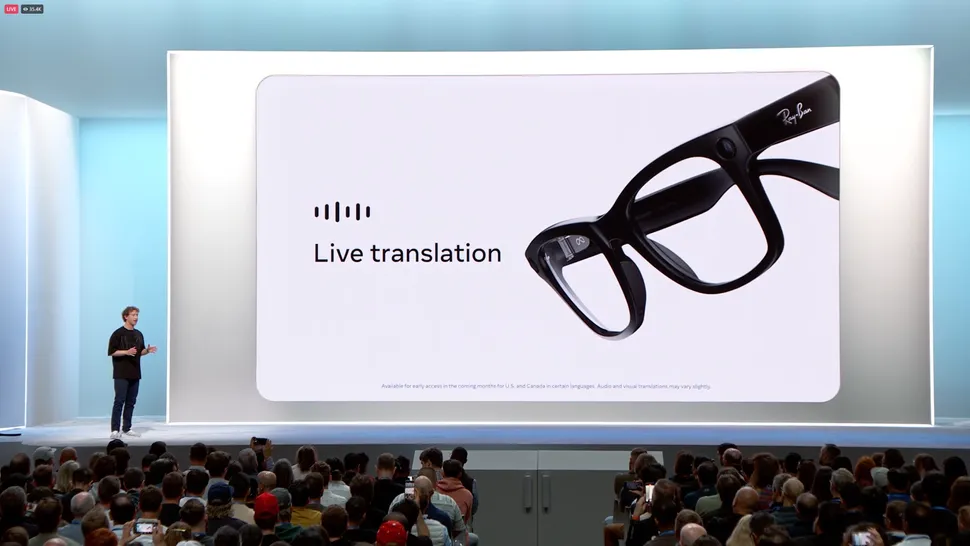

Meta has taken another step toward blending the digital and physical worlds with the launch of its latest artificial intelligence-powered smart glasses. At the company’s annual Meta Connect 2025 event in Menlo Park, California, CEO Mark Zuckerberg unveiled upgraded Ray-Ban AI smart glasses featuring a miniature display and a new neural wristband controller.
The new “Meta Ray-Ban Display” glasses, available in the U.S. starting September 30 at $799, feature a display that allows users to watch videos, view text messages, and even respond to them. Unlike traditional augmented reality headsets, the display does not obstruct a user’s view and disappears when not in use, offering an experience that remains both functional and discreet.
The highlight of the unveiling was the Meta Neural Band, a wristband capable of detecting subtle hand and finger movements. Zuckerberg said users will be able to control the glasses with “barely perceptible movements,” opening the door to more natural, intuitive interactions.
“Glasses are the only form factor where you can let AI see what you see, hear what you hear, and eventually generate what you want to generate,” Zuckerberg said during the keynote.
The new glasses are seen as a bridge between Meta’s audio-only smart glasses and its long-term augmented reality project, Orion. The Orion glasses, still in development, aim to project 3D holographic visuals directly into a person’s field of view. Zuckerberg described Orion as “the most advanced glasses the world has ever seen,” though they remain years away from consumer availability due to cost and technical challenges.
Meta has positioned its smart glasses as a stepping stone toward what Zuckerberg calls “personal superintelligence.” While he has been vague about specific timelines, he has argued that AI-powered glasses will become the primary way humans interact with superintelligent systems, a vision shared by several competitors in the race toward artificial general intelligence.
Beyond the headline product, Meta also announced upgrades to its existing Ray-Ban smart glasses. The updated version now offers eight hours of battery life—nearly double the previous model—and introduces “conversation focus,” a feature that amplifies the voice of the person a wearer is speaking with while filtering out background noise.
These improvements will roll out as a software update to existing devices.
Live translation has also been expanded, adding German and Portuguese to the lineup. The new model will retail for $379, while the older version drops in price to $299.
In addition, Meta introduced a collaboration with Oakley for athletes: the Oakley Meta Vanguard glasses. Priced at $499 and set to release on October 21, these glasses are designed for high-intensity sports. They integrate with Garmin devices to track workout metrics and can automatically record video clips during key performance moments.
“For more than a decade, Zuckerberg’s long-term vision with Oculus and the Metaverse has been that glasses and headsets will blur the lines between physical and digital worlds,” said Forrester analyst Thomas Husson. “After many false starts, the momentum to move beyond an early adopter niche is now.”
With its latest lineup, Meta hopes to bring AI-powered wearables into the mainstream, creating not just gadgets but a new way of interacting with technology.