



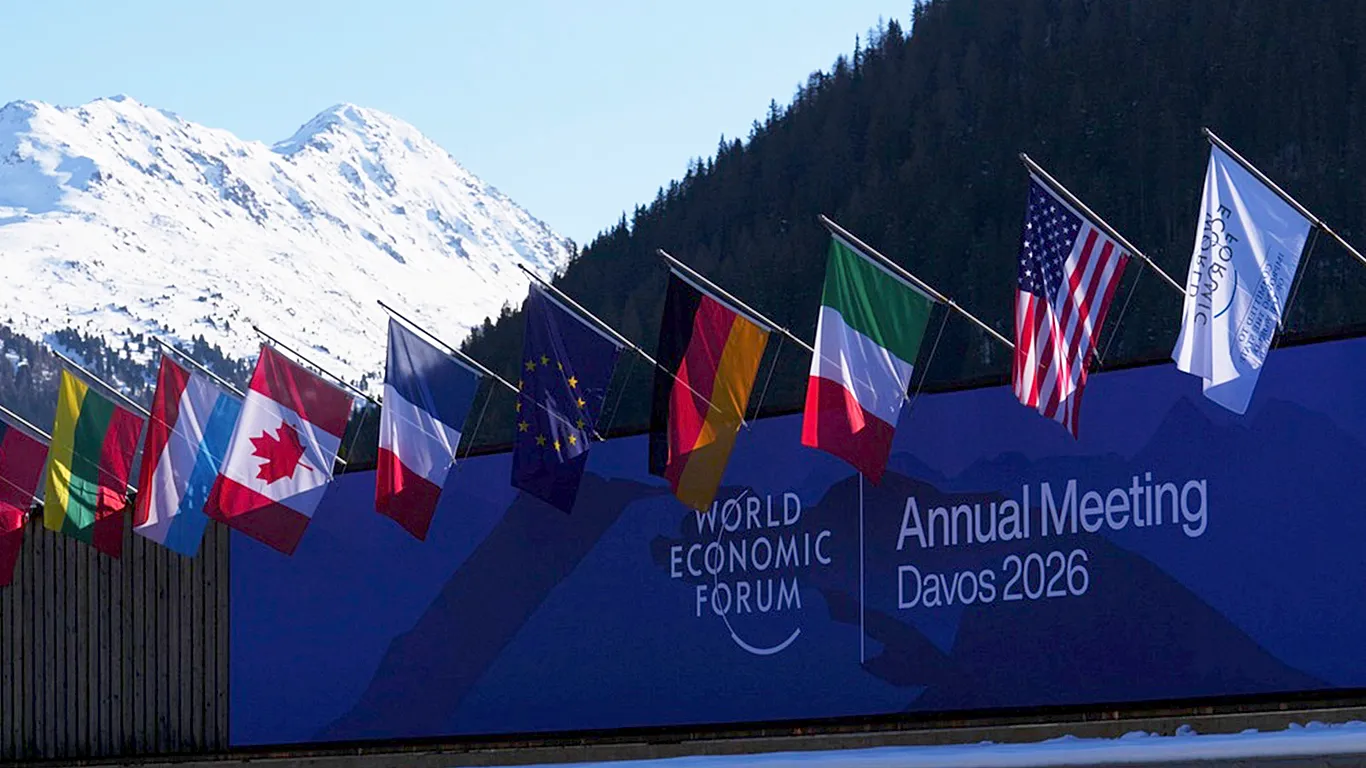

DAVOS, Switzerland — The World Economic Forum’s annual gathering in the Swiss Alps has been dominated by warnings of a crumbling global order, as escalating tensions between the United States and its European allies cast a long shadow over the summit.
As the forum approached its apex on Wednesday, attention turned to the anticipated arrival of US President Donald Trump, whose presence has already loomed large through social media posts, leaked messages and uncompromising rhetoric.
Trump has hinted there is “no going back” on his confrontational approach, particularly over trade and security issues linked to Greenland.
European leaders have voiced growing alarm over what they see as a shift away from multilateralism and rules-based cooperation.
French President Emmanuel Macron delivered one of the forum’s most quoted warnings, describing a world where “international law is trampled underfoot” and the “law of the strongest” prevails.
He framed the moment as a stark choice between rule of law and intimidation.
Canadian Prime Minister Mark Carney echoed that sentiment, arguing the world is undergoing a rupture rather than a transition. The previous global order, he said, “is not coming back,” urging middle powers to unite or risk being sidelined in an era of great power rivalry.
Some of the strongest rhetoric came from California Governor Gavin Newsom, who criticised European leaders for what he described as excessive deference to Washington.
His comments were widely interpreted as positioning himself as a prominent Democratic counter-voice to the Trump administration ahead of a potential 2028 presidential bid.
Security and trade risks have also been central to discussions. European Commission President Ursula von der Leyen warned against escalation, stressing that a trade war would weaken Western cohesion and benefit strategic adversaries such as Russia.
NATO Secretary General Mark Rutte cautioned that the focus on Greenland and tariffs risks distracting from Russia’s ongoing war in Ukraine, calling on allies to maintain unwavering support for Kyiv.
Economic anxieties have been amplified by geopolitical uncertainty. World Economic Forum President Børge Brende warned that major escalations in global conflicts could derail already fragile economic growth.
Meanwhile, US Trade Representative Jamieson Greer defended tariffs as a legitimate geopolitical tool, cautioning European allies against retaliation and signalling a more restrictive approach to access to the US market.
Beyond geopolitics, artificial intelligence emerged as another major fault line. BlackRock CEO Larry Fink acknowledged criticism that the Davos meeting reflects elite interests, warning that AI risks concentrating wealth among those who control data, models and infrastructure.
Palantir CEO Alex Karp offered a blunt assessment, predicting that AI would eliminate many humanities-based white-collar jobs while favouring vocational and technical skills.
As leaders depart Davos, the forum has underscored a shared unease: a world marked by fractured alliances, economic uncertainty and technological disruption, with no clear consensus on how to restore stability