



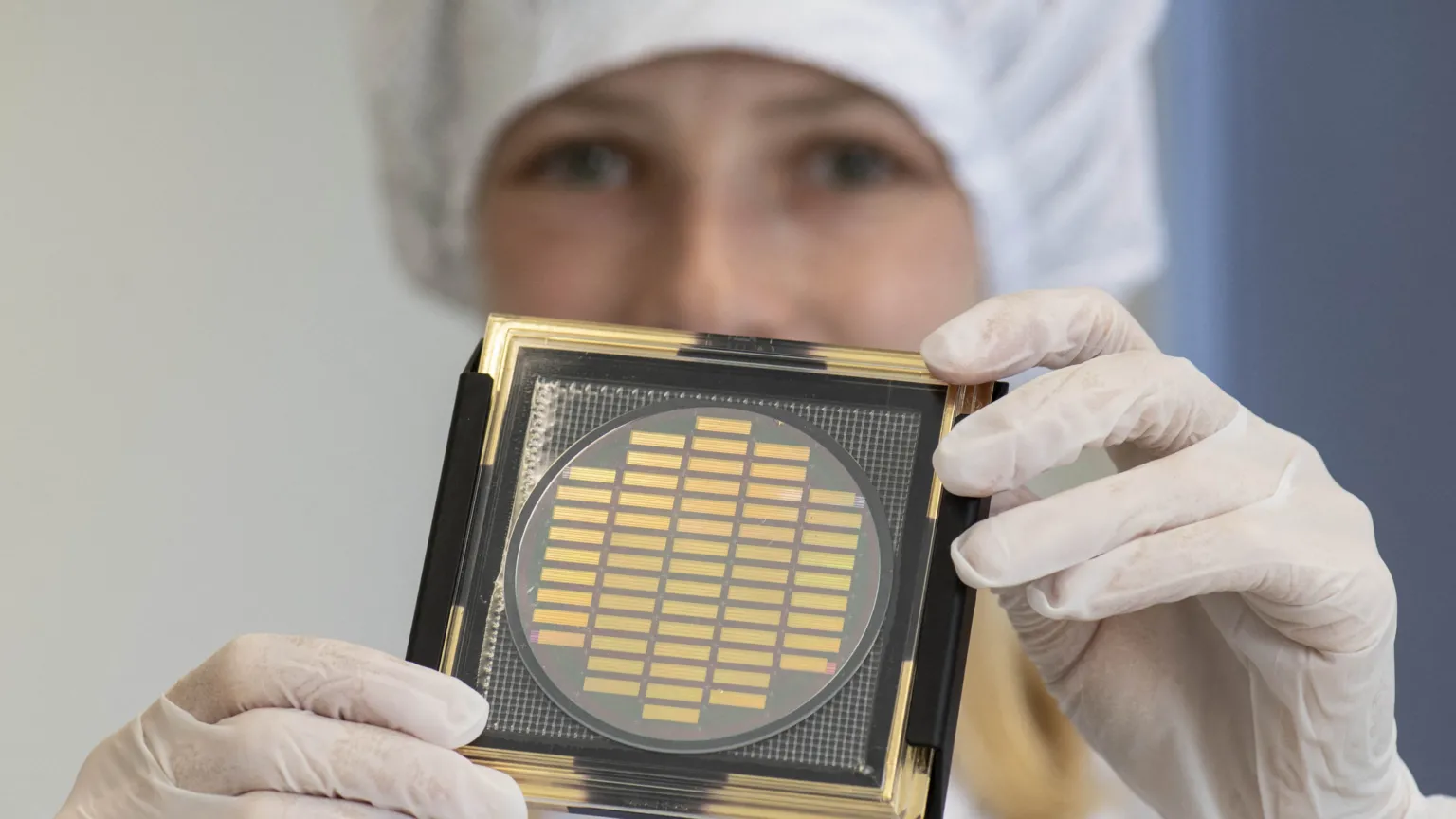

The Netherlands, Europe – Eindhoven leads a €400 million European initiative to scale photonic chip manufacturing and strengthen technological independence
Europe is accelerating its ambitions to become a major force in the global semiconductor industry through investments in photonic chips, an emerging technology expected to transform computing, telecommunications and artificial intelligence. The initiative could create significant economic opportunities.
Ton van Mol, representing Dutch research institute TNO, believes photonic chips are approaching a breakthrough that could fundamentally change how electronic devices process information. With millions of euros in backing, the Netherlands is preparing to accelerate this technological development.
Unlike conventional semiconductor chips, which rely on electrical signals to process information, photonic chips use light. This fundamental difference offers considerable advantages, including faster data transmission, reduced energy consumption and less heat generation during demanding computing operations.
Traditional microchips power almost every aspect of modern society, from smartphones and televisions to sophisticated artificial intelligence systems. These components process information by moving electrons through incredibly small circuits containing billions of transistors, with manufacturing precision measured in nanometres.
However, increasing demand for computing capacity is creating challenges for conventional semiconductor technology. Artificial intelligence applications, particularly large-scale data centres, require enormous processing power, placing growing pressure on electricity supplies, cooling infrastructure and the efficiency of existing computer chips.
Photonic technology could provide an alternative by transmitting and processing information through light rather than relying entirely on electrical signals. Researchers believe this approach could improve computing performance while reducing the energy requirements associated with increasingly complex digital infrastructure.
Van Mol compares the current development of photonic chips with the early stages of conventional semiconductor technology. He believes the industry could experience an acceleration similar to the extraordinary progress achieved by electronic chips since the 1970s.
The opportunity has attracted considerable attention across Europe, where policymakers are increasingly concerned about dependence on foreign semiconductor manufacturers. American, Taiwanese and Chinese companies currently dominate significant parts of the global chip manufacturing industry.
The European Union has therefore committed €400 million to PIX Europe, a programme designed to establish the continent as a global leader in emerging photonic integrated chip technology. The investment forms part of broader efforts to strengthen Europe’s technological capabilities.
European officials recognise that developing domestic manufacturing capacity is essential for maintaining influence over strategically important technologies. The European Chips Act supports this objective by financing pilot production facilities capable of transforming promising laboratory research into industrial manufacturing operations.
Van Mol is leading an important part of this effort, which involves establishing advanced manufacturing infrastructure in Eindhoven, a Dutch city already recognised for its strong semiconductor research and technology ecosystem.
Eindhoven prepares major manufacturing facility
TNO is developing a 10,000-square-metre factory at the High Tech Campus in Eindhoven, dedicated to producing six-inch indium phosphide wafers. The facility represents a significant step towards expanding Europe’s capacity to manufacture photonic chips commercially.
Currently, photonic chip manufacturing worldwide largely relies on four-inch wafers. Moving towards six-inch wafers would allow manufacturers to increase production efficiency, improve manufacturing capacity and potentially reduce the costs associated with producing individual semiconductor components.
According to van Mol, the expansion represents an important technological milestone. His team aims to establish a stable and reproducible manufacturing process capable of delivering consistently high production yields before opening the facility to industrial customers.
The factory is expected to become fully operational in 2030. Once completed, it will provide a pilot production line where businesses can develop and manufacture photonic chips without investing in their own expensive industrial facilities.
The initiative is particularly important because manufacturing advanced semiconductor components requires specialised equipment, highly controlled environments and substantial financial resources. A shared production facility could therefore make the technology more accessible to smaller companies and research organisations.
ASML provides crucial technological support
The Netherlands already occupies an influential position in the international semiconductor industry through ASML, the technology company responsible for manufacturing advanced lithography equipment used in producing sophisticated microchips.
ASML is currently the only company capable of supplying the extreme ultraviolet lithography machines required for manufacturing the world’s most advanced commercial semiconductor chips. Its technological expertise has established the Netherlands as an important player in global chip production.
The Eindhoven photonics project will benefit from equipment and manufacturing expertise associated with ASML. According to van Mol, producing photonic chips involves processes similar to conventional semiconductor manufacturing, including specialised machinery, silicon-based infrastructure and advanced cleanroom environments.
ASML also recognises the potential of photonic technology as an important development for Europe’s future industrial competitiveness. Stanislas Baron, head of the company’s EU/US Customer Team, has highlighted the importance of converting European research achievements into large-scale industrial manufacturing capabilities.
The project also has support from former ASML chief executive Peter Wennink, who has advocated greater investment in strategically important technologies. His report, titled The Roadmap to Future Prosperity, identifies photonics as a market with substantial growth potential.
According to the report, the photonics market could expand between 10 and 20 times over the next decade. Wennink has described the Eindhoven manufacturing initiative as a launchpad for Europe’s future digital economy and technological ambitions.
United States intensifies competition
Europe’s ambitions are emerging alongside growing international competition, particularly from the United States, where manufacturers are also investing heavily in advanced photonic semiconductor production.
In June 2026, American photonics company Coherent announced a major manufacturing expansion at its facility in Sherman, Texas. The company described the development as the world’s first and largest volume-production six-inch indium phosphide manufacturing platform.
The project has received backing from semiconductor giant Nvidia and $50 million in public funding through the United States CHIPS Act. The investment demonstrates how governments and private companies are increasingly recognising photonics as an important technology for future computing infrastructure.
The American development also highlights the urgency facing European manufacturers. As demand for artificial intelligence infrastructure continues increasing, countries capable of producing advanced semiconductor components at scale could secure considerable economic and strategic advantages.
Joris Teer, a policy analyst at the European Union Institute for Security Studies in Brussels, believes Europe’s approach reflects the economic realities of competing in the global technology industry.
Europe faces several industrial challenges, including high energy and labour costs, shortages of skilled workers and limited access to private and public investment. These obstacles make rebuilding manufacturing capacity across every technology sector particularly difficult.
However, establishing leadership in specialised industries such as photonics could allow Europe to maintain international influence without attempting to manufacture every component domestically. Strategic dependence on European technology companies could become an important source of economic and political leverage.
Foundry model could attract international businesses
The Eindhoven facility will operate through a foundry model, meaning TNO does not intend to manufacture its own branded photonic chip products. Instead, it will provide production services to external companies requiring access to advanced semiconductor manufacturing infrastructure.
Businesses from across Europe and potentially other international markets will be able to use the facility to manufacture chips based on their individual designs. This arrangement could significantly reduce the financial barriers associated with entering the photonics industry.
The model resembles the approach adopted by Taiwan Semiconductor Manufacturing Company, commonly known as TSMC. The company manufactures semiconductor products designed by other businesses and has become one of the world’s most influential chip producers.
Photonic chips are already being used in specialised applications, particularly within data centres and light detection and ranging systems, commonly known as LiDAR. These technologies demonstrate the practical benefits of using optical signals for transmitting and processing information.
However, researchers believe their applications could eventually expand into everyday electronic devices, including smartphones, laptops and advanced medical equipment. Photonics could also support the development of next-generation telecommunications infrastructure, including future 6G networks.
For TNO, increasing manufacturing capacity and resolving production challenges are essential to bringing the technology into mainstream commercial applications. The Eindhoven project aims to bridge the gap between laboratory research and large-scale industrial production.
Van Mol believes market demand already exists, but manufacturers must establish reliable production systems capable of meeting future requirements. The ultimate ambition is to make Europe an important supplier of photonic chips for global computing and telecommunications industries.
If the technology fulfils its potential, photonic chips could become an important foundation of future digital infrastructure. Europe’s investment in Eindhoven therefore represents more than a manufacturing expansion, potentially giving the continent a valuable opportunity to influence the next generation of computing technology.
This article was created using automation technology and was thoroughly edited and fact-checked by one of our editorial staff members