



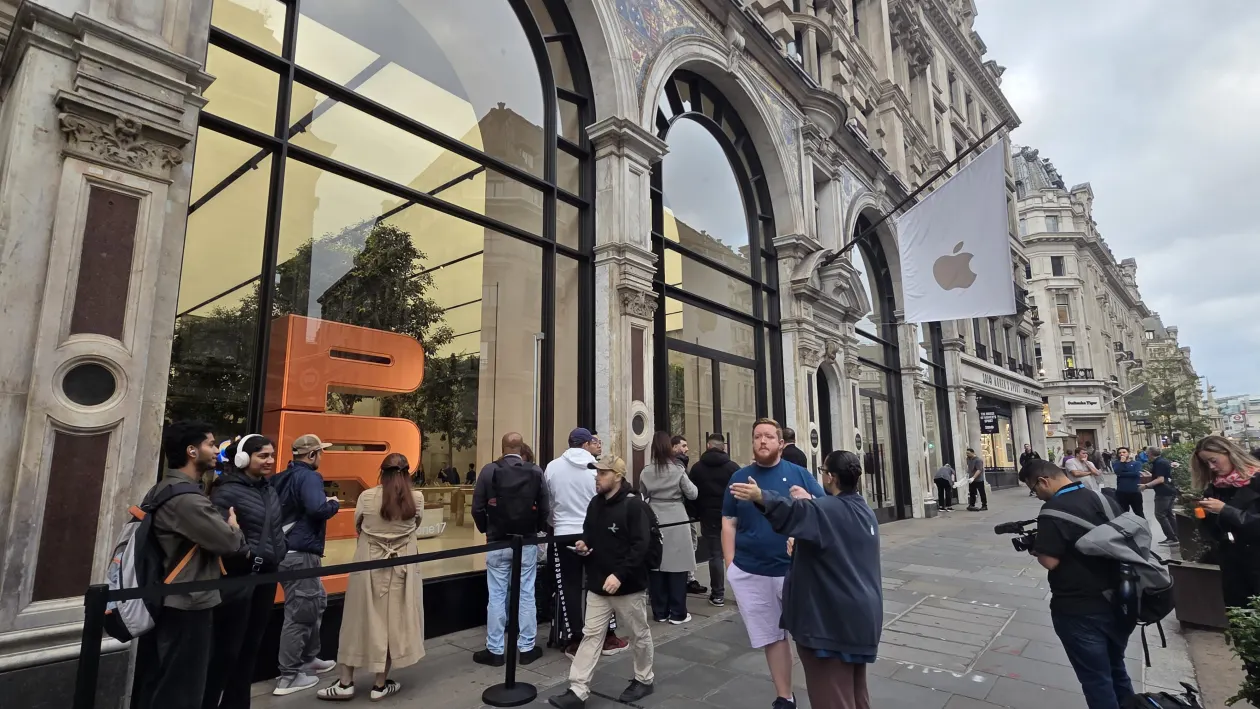

Apple’s highly anticipated iPhone 17 series hit store shelves worldwide on Friday, drawing long queues from Beijing to London and giving the tech giant a much-needed boost as it faces mounting pressure on artificial intelligence and stiff competition in China.
The launch unveiled the iPhone 17 Pro, iPhone 17 Pro Max, and the ultra-thin iPhone Air, alongside refreshed Apple Watch and AirPods models. While preorders began in the U.S. earlier this month, the global rollout carried added weight for Apple’s international strategy, particularly in Asia.
In Beijing, lines stretched outside Apple’s Sanlitun flagship store, with eager customers waiting overnight to secure the latest devices. Among them was Liu, a former Huawei user, who had queued since 11 p.m. Thursday to buy the iPhone 17 Pro Max.
He praised the smartphone’s new design and heat-dissipation features, saying the iPhone now felt better suited for daily entertainment use.
Another customer, Yang, who switched from Xiaomi, cited Apple’s operating system and larger storage as reasons for his purchase. Both expressed optimism that many Chinese consumers would make the iPhone their first Apple device this year, a critical trend for the company as it struggles to regain ground in a market dominated by Huawei, Oppo, and Xiaomi.
According to Omdia data, Apple’s Chinese market share has slipped to just 10%, trailing local competitors. However, early signs are encouraging. JD.com reported that iPhone 17 preorders in the first minute surpassed the entire first day of iPhone 16 preorders last year, while trade-in sales quadrupled compared to 2024.
Elsewhere, enthusiasm was equally strong. In Singapore, affluent buyers like Iman Isa and Daniel Muhamed Nuv camped outside Apple’s Marina Bay outlet to purchase their first new phones in years.
Both cited improved cameras, longer battery life, and the appeal of Apple’s ecosystem as reasons for their loyalty.
The base iPhone 17 model, surprisingly, outperformed expectations thanks to its unchanged pricing and larger memory upgrades. Customers also flocked to buy the new AirPods Pro 3, whose live translation feature has been hailed as a standout innovation.
In London, crowds were larger than during last year’s iPhone 16 launch, with customers leaning toward the premium Pro and Pro Max models. Jasmine, a repeat buyer, said she relished the yearly Apple upgrade experience, while content creator Michael prioritized the phone’s camera and battery improvements.
Still, Apple faces a pressing challenge: convincing investors and consumers of its artificial intelligence vision. Analysts say the company stumbled in 2024 by failing to deliver on promised AI features, even as rivals surged ahead.
“Apple has to catch up [in AI], but right now they’ve got enough runway,” said CCS Insight analyst Ben Wood. “A successful iPhone 17 launch helps, but AI remains the big test.”
For now, though, the long lines and brisk sales suggest Apple has secured another strong start — even as its future hinges on proving its AI capabilities in a rapidly evolving market.