



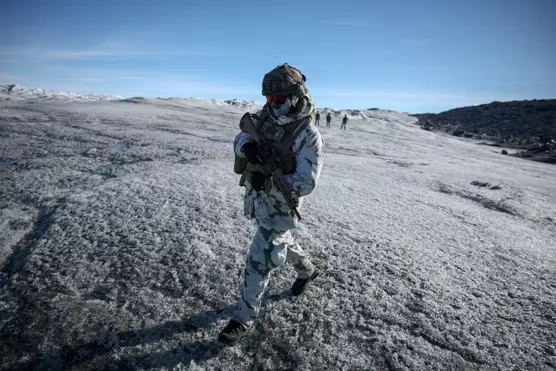

Finland, Lapland — French ground forces will join Swedish-led Forward Land Forces rotations to strengthen NATO security across northern Finland and Sweden
France will contribute ground troops to a Swedish-led NATO mission in Finland, the three countries announced on Wednesday, marking another significant step in strengthening the alliance’s presence in northern Europe.
The deployment will be part of the Forward Land Forces (FLF) Finland mission, a multinational rapid-reaction force established by NATO to bolster defences around the alliance’s newest members. A joint statement from France, Finland and Sweden confirmed that French forces would participate in future rotations of the mission, including the deployment of a battle unit.
The countries did not specify the number of French troops involved, but said France would also provide training support for the mission. French President Emmanuel Macron welcomed the move, describing it as a contribution to both European and NATO security.
“Our soldiers will take part in ensuring security in the High North. Day after day, we are giving substance to this stronger Europe within a stronger NATO,” Macron said in a post on X.
Northern security takes priority
The FLF Finland mission was formally established in June as part of NATO’s broader effort to reinforce its northern flank following Russia’s full-scale invasion of Ukraine in 2022.
Finland and Sweden, which had maintained military non-alignment for decades, changed their security policies after the war began. Finland joined NATO in 2023, while Sweden became a member in 2024.
Finnish Defence Minister Antti Hakkanen said France’s decision was an important milestone in developing the new force.
“Over the past year, the defence ministers of the Nordic countries, the United Kingdom, France and Italy have announced that they will contribute to the development of FLF Finland, and now, together with France, we have been able to move forward on the troop contribution,” Hakkanen said.
The announcement underscores growing military cooperation among NATO members in the High North, a region that has gained strategic importance due to its proximity to Russia and increasing geopolitical competition in the Arctic.
Mission to span three countries
Swedish Prime Minister Ulf Kristersson said the French contribution was welcome, though several operational details still needed to be finalized.
“We’ll have to get back to you on exactly where the French contribution will physically be located,” Kristersson told reporters during a press conference in Ankara.
He noted that the mission’s area of operations extends across the northern regions of Finland, Sweden and Norway, making coordination particularly important.
The core of the FLF Finland force will consist of 600 Swedish soldiers based in the Swedish city of Boden. The unit is designed to rapidly deploy to Rovaniemi in northern Finland if required.
Military planners say the arrangement allows NATO to maintain a permanent readiness posture while avoiding the need for large standing foreign deployments inside Finland.
Part of a wider NATO build-up
The force in Finland forms part of a broader NATO network of multinational land units established along the alliance’s eastern and northern borders.
In 2024, NATO approved the creation of the new rapid-reaction presence in Finland. Similar multinational formations already operate in Bulgaria, Estonia, Hungary, Latvia, Lithuania, Poland, Romania and Slovakia.
Those deployments were expanded after Russia’s invasion of Ukraine to reassure frontline allies and improve the alliance’s ability to respond quickly to any security crisis.
Analysts say the Finnish mission differs from earlier NATO deployments because of the region’s harsh Arctic conditions, vast distances and limited infrastructure. Training and logistics will therefore play a major role in preparing troops for operations in the High North.
French role in Nordic defence
France has increasingly sought a greater role in northern European security despite traditionally focusing more on southern Europe, Africa and the Mediterranean.
By joining the FLF Finland mission, Paris signals its willingness to participate in the defence of NATO’s northern territories and strengthen ties with Nordic allies.
French officials have not yet announced when the first troop rotation will begin, but defence cooperation between France and the Nordic countries has intensified over the past year through joint exercises and planning initiatives.
The French contribution is also expected to include specialized training, particularly in areas related to cold-weather operations and multinational coordination.
Message to Moscow
Although NATO officials insist the alliance remains defensive in nature, the deployment is likely to be viewed in Moscow as another sign of NATO’s expanding military footprint near Russia.
The accession of Finland and Sweden significantly extended NATO’s border with Russia and altered the strategic balance in northern Europe.
For Finland, which shares a 1,340-kilometre border with Russia, the establishment of multinational NATO forces represents a major transformation of its security architecture.
Sweden, meanwhile, has moved rapidly to integrate its armed forces into NATO structures since joining the alliance earlier this year.
Strengthening the High North
Security experts say the French deployment reflects a broader trend toward deeper European cooperation within NATO.
The High North has become increasingly important for military planning due to its role in monitoring Arctic routes, protecting critical infrastructure and ensuring rapid reinforcement capabilities across northern Europe.
With French troops set to join Swedish-led rotations in Finland, NATO will gain another multinational component aimed at improving readiness and deterrence in one of Europe’s most strategically sensitive regions.
The announcement comes as alliance members continue to adapt their defence posture in response to the ongoing war in Ukraine and the changing security landscape across Europe’s northern frontier.