



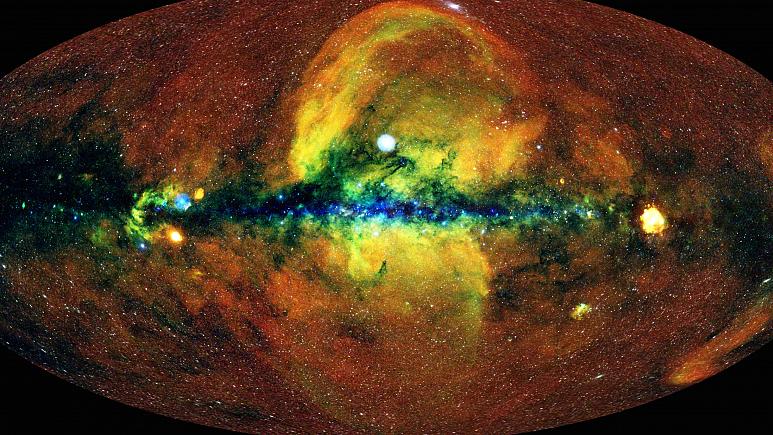

An amazing guide of the sky has been caught by an X-beam telescope, uncovering a universe that appears to be strikingly unique to the one we see with customary telescopes.
By survey, the universe in X-beams, the alleged “hot and lively universe” can be seen, specifying objects that transmit mind-boggling heat, move at incredible speed, or are amazingly thick.
These incorporate uncommon wonders, for example, combining neutron stars, stars being gulped by dark openings, and less uncommon however no less noteworthy – zones of very hot gas, where stars are conceived.
The all-sky picture incorporates one million wellsprings of X-beams, and “totally changes the manner in which we take a gander at the vigorous universe”, as indicated by Peter Predehl, the Principal Investigator of the eROSITA telescope at the Max Planck Institute for Extraterrestrial Physics (MPE).
The abundance of information accumulated is an enormous jump forward from the past X-beam sweeps of the sky, with the eROSITA gathering around multiple times a bigger number of sources than the past all-sky study 30 years back. This is around the same number of sources as have been found by all past X-beam telescopes joined.
Andrea Merloni, a senior researcher at MPE, clarifies that X-Ray cosmology gives a perspective on the “hot and vigorous universe” which is to a great extent imperceptible to optical telescopes.
“It’s a similar universe that everyone can watch, however our instruments are touchy to those items known to man that are hot, or enthusiastic, for example, large blasts, stun waves, exceptionally quick movements, or outrageous gravity, for example, dark openings,” he tells Euronews.
Basically, just specific kinds of items radiate X-beams in huge numbers. While our Sun, for instance, transmits X-beams these are in little numbers contrasted with items, for example, stars being gulped by dark openings or incredibly blistering gas.
Without X-beam telescopes, a significant number of these items would not be identified with instruments taking a gander at various frequencies.
“So as to get X-beams you need a huge number of degrees of warmth,” says Merloni. “The most splendid optical stars won’t really be the most brilliant X-beam stars, and the other way around.”
The eROSITA telescope, which was propelled in 2019 on the SRG rocket, needs to work in circle since X-beams get consumed by the Earth’s air, so they must be concentrated from space.