



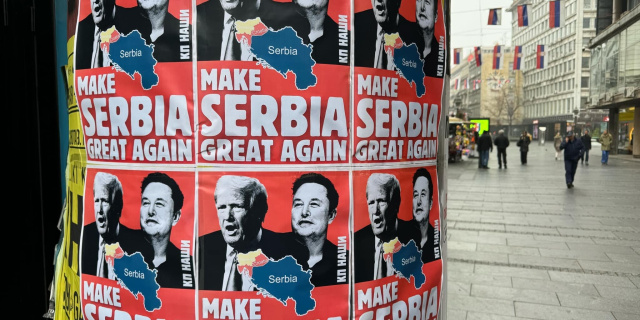

BELGRADE, Serbia – On Monday, controversial posters depicting a map of a “Greater Serbia” – encompassing territories such as the Republic of North Macedonia – appeared in central Belgrade, sparking debate about Serbian nationalism and regional relations.
The posters prominently feature the images of U.S. President-elect Donald Trump and businessman Elon Musk, along with the modified slogan “Make Serbia Great Again,” a play on Trump’s well-known campaign phrase.
The far-right group Nashi, responsible for organizing the display, issued a statement accompanying the posters, emphasizing their aim of restoring Serbia’s historical standing in the Balkans.
They claimed the posters are intended to call attention to “historical injustices” they believe have been inflicted on Serbia over recent decades.
According to Nashi, Serbia should seek to reclaim its “greatness and strength” and expand its influence to territories they consider part of its historical lands.
“Nashi” praised Trump for what they perceive as his efforts to uphold U.S. sovereignty and for challenging globalist agendas, aligning these views with their own push for Serbian resurgence.
Their statement celebrated Trump’s policies and drew a parallel between Trump’s nationalist agenda and Nashi’s goals for Serbia.
The posters display Musk alongside Trump, though it remains unclear what specific relevance Musk holds to the nationalist messaging beyond his status as a prominent Western figure.
The group’s message represents a broader ideological stance within Serbia, where far-right movements have frequently espoused territorial expansion to include areas in the Balkans that they consider part of historical Serbia.
The inclusion of North Macedonia in the map, however, has drawn particular criticism from regional experts who warn of the dangers of revisiting nationalist agendas that have, in the past, led to regional instability.
Despite Nashi’s vocal presence, the Serbian government has refrained from officially endorsing the group’s rhetoric, though it has, at times, maintained cordial relations with key figures from Trump’s network.
According to BGNES, Serbian President Aleksandar Vučić’s government has emphasized its close diplomatic and personal ties with Trump’s associates, including his son-in-law Jared Kushner and former U.S. ambassador to Germany Richard Grenell.
These connections, while not an official endorsement of Nashi, highlight Serbia’s strategic positioning amid shifting U.S. foreign policy dynamics.
For some analysts, these ties represent a dual approach: positioning Serbia as a significant player on the international stage while balancing nationalistic sentiments at home.
“By showing these posters, Nashi aligns with an image of a Serbia that is assertive and, potentially, expansionist,” noted political analyst Dragan Popović.
“However, the government must tread carefully, as endorsing or even appearing to support such movements could strain Serbia’s regional relations, particularly with North Macedonia and other neighboring countries.”
While the posters and accompanying rhetoric underscore an emboldened nationalistic sentiment, they have stirred apprehension within the Balkans.
Regional governments have expressed concern over the resurgence of “Greater Serbia” ideologies, fearing they could escalate into territorial disputes or create new tensions in an already complex regional landscape.
As these posters gain attention, they bring Serbia’s internal dynamics and external relations into sharper focus.
For many, the display is a reminder of the continuing resonance of nationalist ideas and the balancing act Serbia’s leaders face in addressing them while maintaining regional stability.
This article was created using automation technology and was thoroughly edited and fact-checked by one of our editorial staff members