



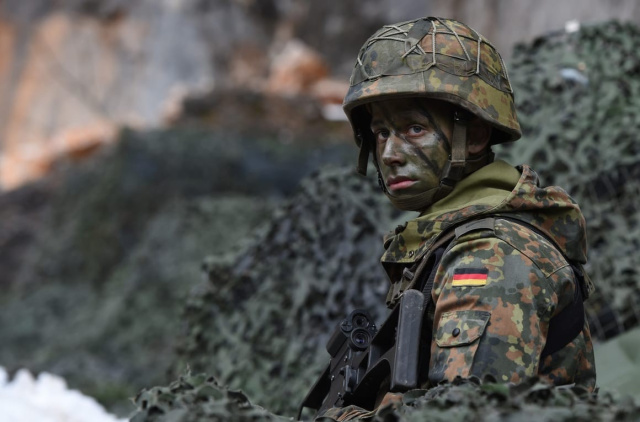

In a bid to strengthen Germany’s military capabilities without reinstating mandatory conscription, Chancellor Olaf Scholz’s government has approved a draft law requiring young men to participate in a survey assessing their willingness to serve in the Bundeswehr, the German armed forces.
This initiative, aimed at addressing the military’s longstanding recruitment issues, has garnered significant public and political attention as the country faces heightened security tensions.
The survey, set to begin in 2025, would be mandatory for young men turning 18, while young women will have the option to participate voluntarily.
This approach marks a middle ground, as the government seeks to gauge youth interest in military service without the rigid framework of a draft.
Approximately 300,000 young men are expected to turn 18 next year, with their responses expected to offer insights into Germany’s ability to meet its recruitment goals for the Bundeswehr.
Germany abolished compulsory military service in 2011, a decision that has since left the Bundeswehr grappling with personnel shortages. Under the previous system, young men were obligated to serve either in the military or in social service.
Since the end of conscription, recruitment efforts have consistently fallen short, with the Bundeswehr’s current active force totaling about 180,000 soldiers—well below its target of 203,000 by 2030. Additionally, the government aims to maintain a reserve force of 60,000 to bolster its defensive capabilities.
The renewed focus on military recruitment comes as Germany faces mounting security challenges, particularly with the ongoing conflict in Ukraine following Russia’s 2022 invasion.
Chancellor Scholz has emphasized the importance of expanding Germany’s military capacity as a critical part of the country’s commitment to NATO and European defense.
The government’s initiative, however, has not been without controversy. Opposition parties, notably the center-right Christian Democrats (CDU) and their Bavarian allies, the Christian Social Union (CSU), have called for a vote of confidence in Scholz’s government following the recent dismissal of Finance Minister Christian Lindner.
Leaders within the CDU and CSU argue that the government’s management of defense and foreign policy has been inadequate, citing the prolonged crisis in Ukraine as a key example of Germany’s insufficient response to security threats.
CDU leader Friedrich Merz voiced strong criticism of the coalition government’s approach, suggesting that internal divisions have hindered Germany’s ability to act decisively on international issues.
Merz is calling for an expedited confidence vote, which he believes should take place next week, and has proposed holding snap elections by January.
“The time for delays has passed,” Merz stated, pointing to Germany’s international commitments as a compelling reason for immediate action.
Political analysts view the opposition’s call for a confidence vote as a high-stakes challenge for Chancellor Scholz’s government, as it navigates both domestic and foreign policy pressures.
If the vote proceeds as demanded, it could reshape the political landscape ahead of potential elections, which would allow the public to weigh in on the government’s handling of Germany’s defense needs.
As the survey initiative moves forward, it underscores Germany’s complex balancing act: attempting to boost military ranks in a post-conscription era while managing public sentiment and the political ramifications of increased militarization.