



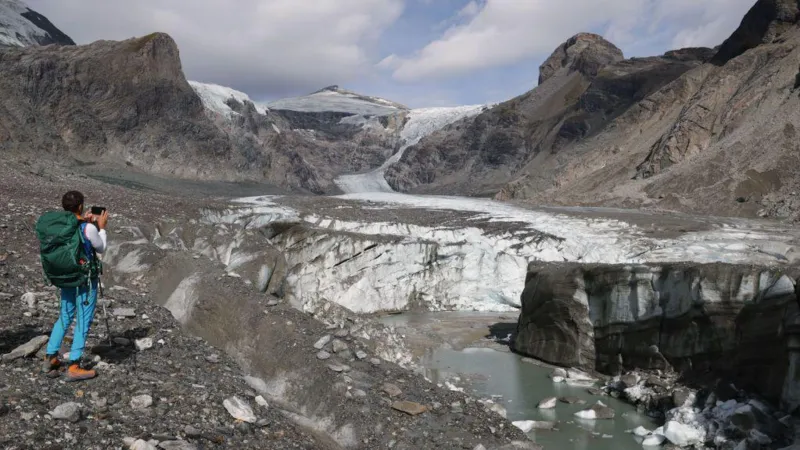

Scientists are warning that glaciers in the Austrian Alps are not simply shrinking but are beginning to disintegrate as climate change accelerates ice loss across the region.
According to the latest glacier monitoring report by the Austrian Alpine Club, nearly every glacier measured in Austria has retreated over the past year, highlighting the growing impact of rising temperatures on the Alpine environment.
Researchers recorded shrinkage in 94 out of the 96 glaciers that were observed during the latest monitoring period. Experts say the scale and speed of the changes are increasingly alarming.
Andreas Kellerer-Pirklbauer from the University of Graz explained that many glaciers are now entering a new and more dangerous phase of deterioration. “Many glaciers are not only shrinking in length but are increasingly entering a phase of structural disintegration,” he said.
This means that instead of gradually retreating, glaciers are breaking apart. Exposed rock ledges, collapsing glacier tongues and large sections of ice breaking away are becoming more common throughout the Alpine landscape.
Scientists say these changes are visible across Austria’s mountain regions, where glaciers that once appeared stable are now rapidly fragmenting. The annual report by the Austrian Alpine Club highlighted several glaciers that experienced particularly severe losses over the past year.
The Alpeiner Ferner glacier in Tyrol recorded the most dramatic retreat, shrinking by more than 114 metres. Close behind was the Stubacher Sonnblickkees glacier in the province of Salzburg, which lost nearly 104 metres in length.
These figures represent some of the most significant annual losses recorded in recent years. Austria’s largest glacier, the Pasterze in the province of Carinthia, is also continuing to shrink rapidly.
Scientists monitoring the glacier warn that its lower section, known as the glacier tongue, could soon break away entirely. If this occurs, it would effectively split the glacier into two separate parts.
Researchers say such developments are a sign of the accelerating deterioration of Alpine ice masses.
Gerhard Lieb, who oversees the glacier monitoring service alongside Kellerer-Pirklbauer, said the recent climate conditions have been extremely damaging to glaciers. “The weather conditions in recent years have been extremely unfavourable for glaciers,” he explained.
Warm winters with limited snowfall mean glaciers receive less protective snow cover. Without this layer, the ice beneath becomes more vulnerable to melting when temperatures rise.
The report also highlighted unusually high temperatures recorded across the Alpine region in recent months.
June temperatures were almost five degrees Celsius above the historical average, while measurements at high-altitude weather stations showed annual temperatures roughly two degrees Celsius above long-term averages.
These warmer conditions have accelerated glacier melt across the mountain range. Even temporary cooling periods are no longer enough to slow the process.
Lieb explained that many glaciers are now losing so much mass that they can barely recover during short colder spells. “Many glaciers are now losing so much mass that they barely react to periods of short-term cooling,” he said.
Scientists say this trend reflects the broader impact of climate change, which is particularly visible in mountainous regions like the Alps. The Alpine environment is highly sensitive to temperature changes, making glaciers one of the most visible indicators of global warming.
As glaciers melt and collapse, the consequences extend far beyond the ice itself. The Austrian Alpine Club warns that disappearing glaciers are increasing the risk of natural hazards, including rockfalls, landslides and unstable mountain terrain.
Melting ice can also destabilise slopes that were previously frozen solid for centuries. In addition, Alpine infrastructure such as mountain huts, hiking routes, roads and cable car systems could face increasing risks as the landscape shifts.
Scientists say the loss of glaciers will also fundamentally reshape the region’s scenery, transforming landscapes that have defined the Alps for generations. Nicole Slupetzky, Vice-President of the Austrian Alpine Club, said the reality of climate change in the Alps is already undeniable.
“Climate change has long been a reality in the Alps, and we are experiencing its consequences right now,” she said. According to Slupetzky, the challenge facing scientists and policymakers is no longer about restoring glaciers to their past state.
Instead, the focus must shift toward adapting to the profound environmental changes already underway. “It is no longer a question of whether we can still save the glaciers in their former state,” she said.
“It is a question of mitigating the consequences for ourselves.” Researchers say the rapid decline of Alpine glaciers serves as a stark reminder of how quickly climate change is reshaping some of Europe’s most iconic landscapes.