



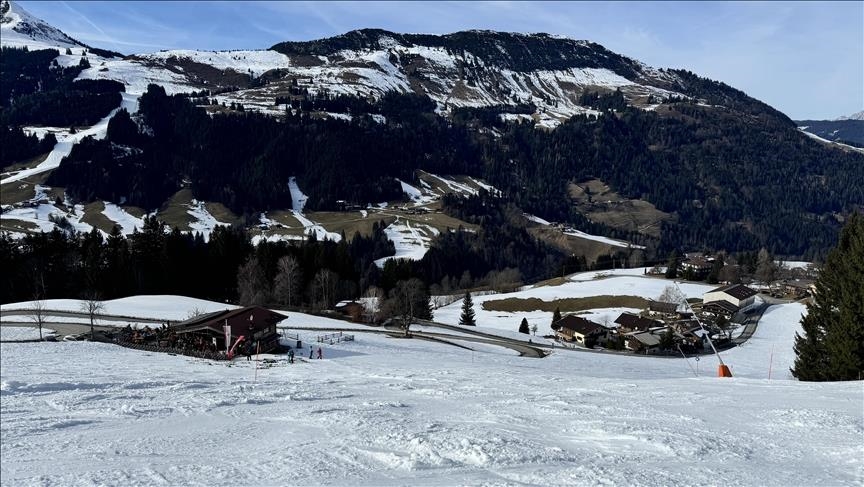

The Austrian Alps are warming at nearly twice the global average, intensifying glacier retreat and reshaping the future of one of Europe’s most important winter tourism regions, according to officials, scientists, and new field measurements.
Long-term monitoring shows that rising temperatures are reducing snow cover at lower altitudes, shortening winter seasons, and increasing pressure on ski resorts to rely heavily on artificial snow. These changes are occurring even as Austria continues to attract millions of winter visitors.
According to the Austrian National Tourist Office (Österreich Werbung), more than 20 million people plan to spend their winter holidays in Austria this season. The figures indicate stable demand despite growing environmental, economic, and operational challenges linked to climate change.
A recent Anadolu report in the series “Europe’s Peak: The Alps” highlights how altered precipitation patterns are affecting tourism. Warmer winters increasingly bring rain instead of snow, while summers are marked by stronger storms and prolonged droughts.
Glacier retreat is among the most visible consequences. The Austrian Alpine Club (Alpenverein Österreich), which has monitored alpine glaciers for more than a century, reports severe and ongoing ice loss across the country’s mountain ranges.
Recent measurements show that Austrian glaciers retreated by an average of 24.1 meters during the 2023–2024 monitoring period. This marks the third-largest annual glacier loss ever recorded in the country, underscoring the speed of environmental change.
The disappearance of ice is also reshaping water systems in high-altitude regions. Meltwater that once fed streams throughout the summer is declining, leading to water shortages that affect ski operations, mountain huts, and local ecosystems.
Several mountain huts have already been forced to close temporarily, while others require costly structural upgrades to remain operational. Water scarcity, combined with unstable terrain, has made logistics increasingly difficult for hut operators and rescue services.
Mountaineering conditions have also deteriorated. Areas once stabilized by glaciers are now prone to mudslides, rockfalls, and shifting ground, increasing risks for hikers and climbers across the Alps.
Climate change is also disrupting alpine wildlife. Speaking to Anadolu, Anna Praxmarer of the Alpenverein explained that animals such as alpine hares and rock ptarmigans rely on seasonal snow camouflage to survive.
“Animals like alpine hares or rock ptarmigans change to white plumage or fur for snow camouflage, but without snow cover, they become easy prey,” Praxmarer said, adding that flooded trails and water shortages are now common.
Looking ahead, scientists warn of irreversible change. “The climate crisis is striking the Alps with full force,” Praxmarer said. “It is now nearly inevitable that Austria’s glaciers will largely disappear within the next 40 to 50 years.”
This article was created using automation technology and was thoroughly edited and fact-checked by one of our editorial staff members