




Norway, a country known for its vast oil reserves, is now leading the world in the transition to electric vehicles (EVs). With electric cars making up nearly 90% of new car sales in 2024, the Nordic nation is on track to become the first in the world to phase out the sale of new fossil fuel-powered cars by 2025.
But can other nations replicate this success? The answer lies in a mix of government policy, economic incentives, and long-term vision.
The Shift to Electric Cars in Norway
Oslo-based Harald A Møller, a car dealership that has been selling Volkswagens for over 75 years, recently made a historic decision. In early 2024, the dealership stopped selling fossil fuel-powered vehicles, replacing them entirely with electric ones.
Chief Executive Ulf Tore Hekneby, who guided the company through this transition, emphasized the irreversible nature of this shift: “The future is electric,” he said, while walking through his electric vehicle showroom. “Long-range, high-charging speed. It’s hard to go back.”
Indeed, on the streets of Oslo, battery-powered cars are no longer a rare sight—they have become the norm. A glance around the capital reveals that almost every other vehicle carries an “E” on its license plate, signifying its electric nature.
Norway, with its population of 5.5 million, has embraced electric vehicles faster than any other country, setting a global benchmark for the adoption of EVs.
In 2024, for the first time, electric vehicles outnumbered petrol-powered cars on Norway’s roads. When diesel vehicles are included, electric cars now account for almost a third of all cars in the country. ‘
The trend is unmistakable—88.9% of all new cars sold in Norway last year were electric, up from 82.4% in 2023, according to data from the Norwegian Road Federation (OFV).
In some months, the figure climbed as high as 98%, with traditional petrol and diesel cars all but disappearing from new car sales.
This dramatic shift stands in stark contrast to the situation in countries like the UK and the US. In the UK, electric cars accounted for only 20% of new car registrations in 2024, while in the US, the figure was a mere 8%.
Although these figures represent progress, they remain a far cry from Norway’s near-total shift toward EVs.
A Three-Decade Long Journey
Norway’s electric vehicle revolution didn’t happen overnight. It has been the result of more than three decades of deliberate policy choices and consistent government support.
As Christina Bu, the Secretary-General of the Norwegian EV Association, explains, “It started in the early 1990s. Little by little, taxes on petrol and diesel vehicles increased, making them more expensive, while electric vehicles were exempted from taxes.”
In its early days, the support for EVs was aimed at helping Norwegian manufacturers like Buddy (previously Kewet) and TH!NK City, both of which have since gone out of business.
However, the incentives for electric cars remained in place. Norway’s Deputy Transport Minister, Cecilie Knibe Kroglund, adds, “It’s our goal to see that it’s always a good and viable choice to choose zero-emission cars.”
Despite being a major oil and gas producer, Norway has set an ambitious goal to make all new cars sold “zero-emission” by 2025. This target, initially set in 2017, is now within reach.
“We are closing in on the target, and I think we will reach that goal,” says Kroglund, who believes the transition to electric cars for passenger vehicles has already been achieved.
The success of this transition is largely attributed to long-term, predictable policies that have shaped consumer behavior.
Rather than outright banning internal combustion engine (ICE) vehicles, the Norwegian government has employed a range of measures to incentivize electric car adoption.
These include the elimination of VAT and import duties on low-emission vehicles, as well as a host of benefits such as free parking, discounted road tolls, and access to bus lanes.
Economic Incentives: A Key Factor
For many Norwegians, the decision to switch to an electric vehicle has made economic sense. Ståle Fyen, a local who purchased his first EV 15 months ago, highlights the financial advantages.
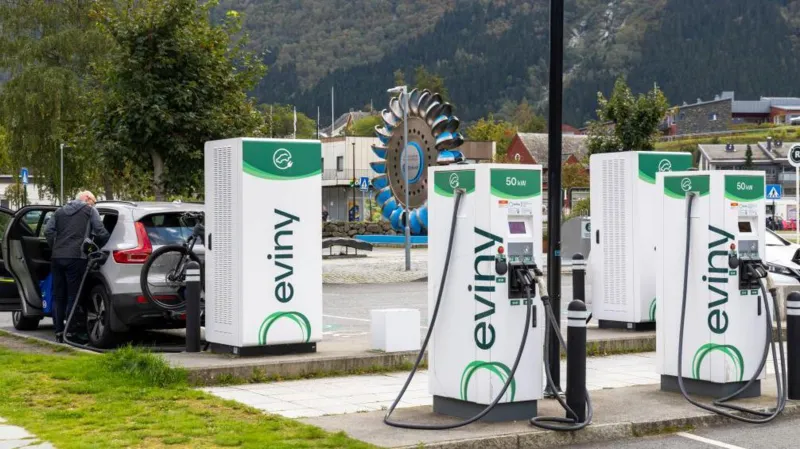
“With all the incentives we have in Norway, with no taxes on EVs, that was quite important to us money-wise,” he says while charging his car in Oslo.
“In the cold, the range is maybe 20% shorter, but still, with the expansive charging network we have here in Norway, that isn’t a big issue really.”
Indeed, Norway’s extensive EV infrastructure has played a crucial role in the widespread adoption of electric cars. The country now boasts more than 27,000 public charging stations, a remarkable number given its small population.
By comparison, the UK, with a population 12 times larger, has only 73,699 chargers. In terms of chargers per 100,000 people, Norway leads with 447, while the UK has just 89, according to recent reports.
The transition to EVs has also been made easier by the country’s reliance on renewable energy sources. Norway’s vast hydroelectric power capacity, which accounts for 88% of its electricity production, ensures that electric vehicles are charged with clean energy.
Can Other Countries Follow Norway’s Lead?
While Norway’s success story is impressive, the question remains: can other countries follow its example?
Bu believes that there is no reason why other nations cannot replicate Norway’s model, though she acknowledges that the approach must be tailored to each country’s specific context.
“Norwegians aren’t necessarily more environmentally-minded than people elsewhere,” Bu says. “It has to do with strong policies and gradually helping people understand that driving an electric car is possible.”
Norway’s wealth, largely derived from its oil and gas exports, has also been a factor in its success.
With a sovereign wealth fund worth more than $1.7 trillion, the country can afford large-scale infrastructure projects and absorb the loss of tax revenue from the sale of petrol and diesel cars.
Additionally, Norway’s abundance of cheap, renewable hydroelectric power makes it an ideal environment for EV adoption.
Nevertheless, the political will to introduce long-term policies and invest in the necessary infrastructure is crucial.
While the European Union has announced plans to ban the sale of new fossil fuel cars by 2035, and the UK aims for a similar ban by 2030, the transition to EVs in these regions is not as advanced as in Norway.
The Global Impact
Norway’s success in electrifying its vehicle fleet is undoubtedly a model for other nations to follow. It proves that with the right combination of government policy, infrastructure investment, and economic incentives, the transition to electric vehicles is not only possible but can be achieved swiftly and effectively.
For other nations, the key will be to tailor Norway’s approach to their own unique circumstances, while keeping the focus on a greener, more sustainable future.
As Kjell Werner Johansen from the Norwegian Centre for Transport Research puts it, “A third of cars are now electric, and it will pass 50% in a few years. I think the government accepts that a few new petrol or hybrid cars will still be on the market, but I don’t know anybody who wants to buy a diesel car these days.”
Norway’s electric vehicle revolution is far from over. The country’s goal of achieving 100% zero-emission car sales by 2025 is fast approaching, and the rest of the world will be watching closely to see if Norway can truly lead the charge in the global transition to sustainable transportation.