



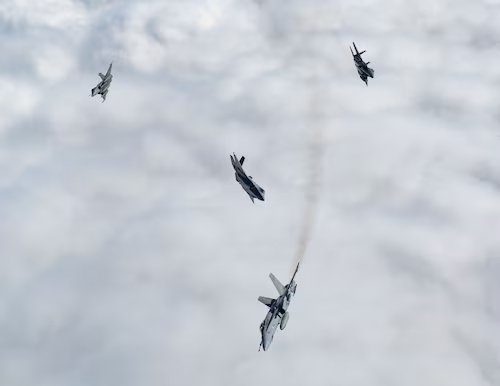

The French Dassault Rafale may have scored a symbolic victory over the American F-35 Lightning II during NATO’s multinational exercise Trident Atlantic 25, hosted by Finland between June 16 and 27.
The large-scale tactical and operational training drill involved aircraft from France, the United States, the United Kingdom, and Finland. The French Air and Space Force deployed Rafales, the US Air Force sent F-35As and F-15Es, Finland flew its F/A-18 Hornets, and the Royal Air Force joined with Eurofighter Typhoons.
While the stated purpose of the exercise was interoperability and joint readiness, attention shifted after the French Air and Space Force posted a video on August 20 that appeared to show a Rafale pilot successfully locking onto a US F-35 during a dogfight.
At 15 seconds into the footage, the Rafale’s Infrared Search and Track (IRST) system is seen locking onto the stealth jet in a Basic Fighting Maneuver (BFM).
In air combat terms, this simulated “kill” reflects a radar lock-on rather than the firing of weapons. Military experts noted that the F-35 pilot would have received a radar warning signal during the encounter.
Neither the French nor the US military formally acknowledged the duel, but the release of the video has sparked debates online. French commentators emphasized the achievement as proof that Dassault’s 4.5-generation Rafale remains formidable against newer fifth-generation stealth aircraft.
The timing of the footage is notable. France has been actively marketing the Rafale as a European alternative to the F-35 amid growing skepticism in some countries over reliance on US-made systems. President Emmanuel Macron has urged greater “strategic autonomy” in defense, though European governments have largely continued to order the F-35.
This is not the first time the Rafale has achieved such a feat. In 2009, during joint drills in the United Arab Emirates, a Rafale locked onto an American F-22 Raptor—a fighter widely considered the pinnacle of air superiority.
That encounter, confirmed by footage released by France’s defense ministry, demonstrated the Rafale’s agility and pilot skill against advanced stealth technology.
Despite its proven versatility, the Rafale has trailed the F-35 in the export market, with many nations prioritizing stealth over fourth-generation-plus capabilities. The aircraft’s reputation also took a hit after unverified Pakistani claims during the Indo-Pakistan conflict suggested losses of Indian-operated Rafales.
The Trident Atlantic 25 episode, however, could help restore confidence in the French fighter. With advanced self-defense systems, electronic warfare capabilities, and integrated sensor suites, the Rafale remains a formidable opponent in close-range air combat.
As NATO allies, the United States and France maintain strong defense cooperation, but their fighter jets continue to compete fiercely on the global stage. With the Rafale again “scoring a kill” against an American stealth jet, the French manufacturer Dassault Aviation may find renewed momentum in showcasing its aircraft as a proven alternative.
This article was created using automation technology and was thoroughly edited and fact-checked by one of our editorial staff members