



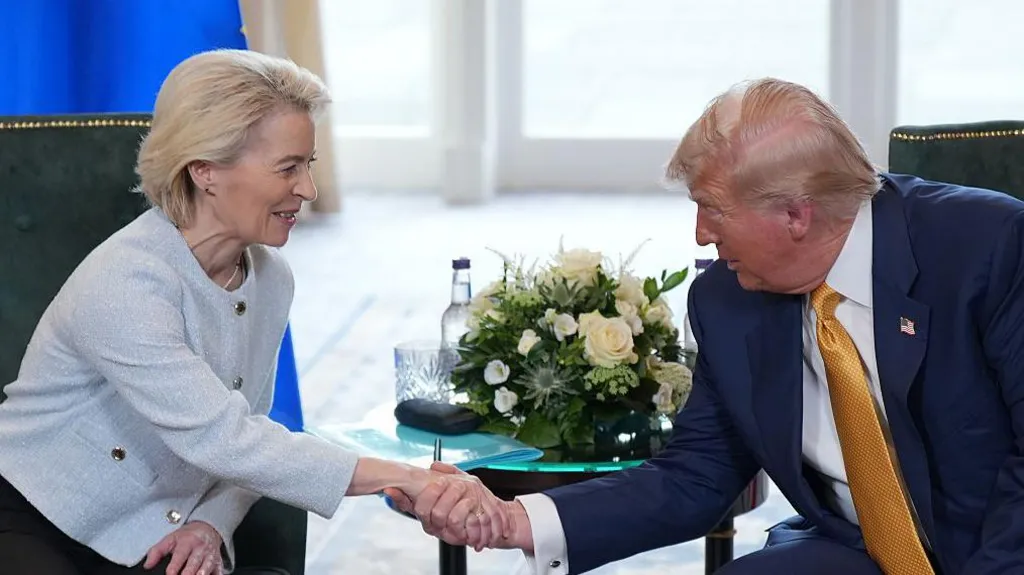

The European Parliament has suspended approval of a major US trade deal agreed last July, escalating tensions between Washington and Brussels after President Donald Trump renewed demands for the United States to take over Greenland.
The decision was announced in Strasbourg on Wednesday as Trump addressed global leaders at the World Economic Forum in Davos.
EU lawmakers said the move was a direct response to the US president’s threat to impose fresh tariffs on European allies unless progress was made on Greenland’s future.
The suspension halts the legislative process required to ratify the so-called Turnberry agreement, negotiated last summer at Trump’s Scottish golf resort.
That deal reduced planned US tariffs on most European goods to 15% from a threatened 30%, in exchange for European investment commitments and regulatory changes aimed at boosting US exports.
However, Bernd Lange, chair of the European Parliament’s International Trade Committee, said lawmakers were left with “no alternative” but to pause work on the agreement.
He accused Washington of pursuing confrontation rather than cooperation and warned that approval would not resume while tariff threats remained on the table.
The move reopened the possibility that the European Union could impose retaliatory tariffs on up to €93bn worth of American goods.
Those measures, announced last year in response to Trump’s so-called “Liberation Day” tariffs, were placed on hold while negotiations continued but are now due to come into force on 7 February unless action is taken.
Hours after the parliamentary announcement, Trump appeared to ease tensions, posting on social media that he had reached a “framework” deal on Greenland’s future and would not proceed with new tariffs on eight Nato members.
The announcement helped calm financial markets, which had been unsettled by the renewed standoff.
In Davos, Trump reiterated his belief that Greenland is vital for US and global security but insisted he would not use force, calling instead for “immediate negotiations” with Denmark.
European officials responded cautiously, with Lange saying it would take time to understand what the proposed framework actually entailed.
Behind the scenes, some EU figures suggested Trump’s retreat was expected. Financial markets have increasingly discounted the impact of his tariff threats, often citing the “TACO” shorthand — Trump Always Chickens Out — to describe his negotiating style.
Markets rallied after the announcement, with major US indices rising more than 1%, while the FTSE 100 edged higher. Gold prices climbed to a record above $4,800 an ounce, reflecting ongoing global uncertainty.
The US and EU remain each other’s largest trading partners, exchanging more than €1.6tn in goods and services last year. While many countries ultimately chose negotiation over retaliation, the episode underlines how geopolitical disputes continue to disrupt global trade.
With a US Supreme Court ruling pending on the legality of many tariffs imposed last year, the future of transatlantic trade relations remains uncertain, even as both sides publicly call for calm and dialogue.