



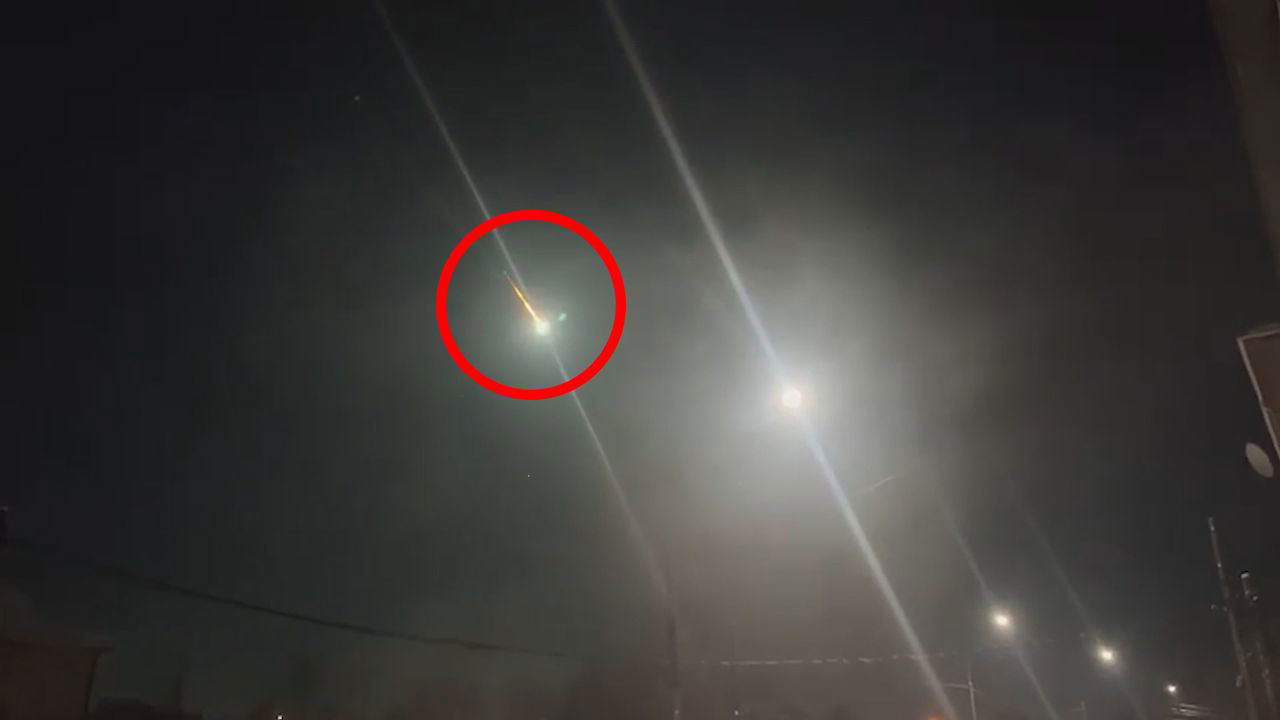

Residents of Russia’s northeastern Siberian republic of Sakha were treated to a spectacular celestial display early Wednesday morning as a small asteroid entered Earth’s atmosphere, producing a brilliant fireball against the night sky.
The asteroid, measuring approximately 70 centimeters in diameter, was first detected about 12 hours before its descent, according to the European Space Agency (ESA).
It entered Earth’s atmosphere at 01:15 local time (16:15 GMT), blazing through the sky and capturing the awe of onlookers in the remote, snow-covered region.
Astronomers had tracked the asteroid’s trajectory as it approached Earth, allowing authorities to prepare for its atmospheric entry.
Despite its dazzling appearance, officials from the Sakha emergencies ministry confirmed that the asteroid posed no significant threat. “No damage or injuries have been reported following the asteroid’s descent,” a ministry spokesperson stated.
A Rarely Witnessed Phenomenon
Asteroid fireballs are rare occurrences, especially in sparsely populated areas such as Sakha, which spans a vast expanse of northeastern Russia.
The event drew dozens of residents outside in subzero temperatures to witness the natural light show. Videos circulating on social media captured the fiery streak illuminating the snowy landscape, followed by a faint sonic boom.
The ESA reported that the asteroid’s size and composition made it a harmless visitor. Measuring less than a meter across, it disintegrated upon entry due to the intense heat and pressure generated as it collided with Earth’s atmosphere at high speed.
“This was a small object, much smaller than the asteroids we monitor for potential impact risk,” said an ESA spokesperson. “Events like this serve as a reminder of the constant activity in our solar system.”
Increased Monitoring of Near-Earth Objects
Astronomers around the globe continuously monitor near-Earth objects (NEOs) to track their trajectories and assess potential threats.
Advances in detection technology have allowed experts to identify smaller asteroids, like the one that appeared over Sakha, with greater accuracy and lead time.
Such monitoring efforts have become a priority following notable events like the 2013 Chelyabinsk meteor explosion, which caused widespread damage and injuries in Russia’s Ural region.
That meteor, significantly larger than the recent Sakha asteroid, exploded with the force of a nuclear bomb, shattering windows and injuring over 1,000 people.
In contrast, the asteroid over Sakha was much smaller and harmless. The ESA emphasized that the event highlights the effectiveness of early detection systems in providing timely information, even for minor celestial objects.
A Moment of Awe in the Arctic
For the residents of Sakha, the asteroid’s fiery descent was a rare moment of wonder in the Arctic winter. “It was like watching a shooting star, but much brighter and closer,” said one witness who braved the cold to observe the event.
The incident serves as a reminder of Earth’s dynamic relationship with its cosmic surroundings.
While this asteroid left no lasting impact beyond its fleeting brilliance, it underscored the need for vigilance and continued advancements in space monitoring.
As the fireball faded and the sky returned to its usual darkness, residents of Sakha were left with vivid memories of a rare astronomical spectacle—a fleeting but powerful connection between Earth and the cosmos.