



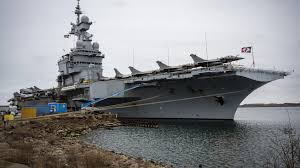

Sweden’s military has confirmed that a drone intercepted and jammed near the French aircraft carrier French Navy vessel Charles de Gaulle was of Russian origin, intensifying security concerns around NATO operations in the Baltic region.
The drone was detected approximately seven nautical miles from the carrier while it was docked in Malmö, marking the first-ever visit by the French flagship to Sweden. The vessel is participating in a series of multinational drills designed to strengthen regional deterrence.
In a statement, the Swedish Armed Forces said the drone had taken off from a nearby Russian intelligence-gathering ship identified as the Zhigulevsk. Naval personnel responded swiftly by deploying electronic countermeasures to disrupt the aircraft’s control signals.
“The Navy acted immediately to jam the drone in connection with the carrier’s visit,” the statement read, adding that the measure prevented further reconnaissance activity close to sensitive military assets.
Military officials said jamming technology interrupts communication between a drone and its operator, often forcing it to lose control or crash. The ultimate fate of the device remains unclear, but authorities confirmed the Russian vessel later departed toward the Baltic Sea.
The incident comes amid heightened alert levels across northern Europe, where NATO allies have reported repeated drone sightings near military facilities, ports, and airports. Similar episodes have occurred in Denmark and the Baltic states in recent months.
Swedish Defence Minister Pål Jonson described a likely “strong link” between the drone and Russian naval movements in Swedish territorial waters, particularly in the narrow Öresund Strait between Sweden and Denmark.
Prime Minister Ulf Kristersson, speaking aboard the French carrier, called the episode serious but unsurprising. He said the event reflected patterns of behavior previously associated with Russian hybrid tactics.
“It is difficult to see this as a coincidence,” he told reporters. “This is a way of acting that we recognize from other places.”
French officials echoed Stockholm’s assessment. Foreign Minister Jean-Noël Barrot, who was visiting the ship alongside Swedish leaders, praised the rapid Swedish response. He characterized any deliberate Russian involvement as a provocative gesture with little strategic benefit.
The carrier group, equipped with Rafale fighter jets and reconnaissance aircraft, relies on host-nation protection while in foreign territorial waters. Swedish defense systems therefore play a key role in safeguarding the vessel during its stay.
The deployment forms part of France’s renewed military focus on northern Europe under NATO coordination. Through the alliance NATO, Paris has sought to demonstrate solidarity with allies bordering Russia following years of escalating tensions.
Operating under a mission dubbed “La Fayette 26,” the carrier strike group is scheduled to conduct extended exercises in both the Baltic Sea and the Atlantic near Norway. The drills include air defense training, anti-submarine warfare practice, and joint surveillance operations.
Security analysts say the suspected drone activity fits within a broader pattern of hybrid warfare tactics attributed to Moscow. These actions often combine intelligence gathering, cyber operations, and low-level provocations to test responses without triggering direct confrontation.
Retired French general Dominique Trinquand told local media that surveillance near a visiting aircraft carrier would send a strategic signal. “It is not surprising,” he said. “But it underlines the competitive atmosphere in the region.”
Meanwhile, Swedish authorities are investigating an unrelated fuel spill discovered in Malmö’s port. Officials stressed there was no indication linking the spill to the French vessel or the drone incident.
Despite reassurances from both militaries that operations were unaffected, the episode underscores the delicate balance of security in northern European waters. As NATO presence grows and Russia continues maritime patrols, encounters such as this are likely to become more frequent.
For Sweden and France, the quick neutralization of the drone served as both a defensive action and a message — that surveillance attempts near allied forces will be met with immediate countermeasures.