



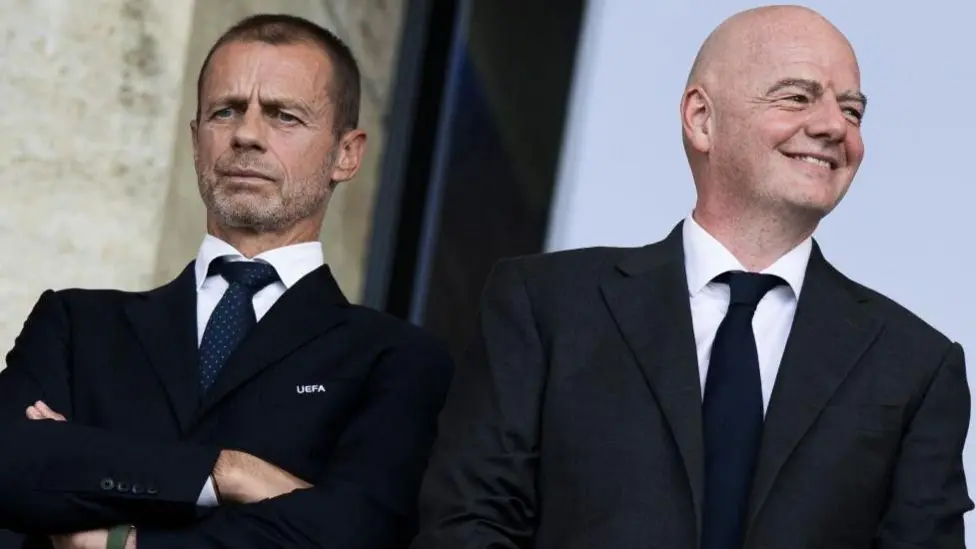

European football has entered one of its most turbulent governance disputes after UEFA threatened to boycott all Fifa competitions if plans to introduce private investment into the governing body’s tournament business receive approval.
The dramatic announcement, released at 16:00 BST on Thursday, marked an unprecedented escalation in the relationship between football’s two most influential governing organizations. UEFA declared that neither it nor its national associations would participate in Fifa competitions should the proposed investment structure move forward.
At the centre of the controversy is Fifa President Gianni Infantino’s proposal to sell a 20% stake in a newly created subsidiary responsible for managing the organization’s global tournaments, including the FIFA World Cup.
While Fifa would continue operating the competitions, the subsidiary would receive funding from private investors. Reports indicate that potential investors include Joshua Kushner, the brother of Donald Trump’s son-in-law, adding further political attention to an already sensitive proposal.
The proposal has drawn fierce criticism from European football officials, who argue that the process lacked transparency and meaningful consultation with member associations before being presented.
The timing of the dispute has created immediate uncertainty for several international tournaments scheduled over the coming months. UEFA has indicated that its boycott would become effective if the investment agreement is formally approved.
The deadline for national football associations to accept Fifa’s proposal is set for 19 September. Associations agreeing to the deal are expected to receive approximately $20 million (£15 million) on 1 January under the proposed financial arrangement.
That schedule creates a complicated scenario for tournaments already underway. The FIFA Under-20 Women’s World Cup, scheduled to begin on 5 September in Poland, could theoretically be disrupted if European nations withdraw after the approval deadline.
Senior football officials acknowledged uncertainty over how such a situation would be managed, with several admitting that practical implications had yet to be fully examined.
Attention is also turning toward the Women’s World Cup qualifying play-offs scheduled for October, where England, Scotland, Wales and Northern Ireland are among the participating nations.
UEFA Vice-President Laura McAllister expressed concern that players could become unintended victims of the dispute despite having no involvement in the governance conflict.
She emphasized that nations have worked for years to reach major international tournaments and argued that no football authority wanted players denied opportunities because of disagreements between governing bodies.
McAllister maintained that responsibility for the current crisis rests with Fifa, stating that UEFA had been placed in an impossible position by decisions taken without sufficient consultation.
The dispute widened further after Concacaf, the governing body representing North and Central America and the Caribbean, publicly rejected the investment proposal. Its statement indicated that all 41 member associations opposed the current plan.
Concacaf’s position significantly strengthens resistance against the proposal by demonstrating that opposition extends beyond Europe and into another major football confederation.
National associations within Europe have also lined up behind UEFA’s stance. The Football Association confirmed it stands “shoulder to shoulder” with its European colleagues in opposing the proposal.
FA Chair Debbie Hewitt, who also serves as a Fifa vice-president, reportedly voiced opposition during UEFA’s emergency meeting before the governing body issued its official statement.
The Scottish Football Association likewise expressed full support for UEFA’s position. Scottish FA President Mike Mulraney, who chairs FIFA’s Finance Committee, said the organization agreed unequivocally with the European governing body’s response.
Sources familiar with UEFA’s emergency discussions described the mood among delegates as one of deep frustration and anger. Much of that dissatisfaction reportedly focused not only on the proposal itself but also on the absence of consultation between FIFA leadership and member associations.
Critics argue that football’s most significant commercial decisions should involve extensive dialogue across the global game rather than being introduced with limited discussion.
The controversy has also revived questions about Gianni Infantino’s long-term future as FIFA president.
Infantino, first elected in 2016, is expected to seek a fourth term when elections take place next March. Until this week’s developments, many observers believed he would face no serious challenger.
However, growing dissatisfaction among several football associations has prompted renewed discussions about whether an alternative candidate should contest the presidency.
Among the names circulating is Paris Saint-Germain President Nasser Al-Khelaifi, one of football’s most influential administrators through both his club leadership and his role within European club football.
Al-Khelaifi previously played a central role in stabilizing European football following the collapse of the proposed European Super League in 2021, helping expand the organization representing the continent’s clubs.
Despite speculation, sources close to the Qatari executive insist he has no interest in pursuing the FIFA presidency, describing suggestions of a challenge as unfounded.
Former Football Association chairman David Bernstein questioned whether such a controversy would normally be survivable for a leader in another organization.
He argued that while executives in many institutions might be forced to resign following a dispute of this magnitude, FIFA’s governance structure has historically allowed presidents to remain in office if they retain sufficient support among national associations.
Former UEFA chief executive Lars-Christer Olsson also criticized the concentration of power within football’s governing system. He suggested the presidency should rotate between confederations to reduce the influence held by individual leaders over extended periods.
Olsson further argued that football requires a fresh start and implied leadership reform could become necessary if confidence in the current administration continues to decline.
Historically, incumbent FIFA presidents have rarely faced serious election challenges. The last sitting president defeated in an election was Sir Stanley Rous, who lost to João Havelange in 1974.
Whether history repeats itself or changes course may depend on how national associations respond over the coming weeks. For now, world football faces one of its most significant governance crises in decades, with uncertainty surrounding the future of international competitions, institutional leadership, and the balance of power between FIFA and its continental confederations.
This article was created using automation technology and was thoroughly edited and fact-checked by one of our editorial staff members