



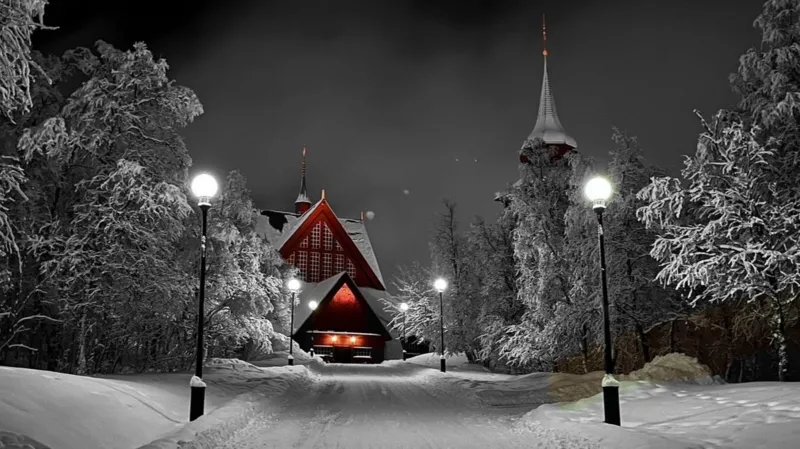

In a feat that blends engineering brilliance with cultural preservation, Sweden has embarked on the historic relocation of Kiruna Church, a 113-year-old timber landmark.
The vast red structure, once voted Sweden’s most beautiful pre-1950 building, is being moved intact over a 5km stretch to a new city centre — a journey that reflects both necessity and sentiment.
The move, which began with a blessing ceremony led by Vicar Lena Tjärnberg and Bishop Åsa Nyström of the Diocese of Luleå, has captivated locals and visitors alike.
Travelling at just 500 metres per hour, the church’s two-day journey north of the Arctic Circle has become a spectacle of “slow TV” broadcast live across Sweden.
A Church Rooted in History
Kiruna Church was completed in 1912, a gift from the mining company LKAB to the growing community that had developed around Europe’s largest iron ore mine.
Designed in striking timber Gothic style, the 35-metre-high, 40-metre-wide church has stood as the spiritual and cultural heart of the town for generations.
For more than a century, it has hosted baptisms, weddings, funerals, and countless community gatherings. Its great altar painting, crafted by Prince Eugen of Sweden, and its organ with more than 1,000 pipes have formed part of its unique character.
But the very mine that made Kiruna flourish has also forced its reinvention. Mining operations beneath the old city centre have caused ground subsidence, creating fissures that threaten infrastructure. Though buildings themselves remain stable for now, water, electricity, and sewage supplies risk collapse in the years ahead.
“People have to move before the infrastructure fails,” explained Robert Ylitalo, chief executive officer of Kiruna’s development company.
A City on the Move
The relocation of Kiruna is one of the most ambitious urban transformations in modern European history. More than 20,000 residents are gradually being shifted to a newly built city centre, with some buildings demolished and others painstakingly transported.
Among those already moved are the former mining manager Hjalmar Lundbohm’s home, split into three sections, and the clock tower from the old city hall, now standing proudly beside the new municipal headquarters.
But moving Kiruna Church is by far the most symbolic and complex element of the project, representing both continuity and change.
An Engineering Marvel
Unlike many historic relocations where buildings are dismantled, Kiruna Church is being transported in one piece. Weighing 672 tonnes, the church has been hoisted onto self-propelled modular transporters, supported by steel beams and stabilised with scaffolding inside.
“The biggest challenge was preparing the road for such a wide building,” said project manager Stefan Holmblad Johansson. “We had to widen it to 24 metres, removing lamp-posts, traffic lights, and even dismantling a bridge.”
The trailers carrying the church move slowly and cautiously, monitored by teams of engineers. Inside, delicate treasures such as Prince Eugen’s altar painting remain in place, secured with protective coverings. Even the grand organ has been left intact.
“It’s glued directly onto a masonry wall, so removing it would cause damage,” Johansson noted. “Everything has been stabilised and will move with the church.”
A Moment of Emotion
For the people of Kiruna, the relocation is not only about engineering triumph but also deep cultural resonance. Large crowds lined the streets under clear skies to watch the church’s slow departure. Some travelled from distant cities, while others came from abroad, recognising the historic nature of the moment.
“It’s like history taking place in front of our eyes,” said cultural strategist Sofia Lagerlöf Määttä. “The church has been a centre of joy and sorrow for generations. We’re not just moving wood and stone — we’re moving our memories.”
Local resident Lena Edkvist, who drove from Gothenburg with her husband to witness the move, echoed that sentiment. “I’m not deeply religious, but this church is part of my tradition and culture. It feels like an honour that it’s being preserved intact.”
A Costly But Necessary Project
The total cost of relocating Kiruna, funded entirely by LKAB, is estimated at more than 10 billion Swedish krona ($1bn). As the town’s largest employer, the mining company has shouldered responsibility for ensuring that the community it created continues to thrive in a safer environment.
Swedish law prohibits mining beneath occupied buildings, but with subsidence inevitable, the shift has become unavoidable.
“There’s no risk of people falling through cracks,” Ylitalo explained. “But fissures would eventually damage infrastructure. We have to act before that happens.”
A Journey Watched by the World
The slow, deliberate progress of the church has drawn comparisons to monumental moves of the past, from Egyptian temples shifted to avoid flooding to historic houses relocated brick by brick. But moving a 672-tonne church intact across Arctic terrain sets Kiruna apart.
Swedish television has turned the journey into a “slow TV” event, captivating audiences as the massive timber structure crawls towards its new home. Each metre marks the survival of history amid change.
For project manager Johansson, who also sings in the church’s gospel choir, the move carries personal meaning. “This is a very special task for me,” he said. “The church was built for the people by LKAB. Now, more than 100 years later, we move it together into the future. There is no other way.”
A Future Rooted in the Past
The relocation is expected to be complete by Wednesday evening, when Kiruna Church will stand in its new city centre — still intact, still magnificent, and still central to the lives of the community.
For Vicar Lena Tjärnberg, the moment is bittersweet. “The church is leaving a place where it truly belongs,” she reflected. “I’m grateful it is coming with us, but there is sorrow in leaving the ground where it became a church.”
As the wheels turn and the church inches forward, Kiruna demonstrates that heritage can move with the times — literally. The red wooden walls, altar, organ, and memories of generations are not being left behind but carried forward into a new chapter of history.
“It’s more than an engineering marvel,” said Määttä. “It’s proof that even when the ground shifts beneath us, we can bring the past with us into the future.”
This article was created using automation technology and was thoroughly edited and fact-checked by one of our editorial staff members