



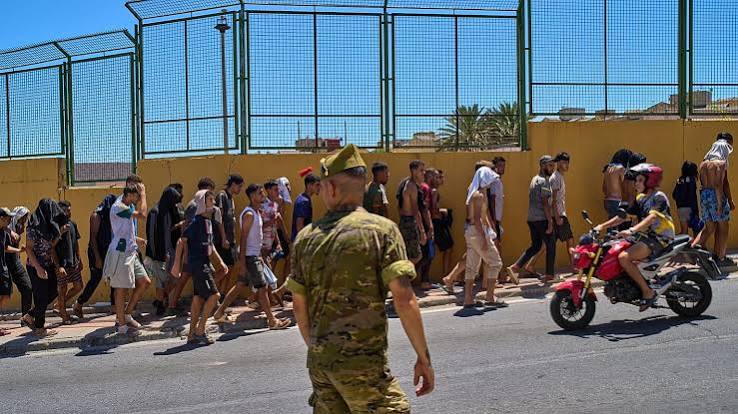

Spain, Ceuta: National Court investigates whether Morocco facilitated July’s mass migrant crossing as a possible attack on territorial integrity
Spain’s Audiencia Nacional has opened a criminal investigation into the mass arrival of migrants in Ceuta during late July, examining whether events constituted criminal conduct committed abroad that seriously affected Spain’s territorial integrity and public security.
Investigating judge María Tardón ruled that the National Court had jurisdiction to examine possible offences involving territorial integrity, negligent homicide and criminal organisation. The decision follows criteria supported by Spain’s Public Prosecutor’s Office regarding the exceptional circumstances surrounding the crossings.
The investigation centres on the unprecedented movement of more than 70,000 migrants from Morocco into Ceuta on 30 and 31 July. Spanish authorities have described the episode as an extraordinary border crisis that placed immense pressure on local services and security forces.
Tardón’s ruling gives particular weight to a Spanish police report that described what investigators characterised as “total permissiveness” by Moroccan security forces. The report allegedly documented behaviour suggesting that officers failed to prevent crossings and, in some instances, assisted migrants.
According to the ruling, the Moroccan security forces allegedly made no serious effort to stop the movement. Some uniformed personnel were reportedly observed providing directions to migrants, potentially helping them overcome obstacles and reach routes leading towards Ceuta.
The judge described the alleged facilitation as a “clear and undeniable” contribution from Moroccan territory. She pointed to behaviour that was reportedly recorded and visually documented, while stressing that the investigation must now establish responsibility and determine who organised the movement.
The court’s decision also introduces the concept of “hybrid warfare” or the “grey zone”, referring to methods through which states or other actors may exploit migration, political pressure and social disruption without conventional military confrontation against another country.
Tardón said the migrant flow could represent one of the characteristic methods associated with such activity, particularly if irregular migration was deliberately used to disrupt daily life and affect the rights and security of residents in Ceuta.
The ruling does not establish that Morocco’s government ordered or orchestrated the crossings. Instead, it authorises a criminal investigation into allegations and evidence that prosecutors and investigators believe warrant further examination before conclusions about responsibility can be reached.
Spanish Prime Minister Pedro Sánchez has maintained that there is no conclusive evidence proving that Moroccan authorities orchestrated the influx. Speaking in parliament, Sánchez acknowledged unusual passivity by Moroccan police but questioned whether this reflected deliberate action or inability to respond effectively.
The Spanish government’s position therefore differs from the interpretation presented in the police material underpinning the court proceedings. Madrid has urged caution, while investigators and the judiciary assess whether the available evidence can establish coordination or deliberate facilitation by Moroccan authorities.
The scale of the movement was extraordinary. Spanish and European sources have estimated that more than 70,000 people crossed into Ceuta during the crisis, although figures vary depending on the period and methodology used to calculate the total number of arrivals.
A Spanish police report examined the crossings as occurring in several waves. According to reporting on the document, the first involved mainly young people, while later groups included families, children and migrants from different backgrounds, placing substantial pressure on overwhelmed border infrastructure.
The circumstances surrounding the crossings also proved deadly. Spanish authorities and media reports have cited numerous fatalities during the episode, with bodies recovered on the Spanish side and additional deaths reported across the Moroccan side of the border.
The human cost is among the reasons the investigation includes possible negligent homicide. The court will need to determine whether deaths were connected to failures or actions by individuals or organisations involved in facilitating, organising or managing the mass movement.
For Ceuta, the influx created immediate humanitarian and political challenges. Thousands of people remained in the Spanish enclave after most arrivals were returned to Morocco, while local authorities faced continuing pressure over accommodation, security and the management of vulnerable migrants.
Spanish authorities subsequently reported that tens of thousands of migrants had returned to Morocco. However, estimates of the number remaining in Ceuta varied considerably, with local officials warning that thousands could still be present and requiring accommodation or other assistance.
Moroccan authorities have not accepted the allegations contained in the Spanish police material. Moroccan media have criticised the report, describing it as flawed and questioning whether it provides sufficient evidence to substantiate claims that Moroccan security forces deliberately facilitated the crossings.
The controversy has also exposed tensions between Spain and Morocco, whose cooperation is strategically important for migration control, border security and regional stability. Any judicial finding implicating Moroccan officials could therefore have consequences beyond the immediate criminal proceedings.
The investigation follows weeks of political debate in Spain over responsibility for the crisis. Opposition parties have demanded stronger explanations from the government, while the episode has intensified arguments surrounding immigration, border protection and Spain’s relationship with Morocco.
The political consequences are already visible. A recent poll found widespread dissatisfaction with the Spanish government’s handling of the Ceuta crisis, while support for the right-wing Vox party increased as immigration became a more prominent political issue.
For investigators, however, the central question remains whether the mass crossings were a spontaneous migration event or part of a coordinated operation. The court will examine evidence concerning organisers, communications, border activity and alleged involvement by Moroccan security personnel.
Spanish police reporting has suggested that the operation may have involved multiple levels, ranging from migrants and social-media mobilisers to people organising movements on the ground and potentially higher-level planners. The court must establish which claims can withstand judicial scrutiny.
The investigation is not yet a judicial finding that Morocco attacked Spain or deliberately weaponised migration. Rather, it represents a formal effort to determine whether evidence supports allegations of criminal conduct, organisation and facilitation surrounding the extraordinary events in Ceuta.
As proceedings continue, investigators are expected to examine police reports, visual material, witness testimony and other evidence relating to the border crossings. The outcome could determine whether responsibility rests with individuals, criminal networks, foreign officials or other unidentified actors.
The case also places renewed attention on Ceuta’s unusual position as a Spanish autonomous city bordering Morocco and situated on Europe’s southern frontier. Its geography makes the territory particularly sensitive to migration pressures and wider diplomatic disputes.
For Spain, the investigation could ultimately become a significant test of how national authorities respond when migration, border security and allegations of foreign interference overlap. For Morocco, the proceedings could create renewed diplomatic pressure if investigators substantiate claims involving its security forces.
Until the investigation produces definitive findings, responsibility for the July influx remains contested. The Spanish government has rejected claims that Morocco orchestrated the crisis, while the court has determined that the allegations and available evidence are serious enough to warrant criminal examination.
The proceedings therefore mark an important new phase in the aftermath of the Ceuta crisis. Rather than ending with the return of most migrants, the episode has moved into Spain’s judicial system, where evidence will now determine whether the extraordinary allegations can be proven.
This article was created using automation technology and was thoroughly edited and fact-checked by one of our editorial staff members