




Spain, Ceuta Autonomous City: Protests intensify pressure on Sánchez government after unprecedented migrant influx from Morocco
Thousands of people have taken to the streets across Spain to protest the government’s handling of a major migrant influx into Ceuta, intensifying pressure on Prime Minister Pedro Sánchez as anger grows over the unprecedented border crisis.
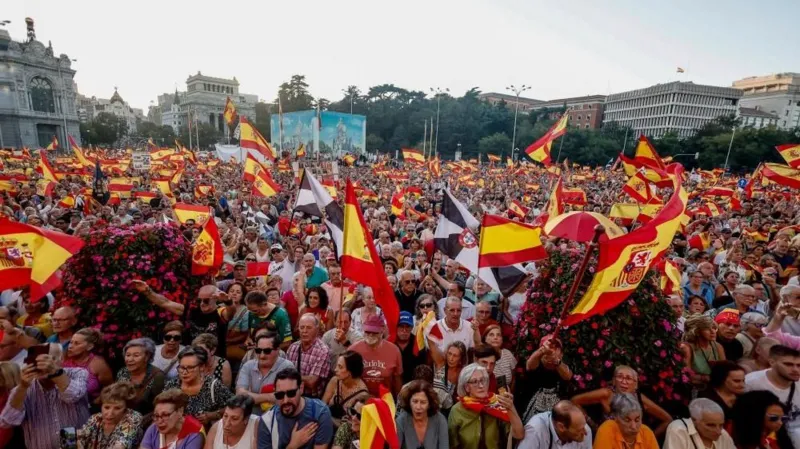
Demonstrations were held in Madrid, Ceuta and other Spanish cities on Wednesday, with protesters demanding stronger border controls, the return of migrants to their countries of origin and a redistribution of arrivals across mainland Spain.
The protests were organised or supported by city councils where Spain’s conservative Partido Popular, or PP, and far-right Vox hold power or enjoy substantial support. Demonstrators also called for Sánchez to resign over his government’s response.
In Madrid, more than 50,000 people attended the rally, according to government figures. PP leader Alberto Núñez Feijóo joined the demonstration and accused the government of abandoning Ceuta while failing to prevent the border crisis from escalating.
Feijóo said the Spanish city had been invaded and occupied, arguing that the crossings occurred with the knowledge of Spain’s government. His remarks reflected opposition claims that Sánchez failed to protect residents and manage the border effectively.
Vox leader Santiago Abascal attacked Sánchez, accusing him of serving Morocco rather than defending Spanish interests. His comments reflected the confrontational debate surrounding migration, border security today and Spain’s complicated relationship with neighbouring European Morocco.
Ceuta itself, a Spanish autonomous city on the North African coast, witnessed a major demonstration. Protesters chanted that Ceuta was not for sale and must be defended, expressing frustration over migrants in streets, beaches and temporary camps.
The demonstrations followed an extraordinary influx on 30 and 31 July, when at least 72,000 migrants crossed from Morocco into Ceuta. Although most have returned, estimates suggest as many as 5,000 remain in difficult conditions.
Many migrants are reportedly living in makeshift camps or scattered around the city, placing pressure on local services and fuelling tensions among residents. Near-daily protests have followed, creating a political and humanitarian challenge for Spanish authorities.
The Sánchez government has rejected accusations that it abandoned Ceuta and has instead blamed trafficking networks and online misinformation for encouraging people to attempt the crossing. Officials have also faced questions over whether Morocco played a role in the episode.
Morocco has denied orchestrating or participating in the mass crossing. The dispute has nevertheless become more serious after a Spanish police report reportedly described Moroccan security forces as showing “total permissiveness” during the unprecedented movement of people.
The report was submitted by the National Police’s National Immigration and Borders Centre, known as CENIF, to Spain’s National Court. It has intensified scrutiny of Morocco’s conduct because Sánchez had previously insisted that Morocco was not responsible.
According to Spanish media reports, the document said the Moroccan police deployment around the border was clearly smaller than usual. It also cited migrants describing a passive attitude among Moroccan security forces during the crossings.
However, the police report did not categorically accuse Morocco of organising the influx. Its findings instead raised questions about whether Moroccan authorities deliberately reduced enforcement or simply failed to control an extraordinary movement of people approaching the border.
Ceuta and Morocco have a particularly sensitive history. Morocco maintains a longstanding territorial claim over Ceuta and neighbouring Melilla, two Spanish autonomous cities on the North African coast that have repeatedly become flashpoints in relations between Madrid and Rabat.
The latest crisis has also been accompanied by a wave of social media activity. Numerous posts appearing in August portrayed the border between Morocco and Ceuta as safe and easy to cross, despite the dangers.
At least 100 people died while attempting to swim around the border fence, according to figures cited by Ceuta’s mayor. The deaths have highlighted severe risks facing migrants attempting dangerous sea crossings or alternative routes around heavily guarded barriers.
Spanish fact-checking organisation Maldita reported that messages encouraging people to attempt the journey had circulated on Moroccan social media before the influx began. The messages appeared after a June ruling by Spain’s Supreme Court, according to the organisation.
The role of social media has become central to competing explanations for the crisis. While the government points to misinformation and trafficking networks, critics argue that authorities should have anticipated the movement and strengthened preparations around Ceuta.
For residents, the dispute is increasingly about security, public services and whether Madrid understands the pressures facing the enclave. Demonstrators say Ceuta cannot be treated as peripheral, particularly when large numbers of people arrive within a very short period.
For Sánchez, the controversy represents another major test of his government’s migration policy and diplomatic strategy. His administration must balance humanitarian responsibilities with demands for stronger border enforcement while preserving a relationship with Morocco that remains strategically important.
The government’s position has been complicated by the police report, which has provided fresh ammunition to opposition parties without definitively establishing Moroccan responsibility. That distinction remains important as investigators and political leaders examine what happened.
Opposition parties are expected to continue pressing Sánchez over the crisis, particularly as public anger remains visible in Ceuta and other Spanish cities. The protests have transformed the migrant influx into a broader debate over national sovereignty.
Meanwhile, the humanitarian situation remains unresolved for thousands of migrants still in Ceuta. Authorities face pressure to provide accommodation and assistance while determining individual cases, managing returns where legally possible and preventing further dangerous attempts to cross the border.
The events have exposed the wider vulnerability of Spain’s North African enclaves. Ceuta and Melilla are surrounded by Moroccan territory, making cooperation between Madrid and Rabat essential for managing migration, security and border incidents despite unresolved territorial tensions.
As demonstrations continue, Sánchez faces demands for accountability from opponents and residents, while his government insists that migration cannot be addressed through political confrontation alone. The coming weeks are likely to determine whether the crisis fades or deepens.
For now, the protests underline how quickly a border emergency can become a national political issue. With thousands affected, questions over Morocco’s conduct unresolved and public anger continuing, Spain faces a difficult challenge on security and humanitarian grounds.