



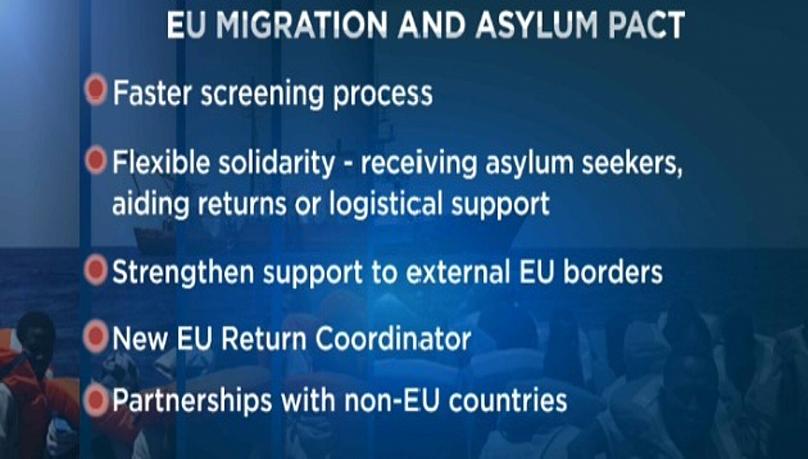

The European Union has disclosed a hotly anticipated movement settlement, intending to smooth out the refuge cycle among part states to fix what EU pioneers recognized was an incapable framework.
The new agreement means to more readily share the weight of migrating refuge searchers by permitting part states to contribute by rather returning people who don’t fit the bill for shelter or offering strategic help.
EU pioneers additionally would like to make quicker outskirt screening measures at the outer fringes.
Commission President Ursula von der Leyen said that the new agreement would strike a “sensible equalization” with all part states sharing the “advantages” and “weights”. She included that it wasn’t an issue of “whether” EU states ought to contribute yet “how”.
Commission Vice President Margarítis Schinás said that the expectation would be this is “a legitimate single strong relocation strategy”.
Movement strategy has verifiably been a prickly issue in EU legislative issues, and it’s conceivable the new relocation settlement will be a hard sell for the European Commission.
The cycle has been a fragile difficult exercise of getting nations who have been loath to obligatory shares like Poland, Hungary and Austria to acknowledge transients, and supporting southern nations like Greece, Italy and Malta in managing individuals showing up on their shores from the Mediterranean.
Schinas said that the new agreement would put “Dublin to bed” and make a more brilliant methodology, with youngsters and family unifications being the primary rules for moving transients.
Addressing Euronews in front of the declaration, the Commissioner for Home Affairs, Ylva Johansson promised there ought to be “no more Morias”, alluding to the stuffed outcast camp on the Greek island of Lesbos which torched over seven days prior.
EU relocation boss promises new agreement will stop stuffed outcast camps
“I think clearly Moria is the outcome, however halfway, of the absence of a typical European refuge and movement strategy,” she included.
Johansson said she figured the new arrangement could connect contrasts between part states over relocation.
“To be straightforward I don’t think I’ll get the opportunity to have too much ‘yahoos’ when I present my proposition, however I do figure I will have acknowledgment and regard since I think we are finding the correct equalization where we show solidarity towards travelers, refuge searchers and between part states, yet that we’re additionally evident that the individuals who are not qualified to remain – they must be returned,” Johansson told Euronews.
At a question and answer session, Schinas included: “Moria is a manifestation of a framework that is a non-framework.”