



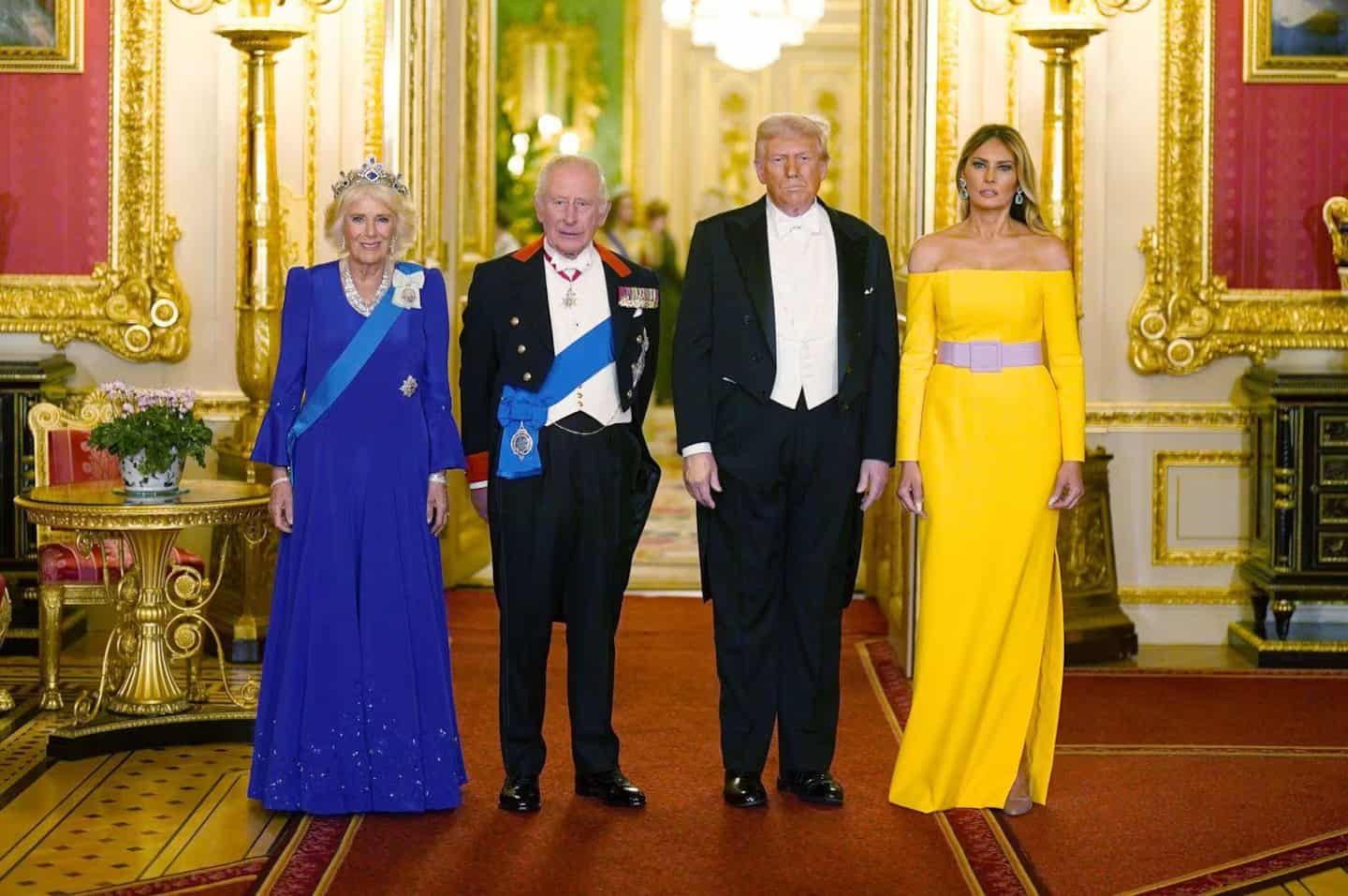

King Charles extended a grand royal welcome to United States President Donald Trump at Windsor Castle on the first full day of his state visit to the United Kingdom. The occasion, steeped in ceremony, underscored the historic bond between the two nations while also revealing the polarized reactions Trump continues to generate abroad.
The president and First Lady Melania Trump were received at the 11th-century castle with a carriage procession, a guard of honour, and a spectacular aerial display by the Royal Air Force’s Red Arrows. Crowds of onlookers gathered near Windsor to witness the pageantry, while television coverage broadcast the symbolic moment to a global audience.
For King Charles, this was one of the most significant diplomatic duties of his reign since ascending the throne. The event served not only as a display of British royal tradition but also as a reaffirmation of the “special relationship” that has long defined US-UK ties.
Following the formalities, the two leaders held a private meeting inside the castle, where discussions reportedly focused on trade, security, and international affairs.
However, the pomp at Windsor was not without its counterpoint. In central London, several miles from the royal grounds, an estimated 3,000 protesters gathered to voice their opposition to Trump’s visit.
Organized by activist groups and civil society organizations, the demonstration featured banners, chants, and speeches denouncing the American president’s policies on climate change, immigration, and foreign relations.
The protests, though smaller in scale compared to previous anti-Trump demonstrations in the UK, reflected lingering unease over his leadership style and rhetoric. Placards declaring “No to Trump, Yes to Unity” and inflatable caricatures of the president highlighted the tone of dissent that has accompanied his visits to Britain.
For the UK government and the monarchy, the visit represents a balancing act between showcasing close diplomatic ties with Washington and acknowledging domestic concerns about the president’s policies.
Royal watchers noted that while ceremonial aspects were meticulously executed, the atmosphere was less effusive than during past state visits by other American presidents.
Political analysts suggest the visit underscores the pragmatism in UK foreign policy. “The optics of royal tradition are critical for maintaining the US-UK alliance,” said Dr. Helena Briggs, an international relations expert at King’s College London. “At the same time, the protests remind us of the democratic right to dissent, which is equally a cornerstone of British values.”
As the day concluded, Trump praised the reception he received at Windsor, describing King Charles as “a gracious host” and the ceremonies as “truly memorable.” The president is scheduled to continue his visit with further engagements in London, including meetings with government officials and business leaders.
The juxtaposition of ceremonial grandeur at Windsor and vocal opposition in London encapsulated the dual realities of Trump’s visit: a reaffirmation of state-to-state ties on one hand, and a reflection of contested public opinion on the other.
For many, it was a day that vividly illustrated both the endurance of tradition and the power of protest in modern Britain.google)