



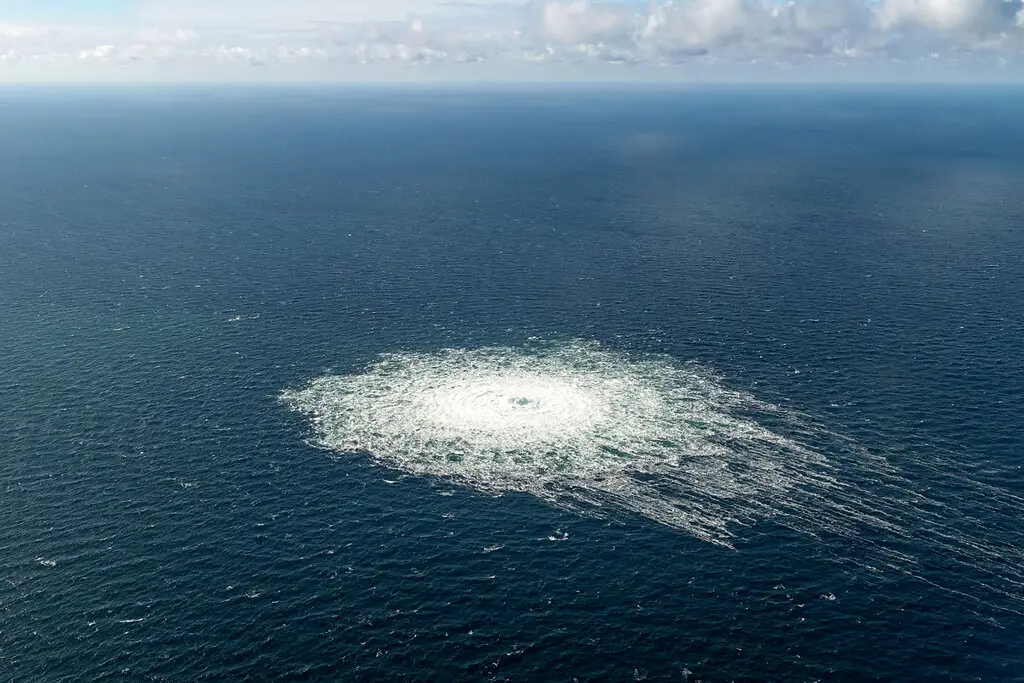

Germany, Hamburg: German prosecutors formally charge a Ukrainian suspect over the 2022 Nord Stream explosions, marking a significant development in one of Europe’s most controversial sabotage investigations
German prosecutors have formally charged a Ukrainian national in connection with the 2022 sabotage of the Nord Stream gas pipelines, marking one of the most significant developments in the years-long investigation into the explosions that severely damaged critical energy infrastructure linking Russia and Europe.
The announcement came on Wednesday when Germany’s federal prosecutors confirmed that charges had been filed against a man believed to have played a leading role in the covert operation.
German media identified the suspect as Serhii K., a Ukrainian national who investigators believe commanded the team responsible for carrying out the underwater sabotage.
The Nord Stream pipelines, stretching beneath the Baltic Sea from Russia to Germany, were designed to transport vast quantities of natural gas to Western Europe. Before the outbreak of the Russia-Ukraine war, the network served as one of Moscow’s most important energy export routes, generating billions of dollars in revenue for the Kremlin.
The destruction of the pipelines in September 2022 sent shockwaves across Europe, disrupting energy markets and intensifying geopolitical tensions during an already volatile period following Russia’s full-scale invasion of Ukraine.
According to German prosecutors, Serhii K. now faces multiple charges, including attacks on civilian energy infrastructure, causing an explosives detonation, and demolition of built structures.
The suspect is currently being held in Hamburg, where he is expected to stand trial following his extradition from Italy late last year.
German authorities said the accused was arrested in Italy during the summer of 2025 after an international investigation tracked his whereabouts. He was subsequently extradited to Germany in November to face criminal proceedings.
Investigators believe Serhii K. served as the operational commander aboard the yacht allegedly used to transport the sabotage team into the Baltic Sea before the explosions.
According to German media reports, prosecutors have gathered what they describe as overwhelming evidence against the suspect.
Among the evidence reportedly collected are intercepted phone conversations that investigators claim contain self-incriminating statements made by the suspect while he was detained in Italy.
Authorities allege that these conversations with relatives and acquaintances provided valuable insight into his alleged involvement in planning and executing the operation.
Although prosecutors have confirmed the filing of charges, they have not publicly disclosed the full body of evidence that will be presented during the upcoming trial.
The case remains one of the most politically sensitive criminal investigations in Europe because of its implications for international security, relations between Russia and Ukraine, and Europe’s energy independence.
The Nord Stream system consists of multiple pipelines running beneath the Baltic Sea between Russia and Germany. For years, the network represented a cornerstone of Europe’s natural gas supply, allowing Russian gas to reach Germany directly without passing through transit countries.
Following Russia’s invasion of Ukraine in February 2022, European governments began rapidly reducing their dependence on Russian energy supplies through sanctions, diversification of imports, and accelerated investment in alternative energy sources.
The pipeline explosions occurred in September 2022, creating massive underwater gas leaks that were detected in both Danish and Swedish waters. The blasts immediately sparked widespread speculation over who was responsible.
Russia blamed Western governments, while several European countries launched independent investigations. No government initially accepted responsibility, and investigators spent years examining multiple theories involving state and non-state actors.
In 2024, an investigation published by The Wall Street Journal presented a detailed account suggesting that the sabotage operation had been carried out by a small Ukrainian team operating from a rented yacht disguised as a pleasure cruise.
According to the newspaper, the operation was allegedly conceived during a gathering of Ukrainian military officers in May 2022, shortly after Ukrainian forces successfully resisted Russia’s initial offensive.
The report claimed the mission cost approximately $300,000 and involved a six-member crew that secretly transported explosives into the Baltic Sea before targeting the pipelines.
The newspaper cited anonymous Ukrainian defence and security officials familiar with the planning, all of whom reportedly viewed the pipelines as legitimate military targets because they generated substantial revenue for Russia’s war effort.
One of the report’s most controversial claims was that Ukrainian President Volodymyr Zelenskyy initially approved the operation before the US Central Intelligence Agency became aware of the plan.
According to the newspaper, the CIA urged Ukraine to abandon the mission. The report alleged that President Zelenskyy subsequently ordered the operation to be halted.
However, the investigation claimed that Ukraine’s then commander-in-chief, General Valeriy Zaluzhniy, allegedly proceeded with the mission despite those instructions. Neither the Ukrainian government nor President Zelenskyy has accepted responsibility for the pipeline explosions.
Kyiv has consistently denied direct involvement in the sabotage, while officials have questioned various media reports linking Ukraine to the attack. The criminal proceedings in Germany are expected to examine evidence gathered over nearly four years by investigators working across several European countries.
Authorities have coordinated closely with international law enforcement agencies throughout the investigation, tracing financial records, travel histories, communications data and forensic evidence connected to the alleged operation.
Security analysts say the trial could provide the clearest public account yet of how one of Europe’s most important energy infrastructure systems was destroyed.
The outcome may also influence future discussions on protecting critical undersea infrastructure, including pipelines, telecommunications cables and offshore energy facilities.
The Nord Stream explosions highlighted the vulnerability of underwater infrastructure at a time when geopolitical competition has increasingly extended beyond conventional military operations.
European governments have since expanded surveillance and security measures around offshore installations, warning that critical infrastructure remains exposed to sabotage and hybrid threats.
The case also underscores the complex legal and diplomatic challenges surrounding acts of sabotage carried out during wartime, particularly when civilian infrastructure becomes intertwined with broader military and strategic objectives.
As Germany prepares to bring the case before a Hamburg court, the proceedings are expected to attract global attention.
The trial could shed new light on one of the most consequential acts of infrastructure sabotage in recent European history while potentially answering longstanding questions surrounding the destruction of the Nord Stream pipelines.
Whether prosecutors can secure a conviction will ultimately depend on the strength of the evidence presented in court, but the filing of formal charges marks a major milestone in an investigation that has remained under intense international scrutiny since the explosions first shook Europe’s energy landscape nearly four years ago.