



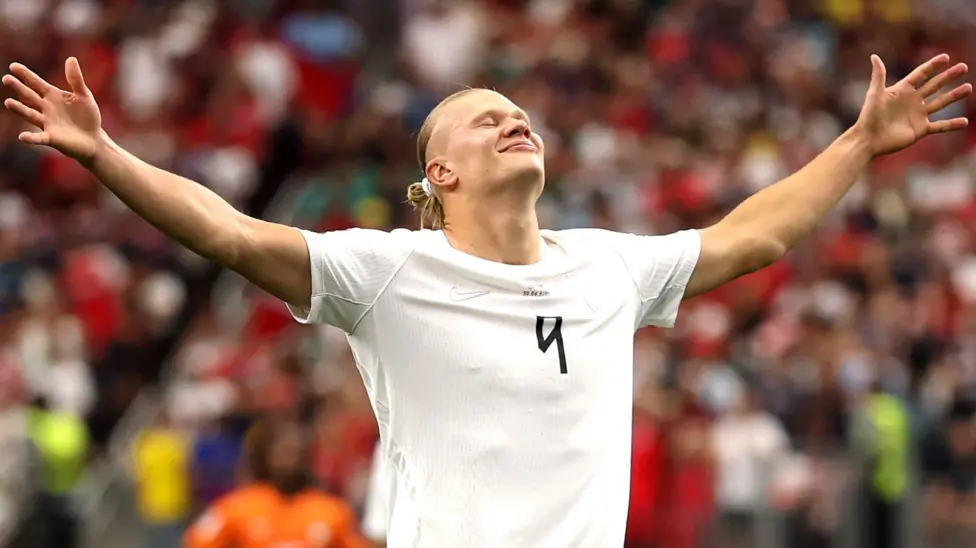

Norway, Oslo County: Erling Haaland leads Norway’s golden generation into a historic World Cup quarter-final against England, ending decades of frustration with belief and ambition
Norway’s remarkable journey at the 2026 FIFA World Cup has reached another historic milestone, with Erling Haaland leading the Scandinavian nation into a quarter-final showdown against England.
For a country that had waited nearly three decades to return to football’s biggest stage, the achievement represents far more than a successful tournament—it marks the fulfillment of a long-standing national ambition.
The last time Norway appeared at a FIFA World Cup was in France in 1998. At the time, Haaland had not yet been born. Today, the Manchester City striker has become the face of a new era, helping his nation erase years of disappointment while establishing himself as one of the tournament’s standout performers.
Norway’s qualification campaign was emphatic, largely driven by Haaland’s extraordinary scoring record. The 25-year-old striker netted 16 goals in eight qualifying matches before continuing his prolific form at the World Cup, scoring seven goals in his opening four appearances to place himself among the leading contenders for the tournament’s Golden Boot.
His influence extends well beyond statistics. Every goal has strengthened belief within a nation that spent years watching major tournaments from home while neighboring countries enjoyed international success.
Ironically, Haaland could have been wearing a different shirt this summer. Born in Leeds, England, during his father Alf-Inge Haaland’s time playing in the Premier League, the striker was eligible to represent England at international level.
However, his connection with Norway was always stronger than the opportunity to play for one of football’s traditional powerhouses. Choosing Norway carried significant risk, particularly given the country’s lengthy absence from major tournaments and uncertainty over whether he would ever experience World Cup football.
Instead of seeking greater chances of international silverware elsewhere, Haaland committed himself to the nation where he grew up and developed as a footballer. That loyalty has now been rewarded with Norway’s deepest World Cup run in modern history.
His journey began at Bryne, where coaches quickly recognized his exceptional talent and accelerated his development through the club’s youth system. Subsequent moves to larger European clubs steadily prepared him for football’s biggest stages before his arrival at Manchester City transformed him into one of the world’s most feared forwards.
Having already won virtually every major club trophy available, Haaland has now turned his attention toward creating history with Norway.
His latest contribution came in the Round of 16, where he scored twice to eliminate five-time world champions Brazil. The victory immediately became one of the greatest moments in Norwegian football history and set up a highly anticipated quarter-final against England in Miami.
For England, Haaland represents the most immediate threat. Yet portraying Norway as a one-man team would ignore the impressive squad assembled around him.
Captain Martin Ødegaard has brought leadership and creativity after arriving in the United States fresh from helping Arsenal secure the Premier League title. His three assists at the tournament have highlighted his ability to dictate matches and supply Norway’s dangerous attacking players.
Alexander Sørloth and Jørgen Strand Larsen have added strength and goals in attack, while Oscar Bobb has offered pace and creativity from wide positions. Midfielders Patrick Berg and Sander Berge have controlled possession effectively, and young winger Antonio Nusa has emerged as one of Norway’s surprise performers during the competition.
Together, they have formed what many observers describe as Norway’s golden generation.
Previous generations featured accomplished players including John Carew, John Arne Riise, Morten Gamst Pedersen and Brede Hangeland. Despite their quality, those teams repeatedly fell short of qualification for major tournaments, leaving supporters frustrated as years passed without a World Cup appearance.
This current squad has finally broken that cycle. Football analysts have compared Norway’s emergence to Belgium’s celebrated golden generation, which transformed a relatively small nation into one of the world’s leading football powers during the previous decade.
Like Belgium, Norway combines elite individual talent with increasing squad depth, giving the country genuine belief that sustained success at international level is possible.
Nevertheless, Haaland remains the undisputed symbol of Norwegian football. Standing 6 feet 5 inches tall with his distinctive long blond hair, he has become one of the sport’s most recognizable figures. His popularity stretches far beyond football supporters, with millions following his activities on social media and YouTube.
His official YouTube channel attracts more than 2.4 million subscribers, offering fans a glimpse into his life away from football. One recent video documenting a shopping trip for cowboy hats and boots in Dallas attracted millions of views shortly after Norway secured victory over Ivory Coast.
The striker is also expanding into entertainment, lending his voice to an animated Viking character appropriately named “Haaland” in the upcoming film ViQueens. Despite his enormous global profile, Norwegian journalists note that Haaland’s confident personality differs from traditional Scandinavian sporting culture.
While humility has often defined Norwegian athletes, Haaland displays remarkable self-belief and openly embraces expectations. Rather than avoiding pressure, he appears energized by it, a characteristic that has become central to his success.
His confidence has occasionally generated criticism at home, but it has also inspired a younger generation of footballers who now believe Norway can compete with the world’s elite nations.
His achievements have increased shirt sales, boosted television audiences and generated unprecedented excitement surrounding the national team. Youth participation in football has also benefited as children increasingly dream of following Haaland’s path from local pitches to the world’s biggest stadiums.
Now, another defining chapter awaits. England stand between Norway and an unprecedented World Cup semi-final appearance. The meeting carries added intrigue given Haaland’s birthplace and his eligibility to represent the Three Lions.
Instead, he will attempt to eliminate them. The striker currently sits firmly in the race for the tournament’s Golden Boot alongside Lionel Messi, Kylian Mbappé and Harry Kane, highlighting the elite company he now keeps among world football’s biggest names.
For Norway, however, individual awards remain secondary. The country’s greatest objective is continuing a journey that has already exceeded expectations while proving that its golden generation is capable of competing for the sport’s highest honors.
Twenty-eight years after their last World Cup appearance, Norway have returned not simply to participate but to challenge football’s established powers.
At the center of that remarkable transformation stands Erling Haaland—a striker whose goals have carried the hopes of an entire nation and whose next performance could deliver the greatest achievement in Norwegian football history.