




Netherlands leads Europe’s electric aviation push as pilots train and engineers develop battery-powered passenger aircraft for regional travel
Flying without kerosene is moving closer to reality in the Netherlands, where pilots are already training on electric aircraft while engineers develop a battery powered regional plane designed to carry up to 90 passengers across distances approaching 1,000 kilometres.
The Dutch start-up Elysian Aircraft has begun testing a scaled demonstrator of its E9X concept, marking an important stage in its effort to prove that larger electric passenger aircraft can eventually become technically feasible for commercial aviation.
Pilots Johannes, Peter and Floris recently completed early test flights with the demonstrator, examining how its systems perform during take-off, flight and landing. The aircraft returned safely, allowing engineers to begin analysing detailed flight data.
The tests are being conducted against a backdrop of rapidly growing aviation demand. Passenger numbers worldwide could double over the next two decades, increasing pressure on manufacturers, airlines and governments to reduce emissions without restricting access to air travel.
Elysian, founded in the Netherlands with 10 million euros in start-up capital, believes battery technology can support aircraft much larger than today’s electric trainers. The company is developing an aircraft intended for regional routes where electrification could make environmental gains.
Daniel Jacobson, an Elysian co-founder, said the E9X design is largely established. The aircraft is planned with six electric engines and folding wingtips, allowing its unusually broad wings to fit existing airport gates despite a span exceeding 50 metres.
Those wings are central to the aircraft’s concept because Elysian plans to integrate battery packs directly into their structure. A full-scale wing model contains around 40 packs, with each weighing approximately 1,000 kilograms, highlighting the enormous energy storage challenge.
Jacobson acknowledged that the aircraft remains heavy, describing it as an ‘obese plane’ while explaining that engineers are continually seeking ways to reduce weight. Material choices, thermal management and other proprietary technologies are being explored as development continues.
The battery-wing approach represents one of Elysian’s most distinctive engineering ideas. The company says research conducted with Delft University of Technology challenged the longstanding assumption that fully electric propulsion could not support a large passenger aircraft.
If successful, the E9X could carry 90 passengers initially over approximately 800 kilometres, with the company ultimately targeting a range of 1,000 kilometres. Elysian estimates that such an aircraft could eliminate emissions on a significant share of flights.
Jacobson claims the concept could potentially cover routes representing around half of global flights and reduce total aerospace emissions by about 20 percent. Those figures are company estimates and depend on successful development, certification and access to low-carbon electricity.
Elysian expects the E9X to become operational in 2034. Jacobson argues that Europe has established a strong position in emerging aviation technologies, while calling for greater support for European start-ups competing with companies in the United States and China.
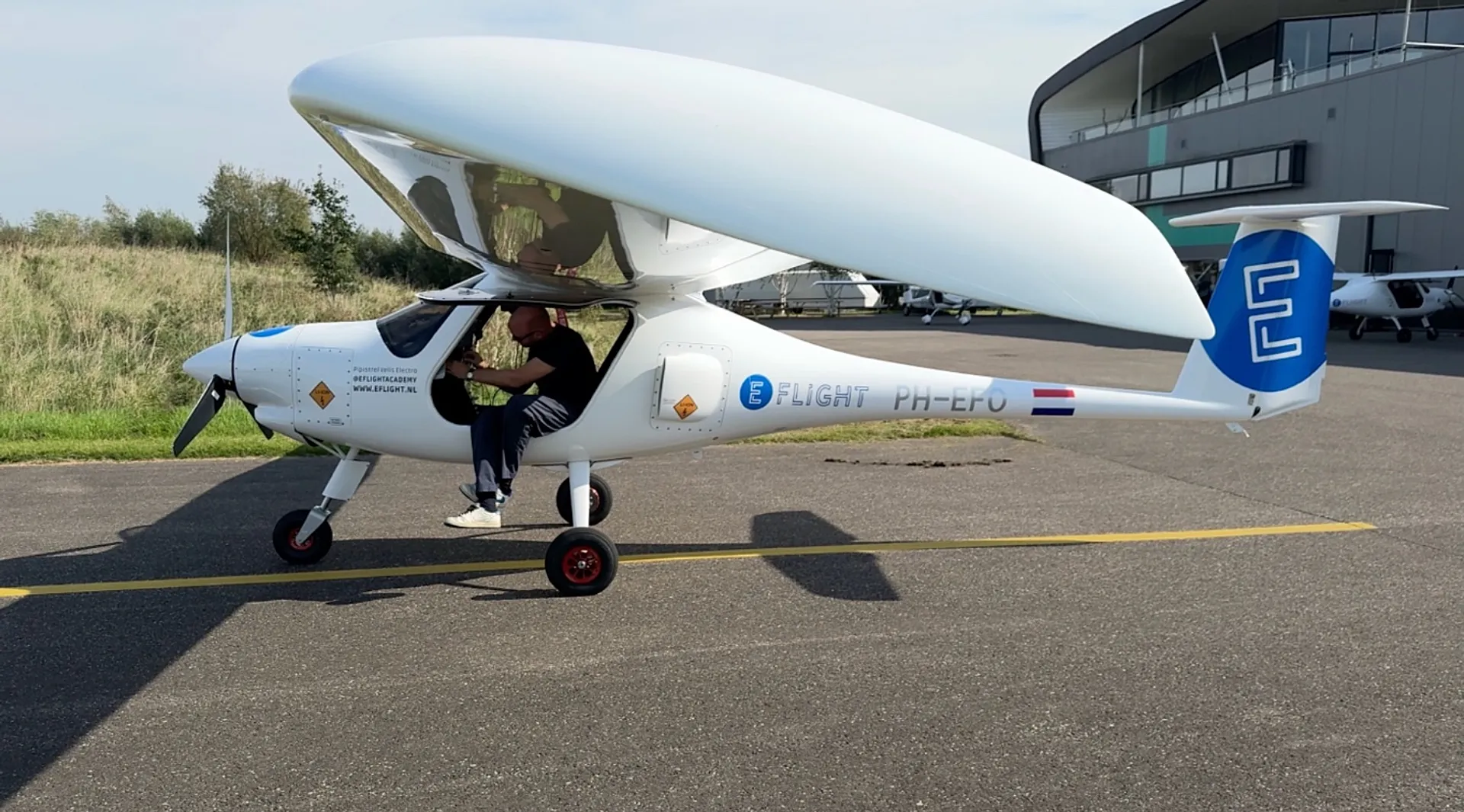
While large electric aircraft remain under development, electric flight is already being used for pilot training in the Netherlands. At Teuge regional airport, the E-Flight Academy operates small two-seat aircraft powered entirely by batteries today.
Co-founder Merlijn van Vliet explained that the training aircraft carries two batteries, each providing 11 kilowatt-hours of energy. With 22 kilowatt-hours available, the aircraft can fly for roughly 45 to 50 minutes while retaining a ten-minute reserve.
During a demonstration flight, the aircraft travelled above green Dutch countryside and followed a river towards the historic city centre of Deventer. Van Vliet said the aircraft’s low noise allows pilots to fly without significantly disturbing people on the ground.
The academy’s experience has strengthened its belief that electric aviation could expand considerably. Van Vliet predicts that within a decade, aircraft carrying 40 or 60 passengers, or potentially more, could begin operating on electric power.
The flight school’s electric aircraft have already accumulated almost half a million air miles, providing pilots and technicians with practical experience of battery-powered operations. That experience could become increasingly valuable as larger electric aircraft move from concepts toward certification.
Technology alone, however, will not determine whether electric aviation becomes commercially viable. Aircraft will also require reliable charging networks capable of delivering large amounts of electricity quickly, particularly at regional airports where conventional aviation infrastructure may be limited.
That challenge is being addressed by NRG2fly, which is developing an electric aircraft charging network across Europe. Co-founder Jurjen de Jong said the company plans to expand from the Netherlands into Nordic countries, France, Germany and Switzerland.
The wider vision involves connecting airports, renewable generation, electric vehicles and stationary batteries into integrated energy hubs. Airports already contain extensive parking areas, creating opportunities to combine solar panels, vehicle charging and energy storage within one coordinated system.
Teuge airport is testing such an approach with about 500 solar panels installed on its rooftop. Their electricity can be stored in batteries, creating an energy hub designed to supply aircraft while reducing dependence on wider grid power.
De Jong describes the concept as an ‘internet of energy’, where sources and storage systems operate together. Such infrastructure could become important if electric aircraft require rapid charging between flights and regional airports handle increasing numbers of battery-powered operations.
Supporters of electric aviation argue that regional aircraft provide a realistic starting point because shorter routes require less energy than long-haul services. If battery technology improves sufficiently, aircraft like the E9X could eventually connect cities without conventional jet fuel.
For Elysian, the objective is not simply to build an electric aircraft but to demonstrate that battery propulsion can work at commercial scale. Its demonstrator flights are intended to show that the ambitious E9X architecture can progress beyond computer models.
The Netherlands is becoming a testing ground for several parts of the electric aviation ecosystem, from pilot training and aircraft design to renewable charging infrastructure. Whether these projects reach commercial scale will depend on engineering progress and sustained investment.
For passengers, the most visible change could eventually be quieter regional flights with fewer direct emissions during operation. For manufacturers and airports, electric aviation represents a transformation involving aircraft design, energy systems, charging networks and new operational procedures.
The E9X remains under development, and its planned 2034 entry into service depends on challenges that have not yet been solved. Yet the first demonstrator flights and growing training activity show electric aviation moving beyond theory in the Netherlands.
This article was created using automation technology and was thoroughly edited and fact-checked by one of our editorial staff members