



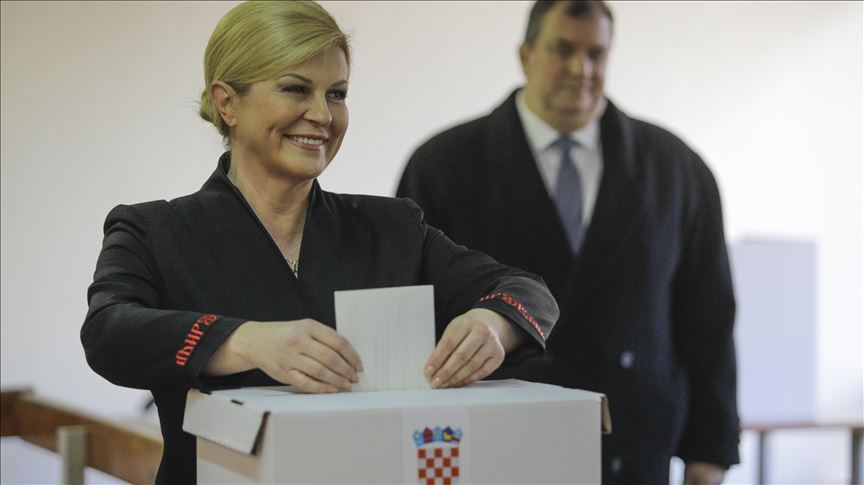

Ballots opened in Croatia on Sunday in a tense election runoff to elect their next president.
Electors will opt among the incumbent conservative and a left-wing rival in what critics say is an unpredictable run with no explicit preference appearing from fresh polls.
It appears just days after the nation took over the presidency of the European Union, indicating the winner will be a compelling character on the European stage just as the bloc wrestles with the accession of Albania and North Macedonia and the departure of Britain.
Members of the European Commission are due to visit Zagreb on Thursday (January 9).
The runoff falls in the middle of a winter holiday week in which thousands of Croatians traditionally head across the border to Italy to ski. However, it is unclear how this would impact the result.
Social media users have been tracking the election with the hashtag #izboriRH
Kolinda Grabar-Kitarović, a former Croatian diplomat to the United States, is going for a second term as the front-runner for the ruling conservative Croatian Democratic Union (HDZ), which is allied to the European People’s Party (EPP) in the European Parliament.
The 51-year-old became the country’s first post-independence female president in 2015 and also the youngest.
She is a mother of two, including a daughter who is an acknowledged figure skater, speaks languages and is a practising Catholic who opposes same-sex marriage,
Her contender is Zoran Milanović, a former prime minister of Croatia and leader of the centre-left Social Democratic Party of Croatia (SDP), which is part of the Party of European Socialists in the European parliament.
Like Grabar-Kitarović, the 53-year-old is also a former diplomat, having worked in the Croatian foreign ministry before enrolling into politics. He was also an advisor at the Croatian Mission to the European Union and NATO in Brussels and is also has a master’s degree in EU law.
In December, he became the first presidential candidate in Croatian history to get more votes in the first round of an election than the incumbent president.
As prime minister, Milanović introduced liberal reforms including health education in schools and an expansion of rights for same-sex couples.