



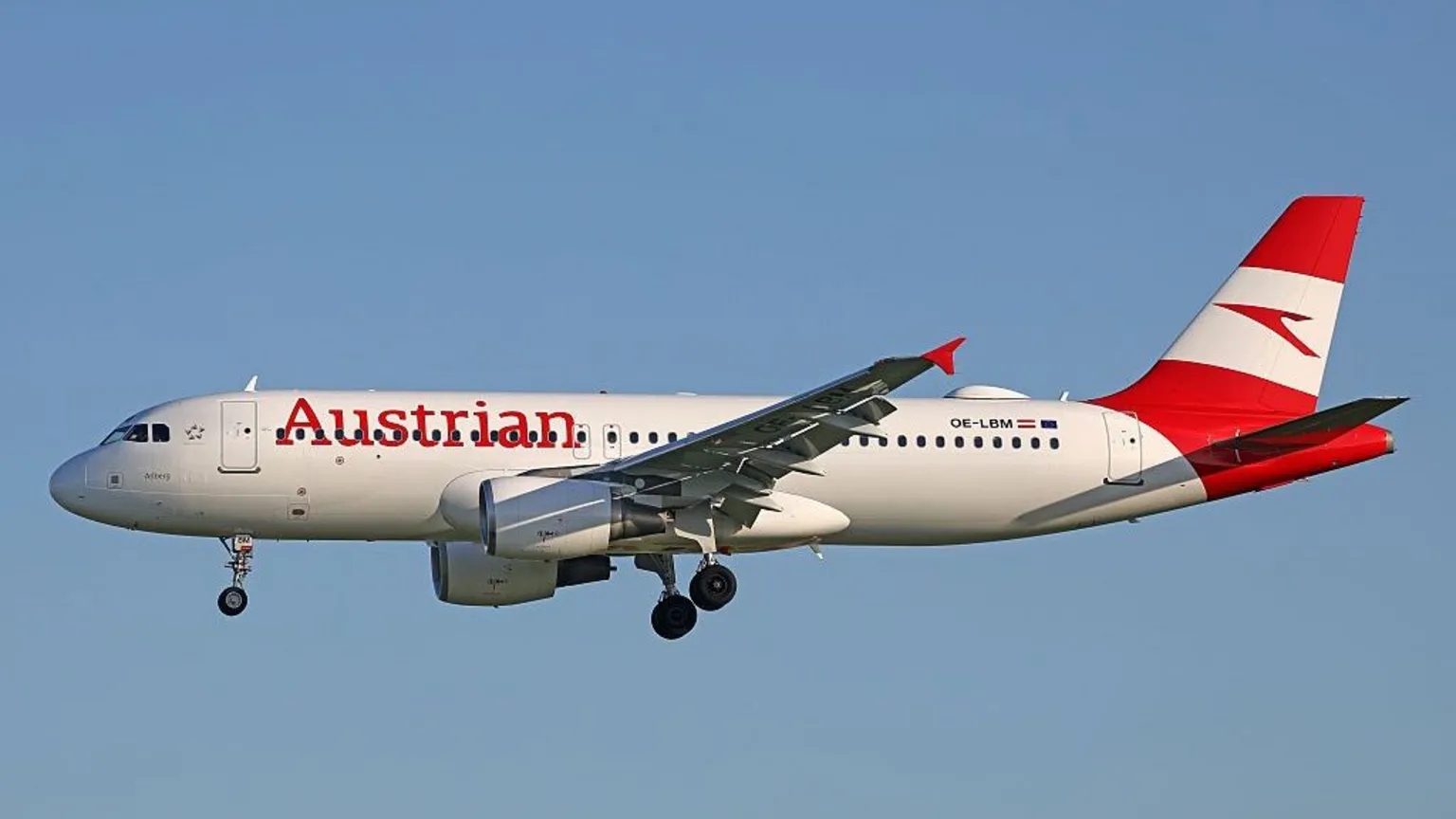

Bulgaria — Sofia: Austrian Airlines flight from Israel lands safely after bomb threat, prompting fighter escort and emergency passenger evacuation
An Austrian Airlines flight travelling from Tel Aviv to Vienna was diverted to Bulgaria after authorities received a reported bomb threat, forcing the Airbus A320 to make an emergency landing in Sofia. Passengers and crew were safely evacuated after arrival.
The incident occurred on Sunday evening as Austrian Airlines flight 82 departed Ben Gurion Airport in Tel Aviv for Vienna. The aircraft was carrying 51 passengers and six crew members when the reported threat was raised during the journey.
According to Bulgaria’s transport ministry, the aircraft was over Romanian airspace when its crew diverted toward Sofia. The emergency landing took place at Vasil Levski Airport, with Bulgarian authorities immediately beginning security procedures after the aircraft reached the ground.
The Bulgarian Air Force also scrambled a MiG-29 fighter jet to escort the passenger aircraft during the incident. The deployment reflected the seriousness with which authorities treated the reported security alert involving the international commercial flight.
Passengers were evacuated from the aircraft after it landed, while security personnel began examining the Airbus A320. Authorities said the security response began approximately 30 minutes after the initial alert was raised, allowing the aircraft to be isolated and searched.
Bulgarian and Israeli media reported that the alert involved a bomb threat. Austrian Airlines subsequently confirmed that a threat had been made, although the airline did not immediately provide additional information about its nature or the circumstances surrounding the warning.
An Austrian Airlines spokesperson confirmed to the BBC that 51 passengers and six crew members were travelling aboard the aircraft. No injuries were reported during the diversion, landing, evacuation or subsequent security operation conducted at the Bulgarian airport.
The aircraft’s arrival in Sofia temporarily interrupted its scheduled journey between Israel and Austria. Instead of continuing directly west toward Vienna, the crew diverted toward Bulgaria, where emergency procedures could be carried out under the supervision of local authorities.
A security search was conducted after the plane landed, with authorities examining the aircraft for any potentially dangerous device. The operation was completed without authorities discovering evidence supporting the reported bomb threat aboard the passenger aircraft.
Austrian Airlines later confirmed that no threat was found during the search. Following the security checks, the aircraft was cleared to continue its journey, allowing passengers and crew to remain aboard as the flight proceeded toward Vienna.
Flight tracking data indicated that Austrian Airlines flight 82 departed Ben Gurion Airport on Sunday evening. The aircraft subsequently landed at Vasil Levski Airport in Sofia approximately three hours after departure, following its diversion from the original route.
The incident highlights the extensive procedures followed when airlines receive threats involving commercial aircraft. Even when authorities cannot immediately establish whether an alert is credible, flights can be diverted while specialist teams assess the situation and protect passengers.
Bulgaria’s decision to scramble a MiG-29 underscored the national security dimension of the incident. Fighter aircraft can be deployed when authorities require additional monitoring or reassurance during unusual circumstances involving civilian aircraft entering national airspace.
The response also involved airport security personnel and other authorities responsible for handling aviation emergencies. Their priority was to secure the aircraft, remove passengers safely and establish whether the reported threat represented an actual danger.
The incident comes during a period of heightened attention surrounding aviation security in Europe and the wider region. Several recent events have demonstrated how quickly apparently unusual signals or threats can trigger major responses from airlines and national authorities.
Last month, a Flydubai flight travelling toward Tel Aviv was involved in a separate security incident after a pilot allegedly attempted to hijack the aircraft. The pilot reportedly attacked the captain before passengers and crew managed to overpower him.
The Flydubai aircraft was subsequently landed safely in Saudi Arabia. That incident attracted international attention because it involved an alleged attempt to seize control of a commercial passenger aircraft while it was travelling toward Israel.
Although the circumstances surrounding the Austrian Airlines flight are different, the incidents share a broader aviation-security context. Authorities remain particularly alert to potential threats involving flights connected with Israel, given the region’s continuing security concerns and heightened tensions.
The Austrian Airlines aircraft ultimately continued its journey after Bulgarian authorities determined that no threat had been found. Passengers were therefore able to complete their planned travel to Vienna following the unexpected interruption in Sofia.
The episode also demonstrates how a reported threat can affect an aircraft even when no dangerous device is ultimately discovered. Aviation authorities generally have to respond immediately, because delaying action could create unnecessary risks for passengers, crew and people on the ground.
Another recent European aviation incident occurred last week when Croatia and Germany scrambled fighter jets following an accidental hijacking alert from a commercial flight. The aircraft was travelling from Corfu, a popular Greek holiday destination, to Nuremberg in Germany.
In that case, the alert was reportedly sent accidentally, but the unusual signal prompted military authorities to respond. Such incidents demonstrate the close coordination between civilian aviation operators and national defence authorities when aircraft generate potential security warnings.
The Austrian Airlines diversion similarly required coordination between the airline, Bulgarian aviation authorities, airport security personnel and military officials. Each organisation had a separate role in ensuring that the aircraft could be safely assessed before its passengers continued travelling.
For passengers aboard the Tel Aviv-to-Vienna service, the incident transformed an ordinary international journey into an unexpected emergency stop. They were removed from the aircraft while authorities investigated, but the operation ended without reported injuries or confirmation of an explosive device.
The aircraft’s eventual continuation to Vienna provided a relatively reassuring conclusion to the incident. Once the security search established that no threat was present, passengers and crew were permitted to resume their journey rather than remain stranded in Sofia.
Authorities are expected to investigate the origin and credibility of the reported threat. Such investigations can help determine how the alert was generated, whether it was deliberate or accidental, and whether further security measures may be required.
For Austrian Airlines, the incident adds another example of the unpredictable security challenges faced by international carriers. Airlines must respond to threats rapidly while balancing passenger safety, operational disruption and cooperation with authorities in multiple countries.
The diversion also demonstrates the importance of contingency planning for airlines operating routes through politically sensitive regions. Crews must be prepared to change course quickly and land at alternative airports when circumstances make continuing the planned route inappropriate.
Despite the disruption, the most significant outcome was that no injuries were reported and no threat was found aboard the aircraft. The flight was eventually able to continue, bringing passengers safely toward their original destination in Vienna.
The Sofia diversion therefore ended without the worst-case scenario feared when the alert was first received. However, the rapid military and civilian response illustrates why aviation authorities continue treating every reported threat seriously until trained security teams can establish that passengers and aircraft are safe.
This article was created using automation technology and was thoroughly edited and fact-checked by one of our editorial staff members