



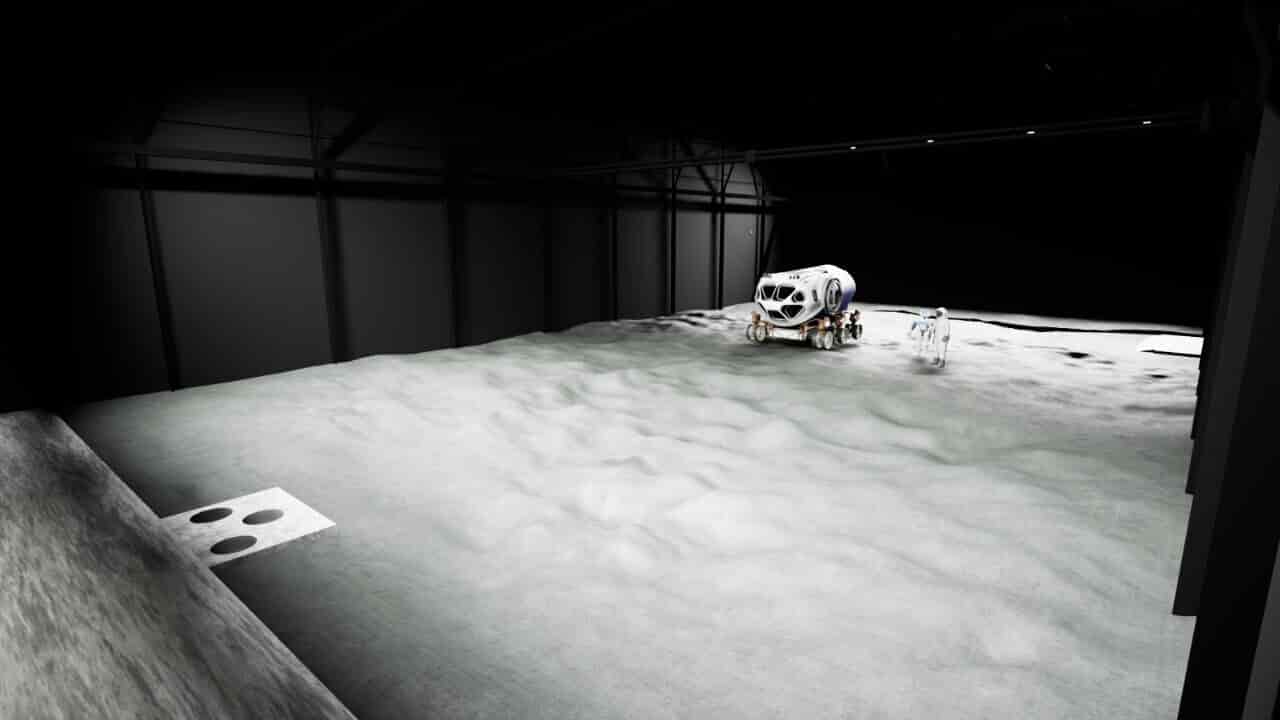

Cologne, Germany— A revolutionary new facility designed to simulate the surface of the Moon is set to place Europe at the forefront of lunar exploration.
Covering nearly 1,000 square meters, this groundbreaking installation offers astronauts an unprecedented opportunity to train for future Moon missions under realistic conditions.
Developed in collaboration with the European Space Agency (ESA) and the German Aerospace Centre, the Luna facility is an ambitious decade-long project aimed at recreating the extreme environment of the Moon’s surface.
Located near Cologne, the facility is poised to be a global hub for astronaut training, welcoming space explorers from around the world.
What initially appears to be a vast, sandy island is, in fact, an advanced lunar simulation area that has no equal anywhere in the world.
The cutting-edge installation will soon be filled with 900 tonnes of lunar dust, providing astronauts and engineers with a hyper-realistic training ground for their missions.
A Realistic Lunar Surface, Right Here on Earth
The Luna facility represents a significant leap forward in space training technology. Its designers, in cooperation with the ESA, have meticulously recreated the Moon’s surface using materials sourced from Norway, Germany, and Italy.
The lunar sand, an essential feature of the facility, is incredibly fine and poses challenges similar to those astronauts will encounter on the actual Moon. This fine dust is hazardous, not just when inhaled by astronauts, but also for sensitive equipment and rovers.
“This installation is unique because here we find everything we’re going to find on the Moon,” said Matthias Maurer, an ESA astronaut and consultant on the project.
“We have lunar sand that is really small and fine, and it’s dangerous if you breathe it in, and also dangerous for the equipment.” Maurer emphasized the importance of such a realistic training environment in preparing astronauts for the rigors of lunar missions.
In addition to the lunar dust, the facility features lunar rocks that are nearly identical to those found on the Moon’s surface. These rocks will help astronauts familiarize themselves with the challenges posed by the Moon’s texture, slopes, and crevices, all of which present hazards for both walking and operating rovers.
Maurer added, “We also have the lunar rocks—rocks that come from the Earth but are really identical to the rocks we’re going to find on the Moon.”
Simulating Moon’s Gravity and Light Conditions
The facility is not just a static environment; it will soon feature a structure capable of simulating the Moon’s gravity. By 2026, the Luna system will allow astronauts to experience the reduced gravity of the Moon through a state-of-the-art rope system. This will help them practice moving in the lunar environment, where gravity is only one-sixth that of Earth.
“A person who weighs 60 kilograms on Earth would weigh just 10 kilograms on the Moon,” Maurer explained. This dramatic difference in weight will be crucial for astronauts to master, as it significantly alters how they move and perform tasks.
The facility will also replicate the Moon’s extreme lighting conditions, particularly those found at the lunar poles. On the Moon, the absence of an atmosphere leads to an intense contrast between light and darkness. Astronauts who have experienced this describe it as disorienting and challenging.
“On the Moon, there is no atmosphere, so there is a very, very sharp contrast between an intense darkness and intense light,” said Samantha Cristoforetti, another ESA astronaut. “People who have experienced it will tell you that it’s challenging. It’s not something we’re used to.”
This stark difference in light is a crucial factor for astronauts to adapt to before they land on the lunar surface, especially as missions target the Moon’s poles, where these extremes are even more pronounced.
A Test Ground for Equipment Manufacturers
While Luna will primarily serve astronauts, the facility will also be invaluable to space equipment manufacturers.
Engineers and manufacturers will be able to test rovers, spacesuits, and other equipment in conditions that closely mimic the Moon’s harsh environment.
The fine lunar dust, in particular, poses a major challenge, as it has the potential to seep into every crack and crevice, damaging vital components.
Juergen Schlutz, one of the engineers working on the project, highlighted the importance of rigorous testing.
“It’s important because we want things to fail on Earth before they fail on the Moon,” he explained. “We want to test everything here to its extreme so that we know how the things are working.”
The facility will allow manufacturers to push their equipment to the limits, ensuring that their designs can withstand the Moon’s extreme conditions.
Equipment will be exposed to the fine dust and tested for resistance to the abrasive material, helping manufacturers refine their products and avoid costly failures during actual missions.
“We want to test everything here to its extreme so that we know how the things are working, how we distribute tasks between astronauts, robots, and teams on the ground. And we want the technologies to be tested in real, realistic environments,” Schlutz added.
Preparing for Extended Lunar Missions
The Luna facility is designed not only to simulate day-to-day activities on the Moon but also to prepare astronauts for longer, more complex missions.
In addition to simulating the Moon’s surface, the installation will feature a lunar base module.
This module will allow astronauts to carry out missions lasting a week or longer in complete isolation, helping them prepare for the psychological and physical challenges of extended lunar exploration.
Such missions will be crucial as space agencies like NASA and ESA look to establish a long-term presence on the Moon.
The lessons learned during these simulated missions will inform future lunar expeditions, including those that aim to set up lunar bases or conduct in-depth exploration of the Moon’s surface.
Global Interest in Luna
Although Luna is a European project, the facility has already attracted interest from space agencies around the world.
Delegations from the United States, Japan, and Canada have all visited the site, recognizing the value of this unique training ground for their own lunar missions.
The Luna facility is part of a broader trend of international cooperation in space exploration. As countries like the U.S. and China ramp up their efforts to return to the Moon, Europe is positioning itself as a leader in lunar research and development.
The Luna project is just one of several initiatives aimed at strengthening Europe’s role in space exploration.
The ultimate goal, as emphasized by the project’s designers, is to give astronauts the feeling that they already have one foot on the Moon before they even leave Earth.
By offering such a realistic and comprehensive training environment, the Luna facility will play a key role in preparing the next generation of astronauts for their missions to the Moon and beyond.
A Giant Leap for Europe
As space exploration enters a new era, with renewed focus on the Moon and potential missions to Mars, Europe is determined to play a central role.
The Luna facility represents a significant step forward in that ambition, offering astronauts and engineers the tools they need to succeed in the harsh environment of space.
Whether through preparing astronauts for the challenges of lunar exploration or testing the next generation of rovers and spacesuits, Luna is set to be a vital component of Europe’s space strategy.
With missions to the Moon becoming an increasing priority for space agencies worldwide, the Luna facility positions Europe at the cutting edge of space exploration.
In the coming years, as astronauts trained at Luna embark on their journeys to the Moon, Europe’s investment in this ambitious project will undoubtedly prove its value, helping to usher in a new era of human space exploration.