



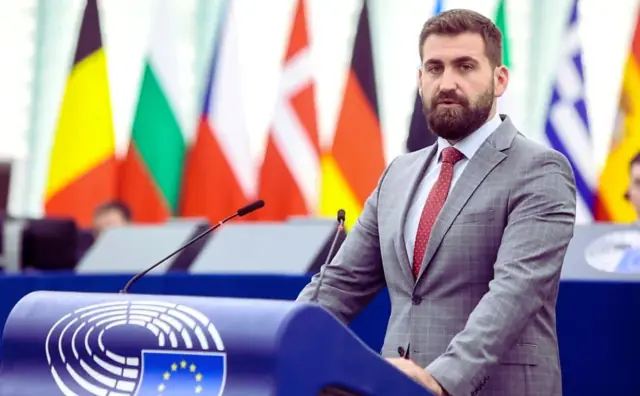

Brussels, Belgium – Bulgarian MEP Andrey Novakov has dismissed speculation about the possible deployment of European military units to Ukraine, stating that such discussions have not taken place within the European Parliament.
In an interview with Bulgarian National Radio (BNR), Novakov, who is a member of the newly formed defense committee, emphasized that Europe must take greater responsibility for its security but reaffirmed that this does not contradict commitments to NATO.
Novakov highlighted the shifting defense dynamics within Europe, noting that no country on the continent is entirely safe from potential threats.
He pointed to Germany as an example, explaining that despite its long-standing historical guilt complex, Berlin has increasingly recognized the need to bolster its defense capabilities.
Europe Must Rely on Its Own Resources
The Bulgarian MEP stressed that Europe will need to depend more on its own resources for defense and security, signaling a growing trend toward strategic autonomy.
According to him, this shift will place defense at the heart of political discussions in the coming years.
He called for an equitable distribution of defense investments across EU member states, arguing that collaboration through the European Defense Fund is key to achieving this goal.
While Europe must take on greater responsibility for its security, Novakov clarified that this should not be seen as a move away from NATO’s framework.
Instead, he suggested that strengthening the EU’s collective defense capabilities complements the alliance’s broader security efforts.
Bulgaria’s Role in European Security
Novakov underlined Bulgaria’s strategic importance in securing one of Europe’s most challenging borders. He noted that the country plays a crucial role in protecting the continent but expressed concerns about the state of its military equipment.
“Our military hardware is 50 years old. It does not inspire confidence in our defense capabilities,” Novakov said, calling for increased investment in modernizing Bulgaria’s armed forces.
He also stressed the need to enhance military mobility, particularly in developing infrastructure that serves both peacetime and wartime needs.
Varied Strategic Priorities Across EU Member States
Despite the growing consensus on the need for stronger defense, Novakov acknowledged that not all EU countries share the same security priorities.
He pointed to Portugal as an example, explaining that as a country bordered only by allied nations and the Atlantic Ocean, it does not face the same defense concerns as Bulgaria, Romania, Poland, and the Baltic states.
These Eastern European nations are directly exposed to potential threats from Kaliningrad and other geopolitical flashpoints.
Common European Army Not on the Agenda
Novakov dismissed the notion that a common European army is under discussion, stating that the immediate focus is on strengthening the collective defense capabilities of individual EU member states. He emphasized the importance of cooperation and investment in defense without compromising national sovereignty.
As security concerns continue to evolve, Novakov’s remarks underscore the EU’s shifting approach to defense policy, with a growing emphasis on self-reliance and strategic coordination among member states.