



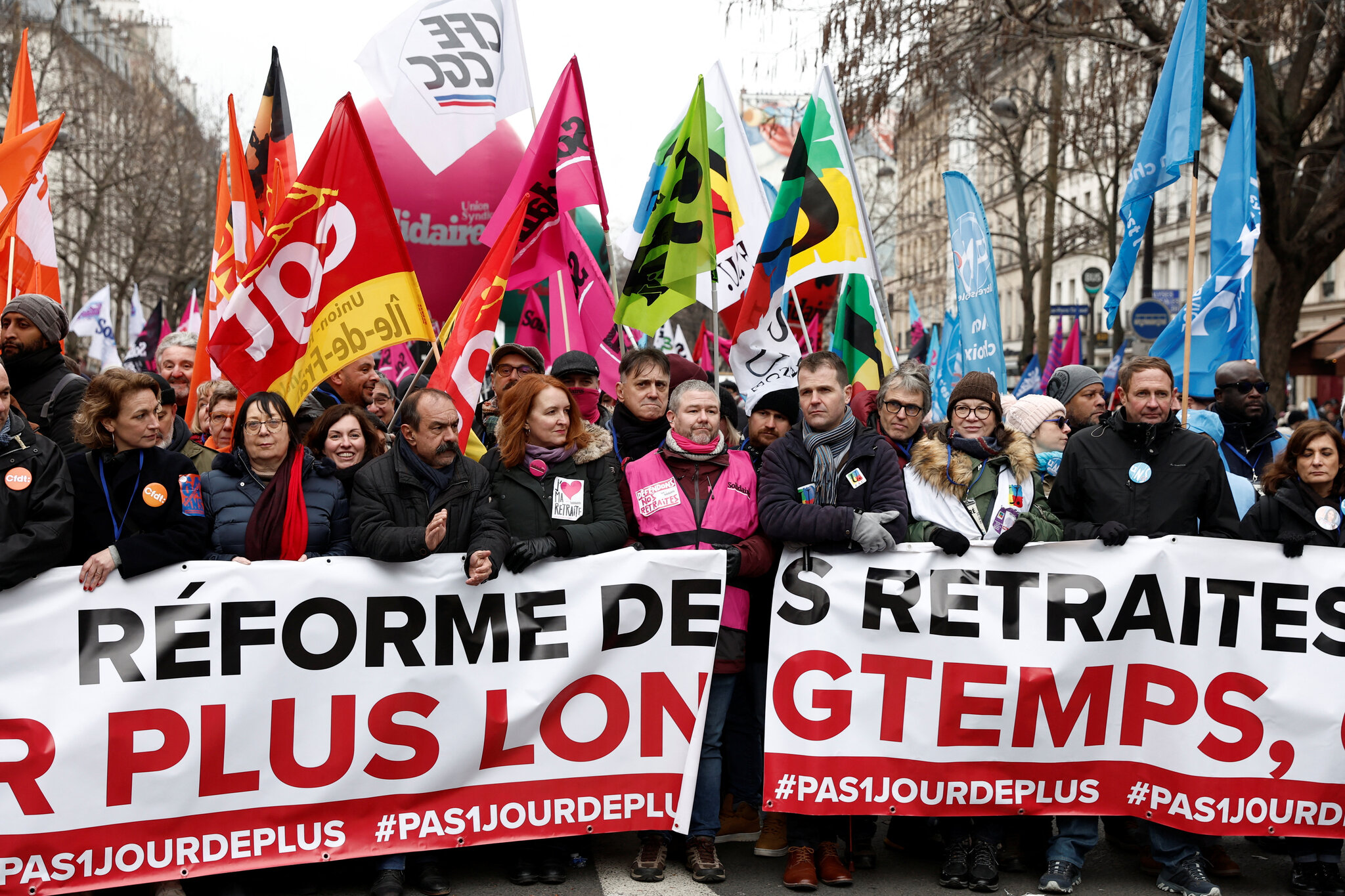

Around 80,000 protesters took to the streets of Paris, and more than 200 other French cities also saw demonstrations. President Emmanuel Macron said that the reforms were “fair and responsible,” but they are now at a point where they will either work or not.
Public transportation was very hard to use during the strikes, and many schools were closed. Train drivers, people who work for the government, and people who work at refineries all walked out of their jobs and joined protests in Nantes, Lyon, Bordeaux, Marseille, and Toulouse.
Philippe Martinez, the head of the large CGT union, said that there were more than two million protesters, which is more than the 1.12 million number given by the government. They said that 400,000 people took part in the biggest march, which started in Paris at Place de la République.
After their first day of action went well, the unions planned another one for January 31. There were a lot of police in Paris in case people from the ultra-left “black bloc” caused trouble, but there were only 38 arrests and few fights. Both the police and the unions were praised by Prime Minister Élisabeth Borne for how “well” the protests went.
As few as one in ten trains ran on some rail lines, and only a skeleton service ran on the Paris metro.
The main secondary school teachers’ union said that 65% of teachers were on strike, but the education ministry said that only 35% of teachers were on strike. Under the plans the prime minister laid out earlier this month, people will have to work 43 years instead of 42 years to get a full pension in 2027.
The government says this reform is important to protect France’s share-out pension system, but an IFOP poll this week found that 68% of the public is against it.
All of the country’s unions, including so-called “reformist” unions that the government had hoped to win over, as well as the left-wing and far-right oppositions in the National Assembly, have spoken out against the measure.
Because his Renaissance party doesn’t have a majority in the Assembly, President Macron will have to rely on the conservative Republicans party, which has about 60 MPs. Even though they are for pension reform in general, some have said they might vote against it.
Since the process in parliament is expected to take a few weeks, Mr. Macron will have to deal with an ongoing campaign of opposition.