




More than 300 earthquakes were recorded across the UK in 2025, according to new data released by the British Geological Survey (BGS), marking a year of heightened seismic monitoring and public interest.
Figures show that by 18 December, a total of 309 earthquakes had been detected nationwide. This means the UK experienced seismic activity “almost once a day” on average, according to seismologist Brian Baptie.
The strongest earthquakes of the year occurred just hours apart near Loch Lyon in Perth and Kinross, Scotland. On 20 October, a magnitude 3.7 tremor was recorded, followed shortly afterwards by another measuring 3.6.
BGS data indicates that 34 earthquakes were detected near Loch Lyon between October and December alone. The cluster made the area one of the most seismically active parts of the UK during the year.
Dr Baptie said western Scotland is naturally more prone to earthquakes compared with other parts of the country. He attributed this to the presence of major geological structures beneath the region.
“The west of Scotland is one of the more active parts of the UK,” he explained. “This is partly due to faults such as the Great Glen Fault and the Highland Boundary Fault.”
By contrast, north-east Scotland experiences very few earthquakes. The variation reflects differences in ancient geological formations and stress points within the Earth’s crust.
Beyond Scotland, southern Wales and parts of northern England also recorded notable seismic activity. Areas of Yorkshire and Lancashire were among those experiencing repeated minor tremors.
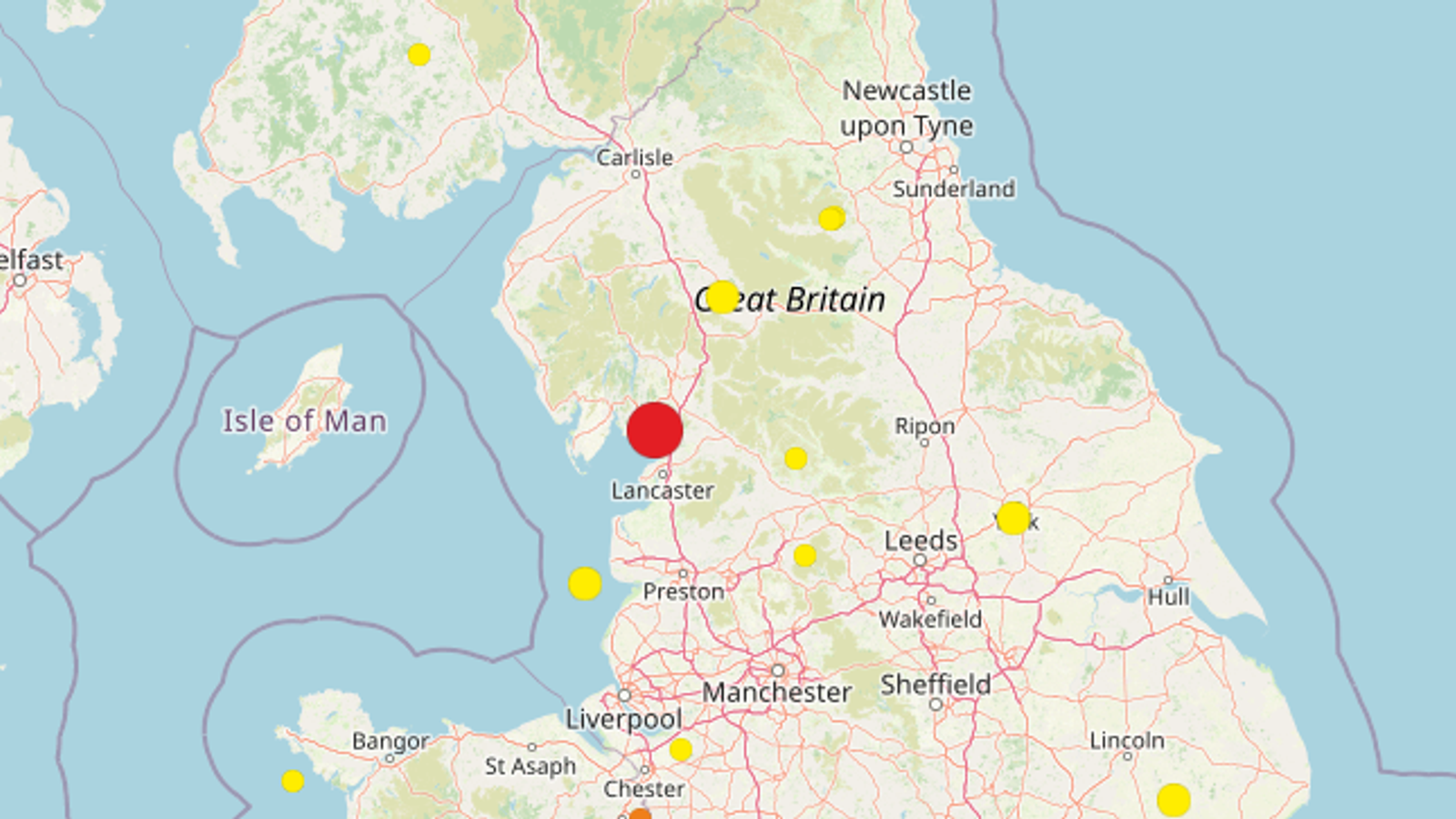
In December, two small earthquakes struck Lancashire within a matter of weeks. One of the tremors, measuring 2.5 in magnitude, had its epicentre off the coast of Silverdale in Morecambe Bay.
The BGS confirmed that this event was an aftershock of a stronger 3.3 magnitude earthquake that hit the same area earlier in the month. Neither quake caused damage, but both were felt locally.
Across the UK, seismic activity is monitored by a network of around 80 stations operated by the BGS. These instruments allow scientists to detect even very small movements in the Earth.
Although the number of recorded earthquakes exceeded 300, experts stressed that most were too weak to be noticed by the public. Typically, the UK experiences between 200 and 300 earthquakes each year.
Of those, only around 20 to 30 are strong enough to be felt or heard. In 2025, however, the BGS received 1,320 reports from members of the public who said they experienced tremors.
These reports are an important source of information for scientists, helping them understand how earthquakes are perceived on the ground and how vibrations travel through different environments.
Historically, earthquakes of magnitude four occur in the UK and surrounding areas every three to four years. Magnitude five events are rarer, happening only every few decades.
The most recent magnitude five earthquake struck Lincolnshire in 2008. Even then, damage was limited, reflecting the generally low seismic risk faced by the UK.
A magnitude six earthquake is considered extremely rare, occurring only every few hundred years. The largest known earthquake affecting the UK happened in 1931 near the Dogger Bank in the North Sea.
That quake measured 6.1 in magnitude and caused minor damage along parts of England’s east coast, despite its epicentre being about 60 miles offshore.
Scientists explain that earthquakes are caused by movements of the tectonic plates that make up the Earth’s surface. Stress builds up as plates move and is released suddenly along faults.
The UK sits within the Eurasian tectonic plate, more than 1,000 miles from the nearest plate boundary. This distance is why the country does not experience the powerful earthquakes seen elsewhere.
Instead, UK earthquakes are usually linked to movements along ancient faults in the Earth’s crust. While mostly small, they continue to remind scientists and residents alike that the ground beneath the UK is far from static.