



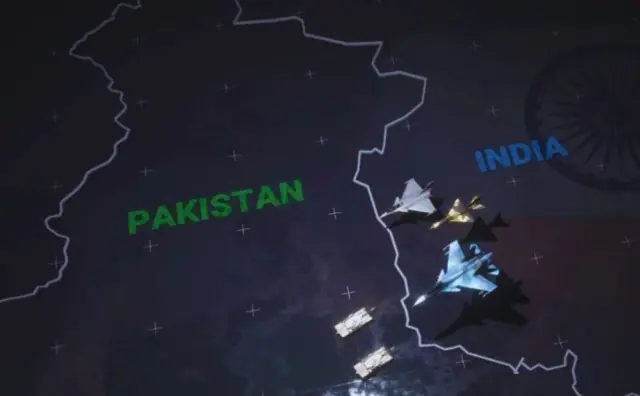

Tensions between nuclear-armed neighbours India and Pakistan flared dangerously this week as both sides exchanged cross-border fire following a series of deadly Indian airstrikes, triggering a sharp escalation in hostilities over the disputed Kashmir region.
The violence erupted after India launched what it described as “precise and non-escalatory” missile strikes targeting alleged terrorist camps in Pakistan.
New Delhi claimed the strikes were in response to a deadly attack on tourists in Indian-administered Kashmir, which left 26 people dead, most of them Hindu pilgrims.
India blamed the Pakistan-based militant group Lashkar-e-Taiba for the assault, a charge Islamabad firmly denies.
Pakistan’s Prime Minister Shehbaz Sharif condemned the Indian strikes, vowing to retaliate “at a time and place of our choosing” and declaring, “We will avenge the blood of the victims.”
The Pakistani military responded by firing across the Line of Control (LoC), the de facto border in Kashmir, resulting in an intense overnight exchange of artillery and small arms fire.
The deadly escalation has so far claimed at least 43 lives on both sides. Pakistan reported 31 civilian deaths due to Indian strikes and shelling, including several children.
In India, authorities acknowledged 12 fatalities from retaliatory Pakistani fire. Witnesses in both countries described scenes of chaos and tragedy.
In Pakistan’s Muzaffarabad, a missile reportedly struck a mosque, while near Poonch in Indian-administered Kashmir, residents like Madasar Choudhary recounted how children were killed by shrapnel when homes were hit.
Among the Indian targets was an Islamic seminary near Bahawalpur, where 13 people reportedly died.
Islamabad has labelled the strikes as “acts of war,” while New Delhi maintained they were intended solely to eliminate terrorist infrastructure and avoid civilian casualties.
In a further development, Pakistan’s military claimed to have shot down five Indian fighter jets, though India has not confirmed the losses.
A senior Indian security official admitted that three Indian aircraft had crashed within its territory but did not attribute the incidents to hostile fire.
Defence Minister Rajnath Singh defended India’s actions, saying, “Our strikes were necessary and measured. We cannot allow terrorists to operate with impunity.”
Pakistan, however, insisted it retains the right to respond militarily, further fueling fears of a wider conflict.
The international community has voiced concern over the escalating hostilities. U.S. President Donald Trump called for calm and urged both countries to exercise restraint.
Meanwhile, Iranian Foreign Minister Abbas Araghchi visited both capitals in an effort to mediate, warning that further conflict could destabilize the region.
Though the situation remains volatile, analysts believe both India and Pakistan may ultimately avoid full-scale war. “Retaliatory posturing is almost inevitable,” said regional security expert Dr. Farah Khan. “But neither side wants to risk uncontrolled escalation.”
Kashmir has been a flashpoint between the two nations since their partition in 1947, sparking multiple wars and countless skirmishes.
The current crisis underscores the enduring volatility of the region — and the fragility of peace between two long-standing adversaries.
As the world watches anxiously, hopes remain that diplomacy will once again prevail over war.