



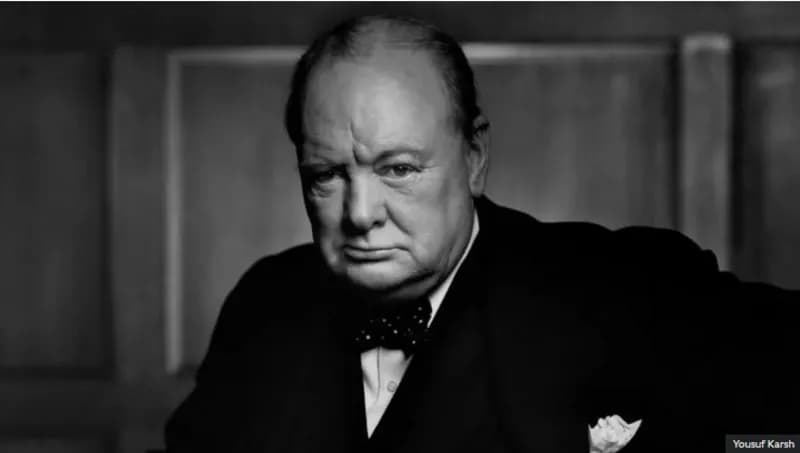

An original print of the iconic Winston Churchill photograph, known as “The Roaring Lion,” has been recovered in Italy after being stolen from a prestigious Ottawa hotel and replaced with a counterfeit, Ottawa police announced Wednesday. The 1941 portrait, captured by renowned photographer Yousuf Karsh, depicts Churchill moments after delivering a wartime speech to Canada’s parliament.
Ottawa police revealed that the stolen photograph was found in the possession of an unsuspecting private buyer in Genoa, Italy. The buyer, who had purchased the artwork in good faith, was unaware of its stolen status. The photograph, a hallmark of historical portraiture, had been sold through an auction house in London before making its way to Italy.
The recovery of the portrait followed the arrest of a 43-year-old man from Powassan, Ontario. The individual, whose identity is protected by a publication ban, faces multiple charges in Canada, including forgery, theft, trafficking, and damage to property. The suspect was apprehended on April 25, 2024, and appeared in an Ottawa court the following day.
The photograph’s theft was first discovered on August 19, 2022, when a staff member at the Château Laurier hotel noticed that the original print had been replaced with a fake. According to hotel management, the theft occurred between December 25, 2021, and January 6, 2022, during stringent Covid-19 lockdowns.
“We are deeply saddened by this brazen act,” said the hotel’s general manager in a statement released at the time of the discovery. The photograph, one of the most recognizable images of Churchill, had been prominently displayed in the hotel’s lobby for years.
The theft of “The Roaring Lion” caused a significant stir within the art and historical communities. The photograph, which captures Churchill with a defiant scowl after Karsh famously removed a cigar from his mouth, is not only a piece of wartime history but also appears on the UK £5 banknote. The portrait’s dramatic backstory adds to its historical significance.
Karsh’s recount of the iconic moment reveals the photographer’s persistence and Churchill’s formidable presence. Karsh described the interaction: “I held out an ashtray, but he would not dispose of it…I waited; he continued to chomp vigorously at his cigar. I waited. Then I stepped toward him and, without premeditation, but ever respectfully, I said ‘forgive me sir’ and plucked the cigar from his mouth.” According to Karsh, Churchill’s reaction was so intense that he looked “belligerent enough to devour” the photographer.
Investigators believe that the portrait was sold through an auction house in London, where it was subsequently acquired by the private buyer in Italy. Both the auction house and the buyer were unaware that the piece was stolen. Ottawa police used forensic analysis, public tips, and “open-source research” to trace the artwork and identify the suspect.
Canadian investigators are preparing to travel to Rome later this month for a ceremony in which the unidentified buyer will formally return the stolen portrait. This final step will mark the portrait’s return to Ottawa, where it will once again be displayed at the Fairmont Château Laurier.
In a statement, police emphasized the significance of the portrait’s return: “Once in Ottawa Police custody, the portrait will be ready for the last step of its journey home to the Fairmont Château Laurier, where it will once again be displayed as a notable historic portrait.”
The case highlights the challenges and intricacies of art theft investigations, particularly involving high-profile pieces with significant historical value. The successful recovery of “The Roaring Lion” underscores the importance of international cooperation and diligent investigative work in preserving cultural heritage.
The return of the photograph is not only a victory for Ottawa police but also for the broader historical and art communities, reaffirming the commitment to protecting and recovering invaluable cultural assets.