



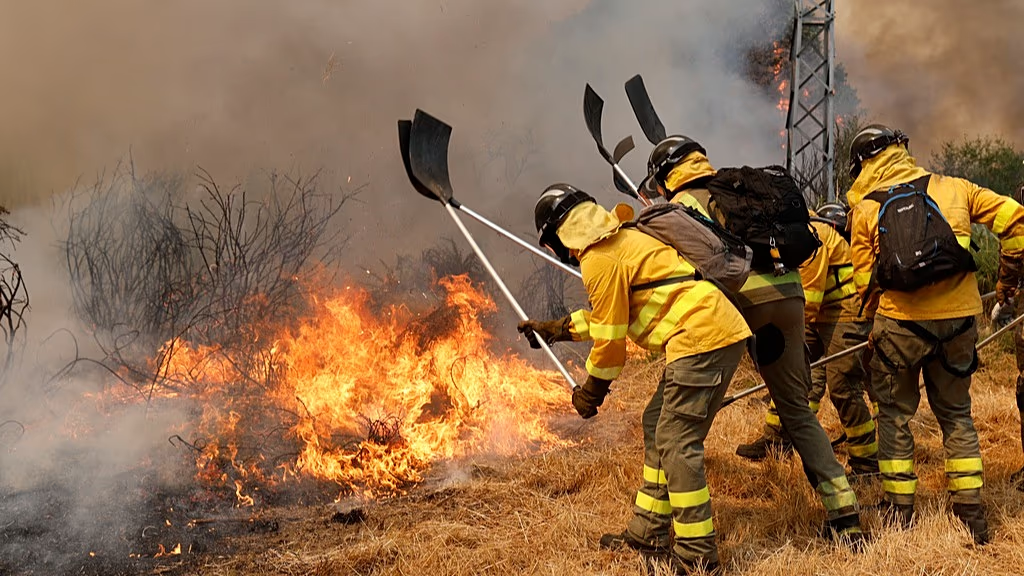

Spanish firefighters are locked in an intense struggle against 12 major wildfires in the northwestern Galicia region, as much of southern Europe reels from a record-breaking heatwave that has pushed temperatures to dangerous extremes and intensified the spread of blazes.
Prime Minister Pedro Sánchez announced on Saturday that an additional 500 soldiers would be deployed to assist in combating the fires, supplementing more than 1,400 troops already working in wildfire operations.
The government’s decision comes as authorities brace for worsening conditions, with Spain’s national weather agency forecasting highs of up to 45°C in some areas on Sunday.
Galicia Under Siege
The most severe fires are concentrated in the province of Ourense, where flames have raged across parched woodland for more than a week. Alfonso Rueda, president of the Galician regional government, warned that homes remain under threat, forcing lockdowns and evacuations in several rural communities.
“Homes are still under threat so we have lockdowns in place and are carrying out evacuations,” Rueda said in a joint press conference with Sánchez. “Galicia has been battling the spreading flames for more than a week.”
Firefighters working on the frontlines have been supported by planes and helicopters dropping thousands of liters of water, yet many fires remain uncontrolled. Local authorities have urged residents to stay indoors, wear masks to avoid inhaling smoke and ash, and limit exposure to extreme outdoor temperatures.
The blazes have already destroyed an area equivalent in size to metropolitan London. According to the EU’s European Forest Fire Information System, Spanish wildfires in 2025 have consumed 3,430 square kilometers of land — far surpassing last year’s totals and making this one of the country’s most destructive wildfire seasons in recent memory.
Record Temperatures Drive Crisis
Spain is not alone in experiencing unprecedented heat. On Saturday, the southern city of Córdoba recorded 44.7°C, one of the highest temperatures ever documented in the country.
The national weather agency AEMET has issued warnings that the “danger of wildfires is extreme in most of the country” as temperatures soar.
Scientists have long warned that climate change is fueling such disasters. Studies show that Europe has been warming at twice the global average since the 1980s, increasing the frequency of droughts, dry conditions, and heatwaves.
These factors have turned large areas of the Mediterranean into tinderboxes, primed to ignite under even the smallest spark.
Reinforcements from Europe
Madrid has appealed for and begun receiving international aid through the European Union’s Civil Protection Mechanism. Aircraft from France and Italy are already operating in Spain, while two Dutch water-bombing planes are expected to arrive imminently.
Spain’s Civil Protection Agency chief, Virginia Barcones, confirmed that firefighters from other European countries would also join efforts in the coming days, reflecting a growing sense of solidarity as the continent confronts increasingly shared climate challenges.
National rail operator Renfe suspended high-speed train services between Madrid and Galicia on Sunday, citing safety concerns due to active fires along the route. It remains unclear when rail operations will resume.
Portugal Struggles with Fires of Its Own
Neighboring Portugal has also been hit hard by wildfires. The country enacted a national state of alert on 2 August, which remained in effect until Sunday, as thousands of firefighters battled dozens of blazes across parched landscapes.
According to preliminary data from the Portuguese Institute for the Conservation of Nature and Forests, approximately 1,390 square kilometers of land have burned so far this year — 17 times more than in 2024.
Portugal’s government deployed more than 4,000 firefighters, 1,300 vehicles, and 17 aircraft in recent days. Sweden also pledged firefighting planes, though Portugal expects cooler weather in the coming week to help ease the strain.
Mediterranean Wildfires Stretch EU Resources
Spain and Portugal are not alone. Greece, Bulgaria, Montenegro, and Albania have all requested assistance from the EU’s emergency firefighting force in recent days. Officials note that the force has already been deployed as many times this year as during the entirety of last summer’s fire season.
This surge in wildfire activity underscores the mounting pressure on European governments to strengthen both their immediate response capacities and long-term climate resilience strategies.
Gallipoli Memorials at Risk in Turkey
In Turkey, recent wildfires have claimed 19 lives, and new blazes have now threatened the historic Gallipoli Peninsula — a site of profound national and international importance.
Authorities evacuated six villages in the northwestern province of Çanakkale on Sunday, fearing flames could spread toward memorials and cemeteries commemorating World War I’s Gallipoli campaign. The site, visited annually by thousands from Turkey, Australia, and New Zealand, closed its visitor facilities as a precaution.
Mayor Omer Toraman said around 1,300 firefighters, backed by 30 aircraft, were engaged in fighting the fires, which have spread rapidly due to dry conditions and strong winds.
Turkey has faced hundreds of wildfires since late June, driven by soaring temperatures and drought. The latest outbreak near Gallipoli highlights how even areas of cultural and historical significance are not immune to the impacts of climate change and natural disasters.
A Summer of Flames
From Spain’s Galicia to Portugal’s forests and Turkey’s Gallipoli Peninsula, the summer of 2025 has seen wildfires spread with ferocity across southern Europe and beyond.
While international cooperation and emergency deployments are helping countries weather the crisis, scientists and policymakers alike stress that long-term solutions must be prioritized.
Climate experts warn that unless greenhouse gas emissions are dramatically reduced, Mediterranean summers will only grow hotter, drier, and more dangerous, leaving communities more vulnerable to deadly blazes.
For now, the immediate priority remains containing the flames threatening lives, livelihoods, and cultural landmarks. But as smoke rises over Galicia’s hillsides and Turkey’s historic coastlines, Europe faces a stark reminder of the urgent need to adapt and act in the face of a warming planet.
This article was created using automation technology and was thoroughly edited and fact-checked by one of our editorial staff members