



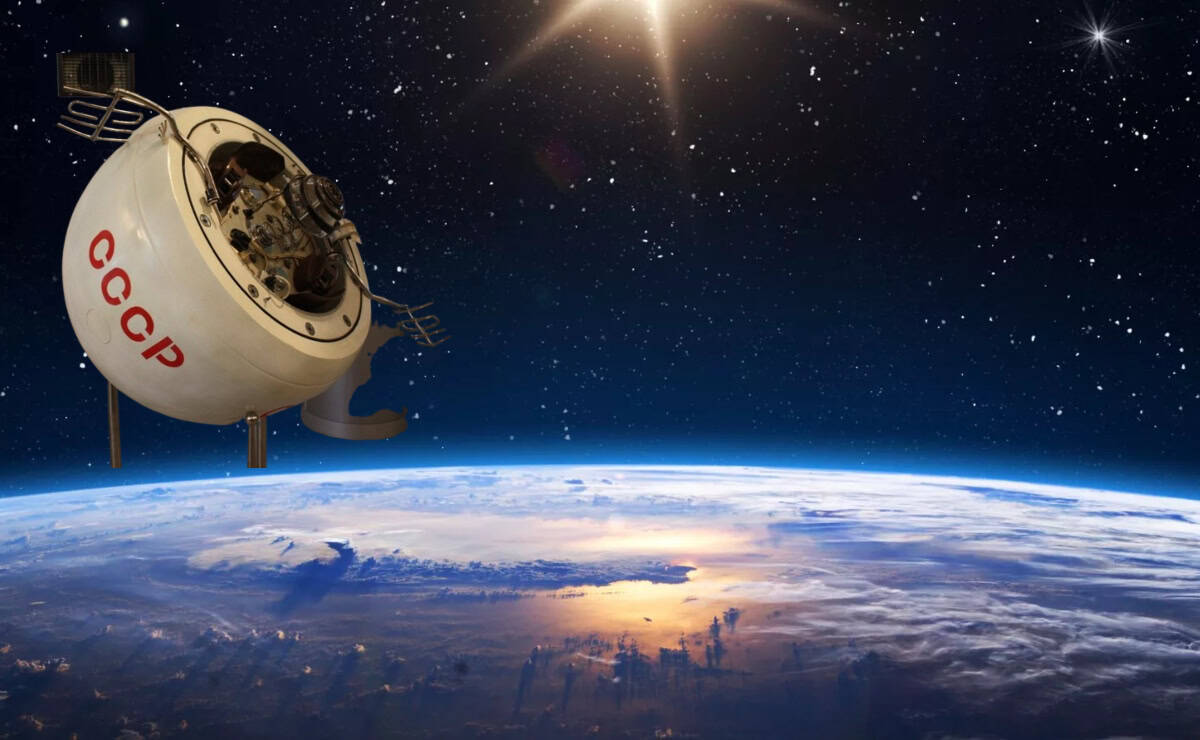

A Soviet-era spacecraft originally intended for a Venus landing could make an uncontrolled re-entry into Earth’s atmosphere as early as May 10, raising limited but notable concerns among space debris trackers and scientists.
Launched in 1972, Kosmos 482 was part of the Soviet Union’s ambitious series of missions to Venus. However, due to a rocket malfunction shortly after launch, the probe failed to escape Earth’s orbit.
While much of the spacecraft disintegrated or fell back to Earth within a decade, the descent capsule — a nearly 500-kilogram metal sphere — has remained in a highly elliptical orbit for 53 years.
Experts now predict that the ageing capsule, originally designed to withstand Venus’ crushing carbon dioxide-rich atmosphere, is gradually losing altitude and will soon re-enter Earth’s atmosphere in an uncontrolled descent.
“It’s likely to re-enter around May 10,” said Marco Langbroek, a satellite tracking specialist from Delft University of Technology in the Netherlands. “It will be traveling at around 242 kilometres per hour, assuming it survives re-entry.”
Langbroek, along with other researchers, emphasizes that while the re-entry poses some risks, the probability of the spacecraft causing harm on Earth remains extremely low.
“The risk is comparable to that of being struck by a meteorite, which happens several times a year globally,” he said. “You run a bigger risk of getting hit by lightning in your lifetime.”
Jonathan McDowell, an astrophysicist at the Harvard-Smithsonian Center for Astrophysics, pointed out that it would actually be preferable if the spacecraft’s heat shield failed, causing it to burn up in the atmosphere. “But if the heat shield holds,” he warned, “you have a half-tonne metal object falling from the sky.”
The re-entry zone spans a broad swath of the planet between 51.7 degrees north and south latitude, a range that includes cities like London and Edmonton, and extends down to the southern tip of South America.
However, Langbroek notes that “most of Earth’s surface is ocean, so there’s a good chance it will splash down harmlessly in water.”
The Kosmos 482 capsule, built as part of the same design lineage as the successful Venera landers, was engineered to withstand Venusian conditions — including intense heat and pressure. This robust construction raises the possibility that significant portions of the spacecraft could survive re-entry.
Yet many of its critical systems, including the parachute, are unlikely to function after more than half a century in space. “The heat shield may also be compromised,” Langbroek added.
Kosmos 482 represents a fascinating relic of Cold War space exploration — a mission frozen in time, now hurtling back toward Earth. As scientists continue to monitor its trajectory, the world watches and waits for a potential fireball from the past to light up the skies once more.
Officials advise the public not to panic. While rare, such satellite re-entries are closely observed, and updates will be issued should any credible threats emerge.