




Serbia has entered a significant new political phase after a student-led movement secured a decisive victory in snap parliamentary elections, defeating the political alliance associated with longtime leader Aleksandar Vučić and prompting celebrations across Belgrade, Novi Sad and several other cities.
With preliminary results covering nearly all polling stations, the Student List had secured about 52.7% of the vote, while the alliance led by Vučić received approximately 39.2%. The figures indicated a clear parliamentary majority for the student-backed candidates.
Vučić, who has dominated Serbian politics as president and prime minister for more than a decade, acknowledged the result after the vote count showed his political camp had been decisively overtaken. He said it was clear that his side had lost the election.
The former president had called the snap election after almost two years of demonstrations that began following the collapse of a railway station canopy in Novi Sad in November 2024. The disaster killed 16 people and became a symbol of wider public concerns.
The student movement emerged from those demonstrations, initially focusing on accountability and concerns surrounding corruption and institutional responsibility. Rather than transforming immediately into a conventional political party, activists developed a broad electoral list featuring candidates from different professional and social backgrounds.
Its candidates included doctors, academics, artists, entrepreneurs and activists, while the movement sought to distinguish itself from established political organizations. Students themselves were excluded from standing as candidates, alongside former governing officials and members of established parliamentary opposition parties.
The movement’s campaign appealed to voters dissatisfied with the existing political establishment, presenting the election as an opportunity to pursue institutional reforms and address concerns over corruption. Its manifesto included proposals targeting political influence over public institutions and state enterprises.
Among its stated priorities were removing officials accused of violating rules, addressing pressure against protesters, ending the appointment of political loyalists to public enterprises and reducing political influence over Serbia’s public broadcaster, according to campaign material.
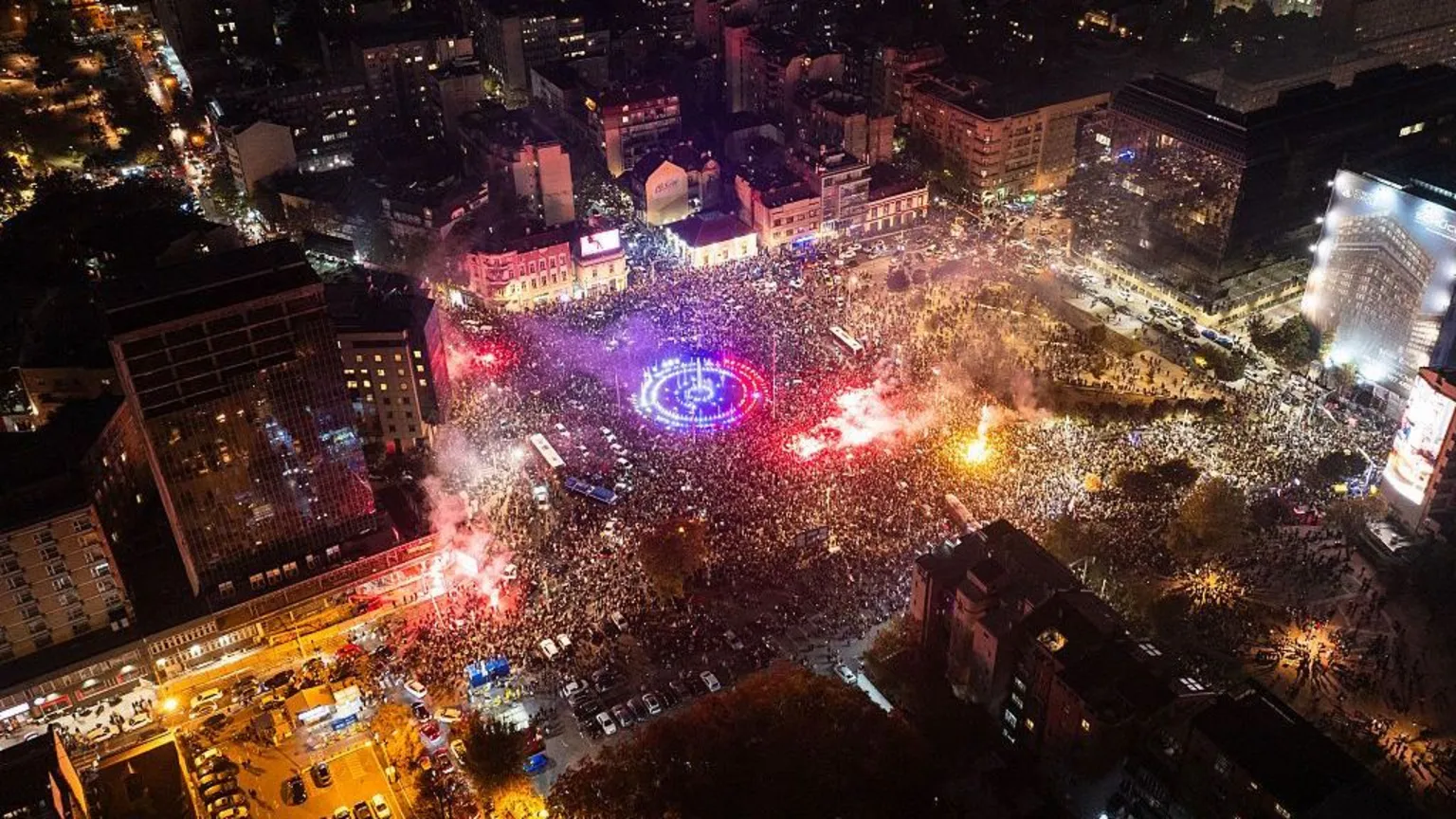
The result was celebrated almost immediately after Vučić conceded defeat. Thousands of people gathered in central Belgrade, with supporters dancing, chanting and sounding car horns, while fireworks and flares illuminated streets as crowds celebrated what they regarded as a major political change.
Similar scenes unfolded in Novi Sad, the northern city where the railway station disaster had triggered the protests. Crowds gathered in the city centre as supporters expressed relief and optimism about the possibility of political change following months of demonstrations and campaigning.
Student List representatives also addressed supporters during celebrations. Candidate Radomir Sajcic said Serbian voters had demonstrated that their determination could overcome obstacles, while other campaign figures described the result as the beginning of a different political period.
The election was particularly significant because Vučić himself could not seek another presidential term after serving two terms. Instead, he led the Serbian Progressive Party and its wider alliance in the parliamentary contest, with the possibility of returning to the premiership.
Vučić first became prime minister in 2014 and later became president in 2017, remaining one of Serbia’s most influential political figures throughout that period. His political camp had maintained control of national institutions for years before the student movement’s electoral breakthrough.
Preliminary figures from Serbia’s Republic Electoral Commission showed the Student List winning 2,267,615 votes, or 52.71%, compared with 1,685,022 votes, or 39.17%, for the Vučić-led United Serbia list. The commission’s figures represented results from 8,187 polling stations.
Those figures translated provisionally into 140 parliamentary seats for the Student List and 104 for the Vučić-backed alliance. Minority parties were also expected to secure representation, meaning the final distribution could differ slightly after all votes and election procedures were completed.
The turnout was also notable. Earlier election data indicated participation of roughly 69%, with more than four million people casting ballots. Long queues were reported at polling stations across Serbia and among Serbian communities abroad, including voters in European cities and the United States.
The election unfolded amid heightened political tensions. Police sealed streets around Serbia’s Republic Electoral Commission headquarters in Belgrade, while supporters and opponents closely monitored the count and awaited indications of whether the student movement could translate its protest campaign into parliamentary power.
The movement’s victory now creates a different challenge: governing. Unlike established parties, the Student List does not have a traditional political hierarchy or a long-established leadership structure. Its candidates will therefore need to determine who can lead the future government.
That question is expected to become one of Serbia’s central political issues in the coming weeks. The movement successfully united voters around demands for change, but its representatives now face the practical responsibilities of managing government institutions, economic policy and international relations.
Serbia’s relationship with the European Union will also attract close attention. The country has maintained its EU candidacy while balancing relations with Russia, and the European Commission’s enlargement leadership welcomed the election result as an opportunity for a new chapter in Serbia’s European integration process.
At the same time, Moscow signalled that it hoped relations between Serbia and Russia would continue. Kremlin spokesperson Dmitry Peskov praised Vučić’s contribution to bilateral ties and said Russia hoped Serbia’s new political forces would understand the importance of cooperation with Moscow.
The election therefore carries implications beyond domestic politics. Serbia occupies an important position in the Balkans, maintains relationships with both European institutions and Russia, and has faced continuing questions over its foreign-policy balance, regional relationships and long-term European integration.
The result also follows a broader period of political change in parts of Europe. Hungary experienced a major change in leadership earlier this year, and Serbia’s student movement has now become another example of a grassroots political force translating sustained public mobilisation into electoral representation.
For supporters gathered in Belgrade, however, the immediate focus remained on the election result rather than its wider geopolitical consequences. Celebrations continued through the night as crowds filled central areas, waving flags, chanting slogans and describing the outcome as a historic moment for Serbia.
Attention will now shift toward government formation and the selection of a prime minister. Serbia’s parliament must organize after the election, while the student-backed representatives face expectations from voters who supported their campaign largely because of promises involving accountability, institutional reform and political transparency.
A presidential election is also scheduled for December, adding another important political contest to Serbia’s rapidly changing landscape. Parliament Speaker Ana Brnabić is currently performing presidential duties in a caretaker capacity, meaning the country faces further political developments in the months ahead.
For now, the central fact of Serbia’s snap election is clear: the Student List has won a parliamentary majority, while Vučić has conceded defeat. After years of political dominance and nearly two years of protests, Serbia’s political landscape is entering an uncertain but consequential new chapter.
The coming period will determine whether the student-backed coalition can convert its electoral mandate into an effective government. Its candidates now face the challenge of maintaining unity, selecting leadership and implementing their promised reforms while navigating Serbia’s domestic institutions and complex international relationships.
This article was created using automation technology and was thoroughly edited and fact-checked by one of our editorial staff members