



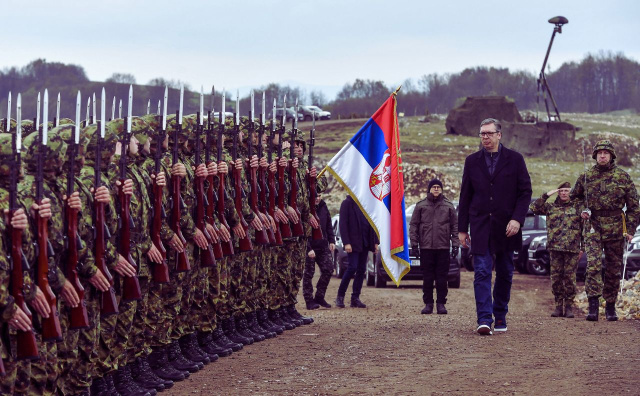

Belgrade, June 21 – Serbian President Aleksandar Vucic has revealed that Serbia has been covertly strengthening its military capabilities over recent years, describing it as a necessary move to safeguard the country’s sovereignty and respond to emerging regional dynamics.
Speaking in a televised address, Vucic emphasized that only a handful of officials are aware of the full extent of the country’s enhanced military strength.
“Few people know what weapons we’ve brought in. We’ve done it in secret,” Vucic said, asserting that the Serbian Armed Forces are now stronger than ever. He suggested that a significant transformation has taken place in both the structure and equipment of the military.
“We have hidden huge changes in our defense capabilities,” he added, hinting at an upcoming military parade in September that will serve as the first public demonstration of Serbia’s new arsenal.
The president pointed to increasing defense cooperation between neighboring Kosovo, Albania, and Croatia as a key driver behind Serbia’s rearmament strategy.
He claimed the three countries are forming what he termed a “military alliance” and have allegedly encouraged Bulgaria to align with them.
In March, Kosovo, Albania, and Croatia signed a Declaration on Security and Defence Cooperation, pledging closer collaboration on regional security. While the signatories have denied that the pact constitutes a formal military alliance, Serbian officials view it as a potential threat.
Vucic defended Serbia’s military modernization as a defensive necessity. “We will not fire first,” he stated, “but we must be ready to defend our country.” Surrounded by NATO members, Serbia is under increasing pressure to maintain strategic parity, the president argued.
Among the key developments disclosed was Serbia’s investment in unmanned aerial technology. “Many types of drones” are now integrated into the country’s defense systems, Vucic said.
He also accused NATO of flying surveillance drones over Serbian territory, but noted that Belgrade has refrained from reacting in order to maintain the element of surprise. “We don’t want them to know what we have,” he explained.
Despite Serbia’s controversial ties with Russia, Vucic rejected any interpretation that the country’s military buildup signals aggressive intent. “Serbia does not pose a threat to its neighbors,” he said, underlining the country’s commitment to peace and regional stability.
On the economic front, Vucic confirmed that Serbia is preparing to resume negotiations with the United States over the future operations of the Serbian Oil Industry (NIS).
The company, partially owned by Russia’s Gazprom Neft, is seeking an extension of its special license from the U.S. Treasury Department before its current authorization expires on June 27.
Without the license, NIS operations could face serious disruptions due to secondary sanctions stemming from Western measures against Russian entities involved in the war in Ukraine.
As the region grapples with shifting alliances and geopolitical uncertainty, Serbia’s clandestine military upgrades have added a new layer of complexity to the Balkan security landscape. Whether these developments will heighten regional tensions or serve as a deterrent remains to be seen.