



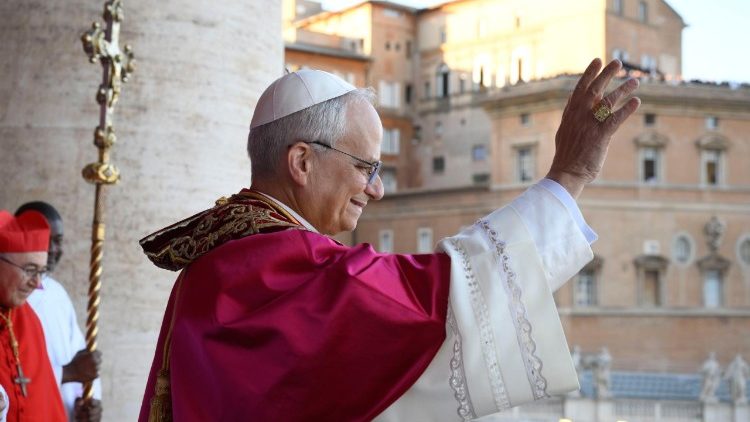

Vatican City – May 9, 2025 — In a moment that will be remembered for generations, Cardinal Robert Prevost, a dual U.S.-Peruvian citizen and Chicago native, has been elected as the 267th pope of the Roman Catholic Church. Taking the name Leo XIV, he becomes the first American in history to ascend to the papacy.
The announcement came after a swift two-day conclave, concluding in just four rounds of voting — a sign of consensus among the cardinal electors. Prevost, 69, currently serves as the prefect of the Dicastery for Bishops, where he has overseen the appointment of bishops around the globe, placing him at the heart of Church governance.
Emerging onto the front balcony of St. Peter’s Basilica, Pope Leo XIV greeted a sea of cheering faithful in Italian, beginning with the words: “Peace be with all of you.” He described peace as “the first greeting of the risen Christ” and extended it to all people around the world.
“God loves us all, unconditionally,” he affirmed, continuing a message of unity and compassion that echoed the tone of his predecessor, Pope Francis. Addressing the crowd in both Italian and Spanish, Leo XIV called on the faithful to “build bridges” and follow Christ as a path to reconciliation in a fractured world.
Switching briefly to Spanish, the new pontiff gave thanks to the people of his former diocese in Peru “where a loyal people has shared its faith and has given a lot.” He then led a prayer to the Virgin Mary, before concluding with a Latin invocation to the saints and Madonna, ending his first address with a blessing to the crowd assembled in St. Peter’s Square.
Observers noted that the election of Prevost marks a turning point in the Church’s long-standing hesitation toward an American pope. For decades, many believed U.S. political influence on the global stage would preclude an American from holding the Church’s highest office.
Bishop Robert Barron once cited Cardinal Francis George of Chicago’s belief that “until America goes into political decline, there won’t be an American pope.”
Nonetheless, Prevost’s extensive experience in Latin America and his dual nationality may have eased concerns among the conclave’s electors. Known for his moderate tone, pastoral focus, and administrative capabilities, Leo XIV is widely seen as a figure who can balance continuity with reform.
Like Pope Francis, he champions outreach to the poor and marginalized but remains doctrinally conservative on key issues, including opposition to the ordination of women as deacons.
As the Carabinieri band played and cheers echoed through the square, Pope Leo XIV waved to the crowd, symbolizing a fresh chapter for the Church. His election signals an ongoing commitment to global inclusivity, particularly with his roots in both North and South America.
In a world rife with conflict and division, Pope Leo XIV’s inaugural message centered on unity and peace — a vision that many hope will define his papacy in the years to come.