



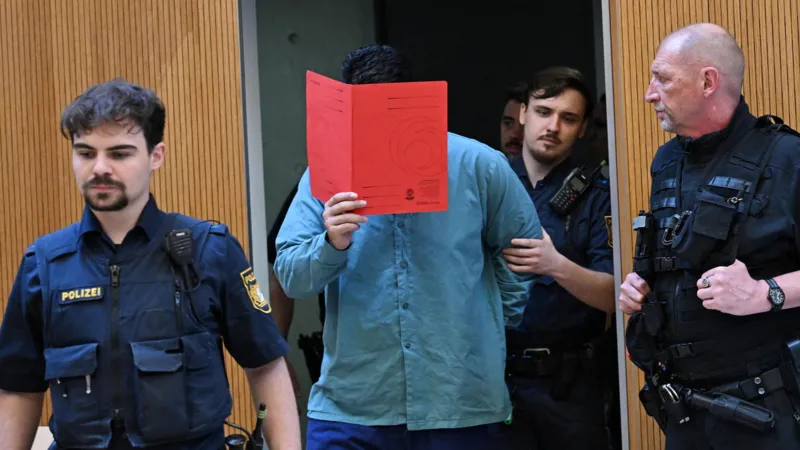

Germany, Bavaria: Munich court imposes life sentence on Afghan attacker responsible for deadly vehicle assault that killed two people
A German court has sentenced the man responsible for one of the country’s deadliest vehicle attacks in recent years to life imprisonment, concluding a case that shocked the nation and intensified political debate over migration, public security, and extremist violence.
The Munich Higher Regional Court found the 25-year-old Afghan national, identified only as Farhad N under German privacy laws, guilty of deliberately driving his Mini Cooper into a crowded trade union demonstration in central Munich on 13 February 2025.
The attack claimed the lives of a 37-year-old woman and her two-year-old daughter, who both died in hospital shortly after the incident. More than 40 other people suffered injuries, with several sustaining life-threatening wounds.
Following a lengthy trial, judges convicted Farhad N on two counts of murder, 23 counts of attempted murder, and multiple additional offences, including grievous bodily harm.
The court ruled that the crime was of a “particularly serious nature,” a legal designation in Germany that makes it significantly harder for the convicted individual to obtain parole after serving the standard minimum of 15 years in prison.
Delivering the verdict, the presiding judge said the attack was a deliberate act aimed at randomly targeting people in Germany. According to the court, the defendant believed the assault would demonstrate his religious devotion and earn divine approval.
The judge stated that Farhad N intended to attack innocent civilians in response to conflicts affecting Islamic countries, describing the crime as ideologically motivated rather than a spontaneous act of violence.
Prosecutors argued throughout the trial that the defendant viewed the attack as a necessary response to the actions of the United States and other Western nations in Gaza and Afghanistan.
They also maintained that personal feelings of anger, disappointment, and bitterness contributed to his decision to carry out the assault.
The prosecution rejected suggestions that severe mental illness diminished his criminal responsibility, insisting the evidence demonstrated careful planning and ideological commitment rather than an uncontrollable psychiatric episode.
Defense lawyers presented a different argument during the proceedings, requesting a fixed prison sentence of 15 years instead of life imprisonment.
They also sought the defendant’s placement in a psychiatric hospital, arguing that he displayed symptoms consistent with a form of schizophrenia that should be considered during sentencing.
However, the court ultimately concluded that the available medical evidence did not outweigh the deliberate and intentional nature of the attack.
Farhad N retains the legal right to appeal the verdict under Germany’s judicial system.
The incident unfolded on the morning of 13 February 2025 when approximately 1,400 people had gathered in central Munich for a trade union rally.
Witnesses described scenes of panic after the vehicle accelerated into the crowd, striking pedestrians without warning before coming to a stop.
Emergency services responded within minutes, treating dozens of injured victims at the scene before transporting many to nearby hospitals.
Despite intensive medical care, the injured woman and her young daughter later died from the severe injuries they sustained during the attack.
Authorities launched a major terrorism investigation immediately after the incident, examining both the defendant’s background and possible ideological motivations.
Investigators determined that Farhad N had arrived in Germany in 2016 during the height of Europe’s migration crisis.
He reportedly entered the country alone as a teenager after leaving Afghanistan.
Although his asylum application was rejected, German authorities did not deport him. Instead, he remained legally resident in Germany and was granted permission to work.
Officials confirmed that he had been employed as a shop detective and also worked for private security companies before the attack.
Prior to the incident, he had no criminal convictions.
Investigators also examined his online activity, noting that he maintained an Instagram account featuring posts related to bodybuilding alongside religious content.
While authorities reviewed his digital presence as part of the investigation, prosecutors primarily relied on evidence presented during the trial regarding his motives and planning.
The Munich attack occurred during a period when Germany experienced several violent incidents involving vehicles and knives, placing renewed attention on national security and immigration policies.
These attacks became major topics in political debate, particularly as concerns over border controls, asylum procedures, and public safety grew across the country.
The incidents also strengthened arguments advanced by the far-right Alternative for Germany (AfD), which has repeatedly linked migration with domestic security concerns.
Germany accepted more than one million asylum seekers during the 2015-2016 migrant crisis, a policy that remains politically divisive nearly a decade later.
Supporters argue that Germany fulfilled an important humanitarian responsibility by providing refuge to those fleeing conflict and persecution.
Critics, however, continue to question aspects of asylum enforcement, deportation procedures, and the effectiveness of security screening for unsuccessful applicants who remain in the country.
The Munich verdict is therefore expected to resonate beyond the courtroom, with legal experts and political leaders likely to view it as a landmark decision in Germany’s ongoing efforts to address terrorism and violent extremism.
For the victims’ families, however, the sentence cannot erase the devastating loss suffered on that February morning.
The deaths of a mother and her young daughter became enduring symbols of the human cost of extremist violence, while dozens of survivors continue to recover from both physical injuries and psychological trauma.
Although the court’s decision closes one chapter of the legal process, the wider discussions surrounding migration, integration, public safety, and counterterrorism are expected to remain central issues in German politics.
With the defendant now sentenced to life imprisonment and facing strict conditions before any possibility of parole, German authorities hope the ruling demonstrates the country’s determination to hold perpetrators of terrorist violence fully accountable while reaffirming justice for the victims and their families.