



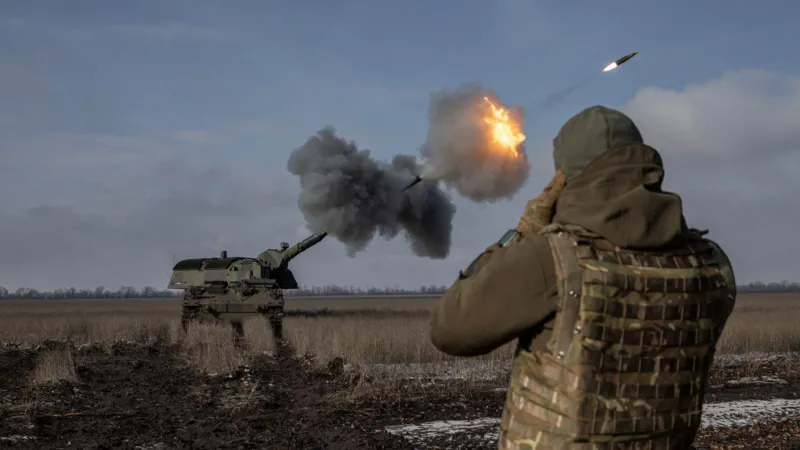

A decisive moment for European defence is unfolding in Germany today as the Bundestag votes on a historic budgetary reform that could dramatically reshape the country’s military spending.
The outcome of this vote could set the trajectory for Germany’s defence policy for years to come and influence the continent’s ability to stand against growing security threats, particularly from Russia.
The proposed legislation seeks to remove constitutional borrowing restrictions for defence expenditures exceeding 1% of Germany’s GDP, potentially unlocking hundreds of billions of euros for military investment.
The vote also includes provisions to allocate €500 billion to infrastructure projects and climate change initiatives, addressing broader economic concerns alongside defence priorities.
As Europe grapples with the implications of a semi-victorious Russia in Ukraine and mounting uncertainty over the United States’ commitment to NATO, Germany’s decision carries weight far beyond its borders.
If passed, the measure will reinforce the European Commission’s proposed €800 billion ‘ReArm Europe’ fund, designed to strengthen the continent’s collective security.
The Strategic Imperative
Germany’s incoming Chancellor, Friedrich Merz, is pushing hard to secure approval before the newly elected Bundestag convenes on March 25.
With opposition from both the far-right Alternative for Germany (AfD) and the far-left Die Linke, the ruling coalition is relying on support from centrists to meet the two-thirds majority threshold.
“This vote in the Bundestag is absolutely crucial,” says Prof. Monika Schnitzer, chair of Germany’s Council of Economic Experts.
“After the Munich Security Conference and the Trump-Zelensky dispute, Europeans are beginning to realize that Washington’s military support cannot be taken for granted. Many policymakers had sleepless nights after those revelations.”
The concerns are reinforced by comments from U.S. officials signaling a retreat from longstanding defence commitments. Vice President JD Vance’s scathing critique of European policies on migration and free speech at the Munich Security Conference left European delegates stunned.
Shortly before, U.S. Defense Secretary Pete Hegseth warned NATO allies not to assume America’s defensive umbrella would remain in place indefinitely.
European defence experts worry that should the U.S. scale back its involvement, Russia could threaten NATO’s eastern members, including the Baltic states, within three years. This prospect is alarming given Russia’s increased military production and wartime economy.
Germany’s Defence Spending in Focus
Germany’s military investment surged by 23.2% in 2024, contributing to a record 11.7% increase in European defence spending. However, many analysts argue this is still insufficient given the scale of threats on the horizon.
“The remarkable initiatives announced in Germany are key to enabling further growth,” says Dr. Fenella McGerty, a senior fellow at the International Institute for Strategic Studies in London. “Without them, progress in strengthening Germany’s military capability may stall.”
Traditionally cautious about military expenditure due to historical sensitivities and financial constraints, Germany has maintained a debt ceiling of 0.35% of GDP.
The proposed revision would significantly ease these restrictions, allowing for large-scale investments in defence and security.
A Shifting Transatlantic Alliance
The Trump administration’s stance on NATO has introduced a new level of unpredictability into transatlantic relations. Some close to President Trump have even urged him to withdraw the U.S. from NATO entirely and relocate American troops stationed in Europe.
In response, European leaders are considering alternative security frameworks, including an expanded role for France’s nuclear deterrent. However, Europe’s conventional military capabilities remain heavily dependent on U.S. support, particularly in advanced weaponry and intelligence.
According to the Kiel Institute, 86% of Ukraine’s rocket artillery and 82% of its howitzer ammunition come from the U.S. If Washington reduces or ceases its support, Kyiv would face severe operational disadvantages.
Additionally, the U.S. provides critical intelligence gathered from satellites and geospatial sources, without which Ukraine’s battlefield awareness would be significantly impaired.
The Military Balance in Europe
Russia has embraced a war economy, channeling nearly 40% of its national budget into defence and maintaining a military expenditure close to 7% of GDP—far beyond NATO’s standard 2% benchmark.
In contrast, Europe has struggled to boost military spending at a comparable rate, despite calls from security experts to do so.
Germany’s Rheinmetall corporation is ramping up production of 155mm artillery shells, yet the vast majority of Ukraine’s munitions have been supplied by the U.S.
The British Army, for example, has been reduced to its smallest size since the Napoleonic Wars and, according to analysts, would run out of ammunition within two weeks in a full-scale conventional conflict.
The Cultural and Strategic Shift Needed
Experts argue that while increased funding is necessary, Europe must also address deeper structural and cultural challenges within its military institutions.
“If the vote passes, it will be significant for Germany and for Europe,” says Ed Arnold, a senior research fellow for European security at the Royal United Services Institute.
“It will set a precedent and allow others to follow. However, three years on from the invasion of Ukraine, the case of Germany is a reminder that more money for defence is necessary but not sufficient. Europe needs leaders who can navigate a rapidly deteriorating security environment. Cultural, rather than financial, reform would be most valuable right now.”
This includes reforming procurement processes, improving coordination among European allies, and increasing the speed and scale of military production. A more streamlined and efficient defence industry is crucial to closing the gap with Russia’s high-output arms manufacturing.
What’s at Stake in Today’s Vote?
If the Bundestag approves the proposed reforms, Germany will enter a new era of defence policy, committing to higher military spending while also bolstering European security initiatives.
This would align Berlin with the European Commission’s ambitions to create a stronger, more autonomous defence capability. However, if the proposal fails, the ‘ReArm Europe’ project could face significant setbacks, leaving European nations scrambling to find alternative funding sources.
This would also weaken the EU’s ability to counteract Russia’s growing military dominance and reinforce concerns about Europe’s reliance on an increasingly unpredictable U.S. administration.
As lawmakers cast their votes, the stakes could not be higher. Today’s decision will shape not only Germany’s future defence posture but also the broader security landscape of Europe.
With the geopolitical climate becoming increasingly volatile, Germany’s role as a cornerstone of European defence policy has never been more critical.
This article was created using automation technology and was thoroughly edited and fact-checked by one of our editorial staff members