



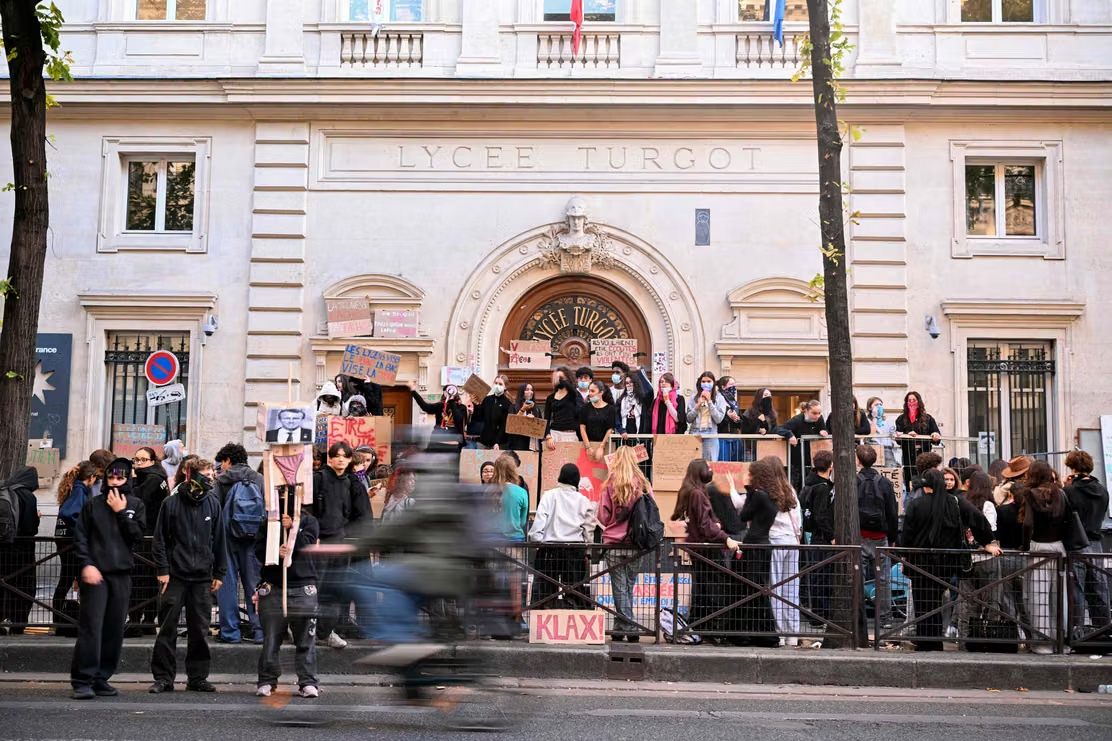

France’s Île-de-France region sees growing student unrest as teenagers demand better schools, greater support and a stronger voice nationwide
France’s high school protest movement has gathered momentum in recent weeks, with students across the country blocking entrances, displaying handwritten messages and demanding greater attention to problems they say affect everyday education, personal wellbeing and their prospects after graduation.
Nearly 590 high schools, out of roughly 3,700 nationwide, remained disrupted on Monday, October 5, according to the account published by Le Monde. The disruption came before a major protest day expected to bring students, university groups and workers together.
The demonstrations have produced a wide range of slogans reflecting frustration among teenagers. Messages placed on school gates have focused on education, policing, school hours, inadequate facilities and concerns about being treated as statistics rather than individuals within the education system.
Although the demands vary from school to school, students interviewed during blockades in Paris, Marseille and Toulouse described remarkably similar concerns. Their comments pointed toward deteriorating study conditions, anxiety about academic orientation and uncertainty over what lies ahead.
For many teenagers, the protests are rooted in ordinary experiences inside schools. Complaints can involve seemingly basic necessities, including shortages of toilet paper, while broader frustrations concern crowded classrooms, the organization of lessons and the resources available to students.
Academic orientation has also emerged as a significant source of anxiety. Students approaching important educational decisions face pressure to select courses and pathways that could influence their future, while some feel they lack sufficient guidance to make those choices confidently.
That uncertainty is particularly significant for teenagers who already feel disadvantaged by their social or economic circumstances. For them, educational decisions can appear to carry consequences far beyond school, affecting access to higher education, employment opportunities and longer-term financial security.
The protests therefore represent more than dissatisfaction with individual school facilities. Students are increasingly connecting everyday problems with larger questions about how education is organized and whether young people are receiving enough support to prepare for adulthood.
Security and policing have also become part of the debate. Some protesters have objected to the presence or role of police around schools, arguing that educational institutions should prioritize learning and support rather than creating an atmosphere they associate with surveillance or control.
One slogan highlighted in the protests questioned whether long school days made students feel as though they were at school or in police custody. Such messages illustrate how some teenagers perceive the relationship between educational discipline, security measures and their personal freedom.
At the same time, other slogans have emphasized the importance of education itself. Messages declaring that the nation’s future depends on education suggest that students are not rejecting schools or learning, but instead demanding improvements to a system they consider essential to society.
This distinction is important because the movement is not built around a single demand. Students have raised concerns about material conditions, academic orientation, public spending, policing and their prospects, creating a protest movement that is broad but united by dissatisfaction.
The geographical spread of the demonstrations has further strengthened that impression. Reports from working-class areas around Paris, as well as major cities such as Marseille and Toulouse, indicate that students in very different environments are describing many of the same pressures.
For teenagers in working-class communities, educational frustrations can carry an additional weight. Schools are often viewed as one of the principal routes toward social mobility, making inadequate resources or uncertainty over educational opportunities especially concerning for students already worried about their future.
The protests have also created a space for students to express emotions that are difficult to capture through statistics. Anxiety, frustration and fear about the future rarely appear in official measures of school performance, but they are central to many young people’s experiences.
Students’ repeated calls to be heard underline another major theme of the movement. Beyond specific demands about facilities or education policy, many protesters appear to want recognition that teenagers have legitimate views about the institutions shaping their daily lives.
The timing of the demonstrations has added political significance. With hundreds of schools disrupted on October 5, the movement entered a wider phase just before a major nationwide protest involving unions and other groups.
Some of the most committed students are hoping for what they describe as a convergence of struggles, bringing high school pupils together with university students and workers. Such cooperation could broaden the movement beyond education and connect it to wider social concerns.
However, the breadth of the movement also presents challenges. When demonstrations include demands ranging from school supplies and academic guidance to policing and public spending, authorities may find it more difficult to identify a single response capable of satisfying protesters.
For students, though, these issues may not feel separate. Poor facilities, academic pressure and fears about the future can form part of the same experience, particularly for young people who believe the education system is failing to provide adequate preparation and support.
The movement also reflects a generation growing up amid considerable uncertainty. Students making decisions about their education are simultaneously confronting concerns about employment, social inequality and their ability to build secure lives after leaving school.
That uncertainty helps explain why seemingly simple messages have resonated so widely. A complaint about classroom conditions can quickly become a broader statement about whether society is investing sufficiently in its young people and giving them a meaningful stake in the future.
For authorities, the growing disruption presents a delicate balancing act. Schools must remain capable of operating safely, while officials also face pressure to address legitimate concerns without allowing demonstrations to prevent other students from receiving their education.
The coming days could determine whether the current movement remains concentrated around school blockades or develops into a broader student campaign. Much will depend on how effectively students organize and whether their demands gain support from universities and workers.
Whatever happens next, the protests have already demonstrated that France’s high school students are prepared to make their concerns visible. Their messages reveal not only dissatisfaction with schools, but also a deeper desire for recognition, security and hope.
The immediate issues may range from toilet paper and classroom conditions to academic guidance and policing, but the underlying question is considerably larger. Students want confidence that the education system can prepare them for a future they increasingly fear may be uncertain.
As France enters another day of demonstrations, the voices emerging from school gates are therefore likely to remain part of the national conversation. The students’ demands may be diverse, but their central message is increasingly consistent: they want to be heard.
This article was created using automation technology and was thoroughly edited and fact-checked by one of our editorial staff members