



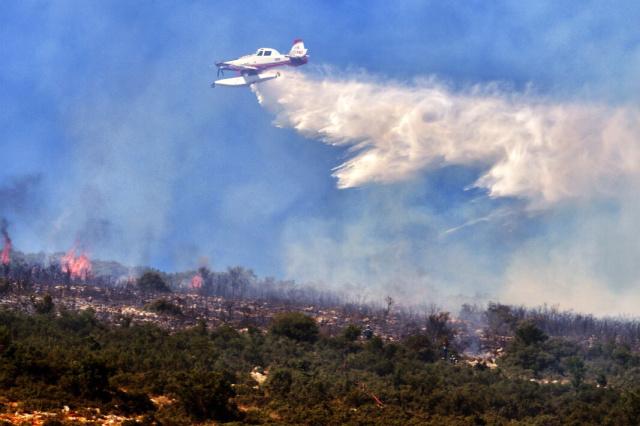

In an urgent response to the escalating wildfire crisis, a firefighting aircraft from France is set to arrive today in Bulgaria to assist in combating the raging blaze on the Slavyanka border mountain.
The Bulgarian authorities sought international aid under the European Civil Protection Mechanism after the fire, which has already devastated over 15,000 acres in Greece, spread into Bulgarian territory.
The presence of mine fences has further complicated efforts to extinguish the fire on both sides of the border.
International Assistance Mobilized
The call for international assistance came as Bulgarian fire crews grappled with the intensifying situation. The fire, initially a Greek calamity, crossed into Bulgaria, posing significant threats to both nations.
The European Civil Protection Mechanism, a framework designed to enable coordinated responses to disasters, facilitated the swift deployment of resources from France.
Bulgaria’s Interior Minister, Kalin Stoyanov, highlighted the capabilities of the incoming French aircraft.
“A plane that I actually saw for myself within 10-12 seconds was able to fill between 6 and 7 tons of water. We have already detained this mechanism. I suppose that with a good set of circumstances this plane will be able to operate on Tuesday,” Stoyanov stated.
This rapid response and high-capacity water-dropping ability of the French plane are expected to significantly bolster the firefighting efforts.
Challenges on the Ground
The situation on the ground remains perilous. The Slavyanka Mountain, with its rugged terrain and dense forestation, presents a formidable challenge for firefighters.
The presence of mine fences, remnants from past conflicts, exacerbates the danger, limiting the movement and operations of ground crews.
These obstacles necessitate the use of aerial firefighting methods, such as those provided by the French aircraft, to effectively tackle the blaze from above.
Despite these challenges, Bulgarian firefighters have demonstrated resilience and determination. Over the past 24 hours, 128 fires have been extinguished across the country, according to the General Directorate “Fire Safety and Protection of the Population.”
The Directorate’s website reported no fatalities or injuries from these incidents, underscoring the efficiency and dedication of the fire crews.
Local Incidents Under Control
In addition to the border blaze, local firefighting units have been kept busy with other emergencies. Last night, a fire broke out in the Seventh District of Samokov, affecting a house and several outbuildings.
Initial reports had suggested the fire engulfed three houses, but this was later corrected. Fire crews managed to control the blaze successfully, ensuring no injuries were reported.
This incident, while alarming, showcases the effectiveness of local fire response teams in managing and mitigating fire outbreaks.
The swift containment of the Samokov fire is a testament to the preparedness and capability of Bulgarian firefighting units, even as they contend with the larger crisis at the border.
National Firefighting Efforts
The broader firefighting efforts across Bulgaria continue unabated. Over the past 24 hours, fire crews responded to 166 accident reports, including 21 fires that caused material damage. Of these, five incidents occurred in residential buildings.
Additionally, there were 107 fires reported that did not result in material damage. The General Directorate “Fire Safety and Protection of the Population” has been at the forefront of these efforts, coordinating responses and ensuring public safety.
The Human Element
Amidst the ongoing fire crisis, the human element remains a focal point. The collaborative efforts of international allies, local firefighting units, and the broader community highlight the resilience and solidarity in the face of disaster.
The arrival of the French aircraft symbolizes the unity and collective resolve within the European Union to confront and overcome shared challenges.
Interior Minister Stoyanov’s remarks encapsulate this spirit of cooperation and determination. The anticipation surrounding the deployment of the French firefighting plane brings a glimmer of hope amidst the smoke and flames.
As the aircraft prepares to take flight and douse the inferno, the collective efforts of all involved continue to inspire and drive the mission forward.
Looking Ahead
As the situation evolves, continuous monitoring and adaptation remain crucial. The firefighting teams, both local and international, are poised to tackle the blaze with renewed vigor and enhanced capabilities.
The integration of aerial support, such as the French plane, represents a strategic advantage in the firefighting arsenal.
The immediate priority is to contain and extinguish the fire on the Slavyanka Mountain, preventing further spread and mitigating the impact on both Bulgarian and Greek territories.
Long-term strategies will focus on addressing the underlying causes, enhancing preventive measures, and fortifying international cooperation to better respond to future crises.
The unfolding events underscore the importance of readiness, resilience, and international solidarity in the face of natural disasters.
As Bulgaria and its allies confront the fire head-on, the lessons learned and the bonds forged will undoubtedly shape future responses and bolster collective security and preparedness.
Conclusion
The arrival of the French firefighting aircraft marks a pivotal moment in Bulgaria’s battle against the border fire. With over 15,000 acres already consumed in Greece, the international assistance is a beacon of hope amidst a challenging and dangerous situation.
The complexities of the terrain and the presence of mine fences necessitate innovative and coordinated efforts to combat the blaze effectively.
As the nation stands united in its firefighting efforts, the resilience and determination of both local and international crews will be instrumental in overcoming the crisis.
The collaborative spirit and the strategic deployment of resources highlight the strength and solidarity of the European Civil Protection Mechanism, ensuring that no nation stands alone in times of need.
This article was created using automation technology and was thoroughly edited and fact-checked by one of our editorial staff members