



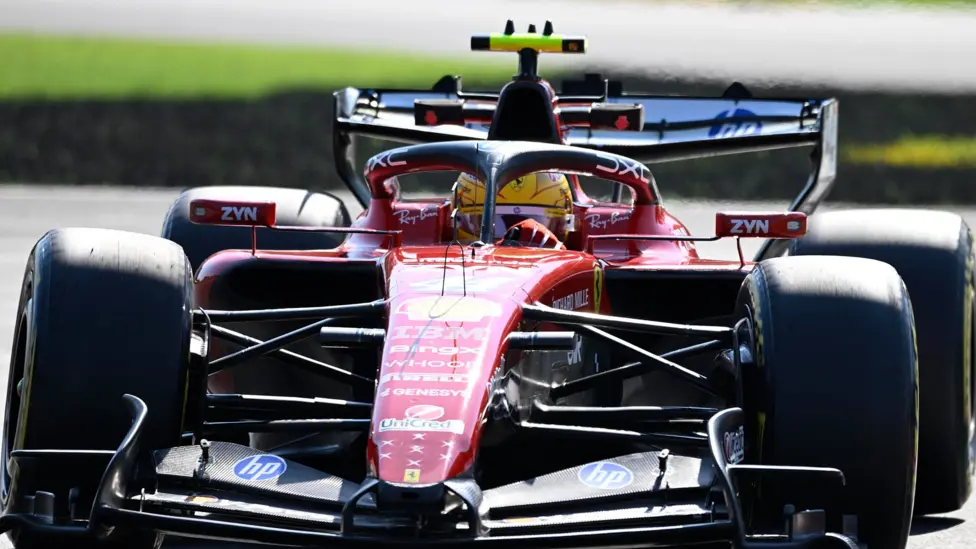

Italy, Lombardy: Lewis Hamilton says Ferrari has improved its engine, but Mercedes retains an advantage on Monza’s long straights
Lewis Hamilton has welcomed Ferrari’s improved engine but warned that the team remains significantly behind Mercedes in straight-line speed at the Italian Grand Prix, after Friday practice highlighted a performance gap that could prove crucial around Monza’s high-speed layout.
George Russell set the fastest time during Friday’s second practice session, finishing 0.120 seconds ahead of Ferrari driver Charles Leclerc. Hamilton was fifth fastest, 0.457 seconds behind Russell, while Mercedes team-mate Kimi Antonelli and McLaren’s Lando Norris also finished ahead.
Hamilton said Ferrari appeared to be losing substantial time to Mercedes on Monza’s long straights, where aerodynamic efficiency and power deployment are particularly important. The seven-time world champion estimated that approximately six-tenths of a second disappeared during straight-line sections.
“Just looking at the deltas there, I was losing something like 0.6secs to George on the straights,” Hamilton said, highlighting an area Ferrari will need to investigate before Saturday’s qualifying session and Sunday’s race.
Ferrari introduced a new engine for the Italian Grand Prix, providing the team with an important performance upgrade at a circuit where power-unit efficiency traditionally carries significant weight. However, Hamilton believes the improvement has not completely closed Mercedes’ advantage.
“The engine is an improvement, which I’m really grateful for the guys back at the factory for working on,” Hamilton said, while explaining that Ferrari’s energy deployment strategy differs from those used by its competitors.
Hamilton also suggested that Mercedes could be benefiting from lower aerodynamic drag. Ferrari’s deployment schedule may be contributing to the apparent straight-line deficit, although the team is unlikely to have revealed its full performance potential during Friday’s running.
Mercedes driver Antonelli offered a more encouraging assessment of Ferrari’s progress. The Italian said Ferrari had clearly taken a step forward with its new engine and suggested that the straight-line speeds were now much closer than Hamilton’s analysis indicated.
“Ferrari definitely took a step forward with the new engine and now the speeds are the same,” Antonelli said. He believes the Ferrari remains particularly strong through the corners, potentially setting up a close qualifying battle.
Antonelli enters his home weekend as one of the championship’s leading contenders, holding a 59-point advantage over Hamilton and Russell. However, his Italian Grand Prix will begin from the back of the grid because of an engine-component penalty.
Mercedes deliberately selected Monza for Antonelli to serve the grid penalty, despite the punishment potentially costing him a first home victory opportunity. The team believes the circuit’s long straights and overtaking possibilities could allow the young driver to recover significantly during Sunday’s race.
Antonelli nevertheless appeared satisfied with Mercedes’ Friday programme. The Italian explained that the team concentrated heavily on long-run work rather than simply chasing qualifying performance, collecting valuable information about tyre behaviour and race pace.
“It’s amazing to be here and the support has been incredible,” Antonelli said, describing the session as unusual because of its emphasis on long runs. He also focused on understanding how cars behaved while following competitors around Monza.
The information could prove particularly valuable because slipstreaming is expected to play a major role during qualifying. Drivers can gain significant speed by following another car down Monza’s long straights, making the search for an effective tow potentially decisive.
Hamilton acknowledged the importance of the slipstream and indicated that he would probably attempt to use it during qualifying. At Ferrari, he has the choice of whether to run before or after Leclerc, adding another strategic element to Saturday’s session.
“The tow is everything here,” Hamilton said. His comments underline the unusual qualifying dynamics at Monza, where drivers must balance the benefits of aerodynamic assistance against the risk of encountering traffic or compromising their final flying lap.
Ferrari’s Friday performance nevertheless provided reasons for optimism. Although Hamilton struggled to extract maximum performance from the car, Leclerc finished second fastest, demonstrating that the Italian team remains firmly in contention for pole position at its home circuit.
Hamilton was also unhappy with the balance of his Ferrari during practice. He described the car as difficult to drive and said changes made during the session had not immediately produced the expected improvement.
“It was really difficult to pull a lap out of the car,” Hamilton explained. Ferrari will now analyse the data collected during Friday practice before deciding how to adjust the setup for qualifying, when outright performance becomes significantly more important.
McLaren endured a more difficult Friday than expected. Lando Norris, who has won the previous two grands prix from pole position, admitted that Monza was proving considerably more challenging than recent circuits.
Norris said McLaren was struggling for pace across almost every section of the lap. The team expected the high-speed Italian circuit to expose some weaknesses, but losing performance through the corners was particularly surprising given McLaren’s recent strength.
“We are struggling for pace quite a lot more than the last few,” Norris said. He added that the team would investigate overnight changes but acknowledged that McLaren was not currently in as strong a position as during recent weekends.
Max Verstappen also struggled to match the leading Mercedes and Ferrari cars. The Red Bull driver, still searching for his first victory of the season, finished ninth fastest, 0.818 seconds away from Russell’s benchmark time.
Verstappen’s Friday performance, however, was difficult to assess directly because teams used different tyre compounds during their race simulations. Mercedes focused on hard tyres, Ferrari ran softs, while Verstappen completed his programme using medium tyres.
The long-run data therefore provided a mixed picture, although Mercedes appeared particularly strong on the hard compound. Antonelli was only 0.038 seconds faster than Russell on average, while McLaren’s Norris and Oscar Piastri were approximately half a second slower.
Ferrari’s soft-tyre performance remained encouraging, with Hamilton and Leclerc less than two-tenths behind Mercedes’ hard-tyre pace. Verstappen, meanwhile, was roughly three-tenths slower than Antonelli on mediums, leaving the competitive order difficult to establish.
Haas also benefited from Ferrari’s new power unit, with Oliver Bearman using the upgraded engine alongside a separate car upgrade. Team-mate Esteban Ocon did not receive the same engine specification, creating another interesting comparison during the weekend.
As teams prepare for qualifying, Ferrari will focus on extracting more straight-line performance while improving Hamilton’s car balance. Mercedes appears confident, but Ferrari’s strong cornering performance and new engine could make the battle for pole extremely close.
Beyond the track, Formula 1 has also announced plans for a major fan event in Milan next February. The three-day gathering will take place from 18 to 20 February and will feature all eleven teams and their drivers.
The event, also called F1 Live, follows the successful 2025 event held at London’s O2 Arena. Organisers are planning a combination of team appearances, driver participation, music and entertainment as Formula 1 continues expanding its fan engagement programme.
For now, attention remains firmly on Monza, where Saturday’s qualifying session could provide the clearest indication of Ferrari’s progress. Hamilton believes the engine has improved, but Mercedes’ apparent straight-line advantage means Ferrari still has significant work to complete.
With slipstream tactics likely to dominate qualifying and long-run data offering an inconclusive picture, the Italian Grand Prix remains finely balanced. Ferrari has shown enough pace to challenge Mercedes, but Hamilton’s concerns suggest the smallest performance gains could ultimately decide the weekend.