



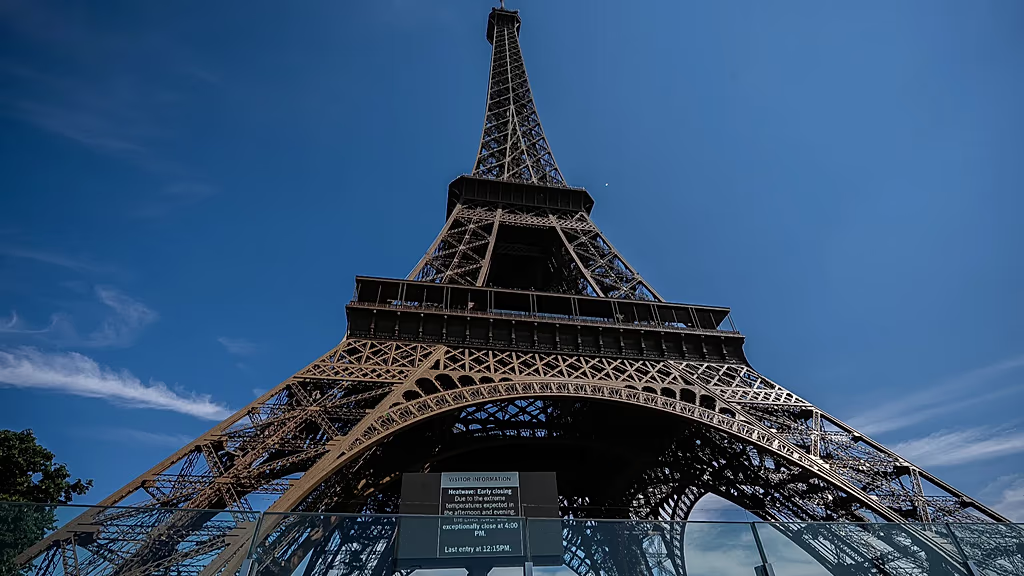

France, Île-de-France: Eiffel Tower workers stage walkout after female employees were reportedly sidelined during a Hindu religious delegation’s visit
Paris’s Eiffel Tower was closed on Monday after employees staged a walkout following controversy surrounding a visit by a large Hindu religious delegation, during which female workers were reportedly moved away from their usual positions.
The delegation was connected to the Bochasanwasi Akshar Purushottam Swaminarayan Sanstha, commonly known as BAPS, a Hindu movement that recently inaugurated a new temple in France.
Around 100 people associated with the organisation visited the Eiffel Tower on Saturday, with arrangements reportedly made in advance to accommodate the group and avoid disruption during the landmark’s normal opening hours.
However, the visit quickly became controversial after union representatives alleged that female employees were removed from their workstations as the delegation moved through different areas of the famous Paris landmark.
Diane Davoine, a union representative, told French television that female workers had been “moved away from their workstations” while the delegation passed through the Eiffel Tower during its visit.
Employees subsequently issued a statement condemning what they described as professional instructions that resulted in female colleagues being sidelined, replaced and effectively made invisible because of their sex.
The dispute has placed the company operating the Eiffel Tower, SETE, under scrutiny over the decision to accept conditions reportedly requested by the visiting religious delegation.
SETE acknowledged that BAPS had requested the visit be organised in a way that would limit interactions between members of the delegation and women working at the Eiffel Tower.
The company said such conditions should not have been accepted, effectively acknowledging concerns raised by employees and adding to pressure for an explanation of how the arrangements were approved.
The controversy also prompted an immediate response from BAPS, whose Paris temple released a statement on Monday evening addressing the concerns raised by Eiffel Tower employees and apologising for any pain or inconvenience caused.
BAPS said the size of its delegation meant the visit had been arranged with the Eiffel Tower team at the beginning of normal opening hours, with the intention of avoiding disruption or inconvenience to other visitors.
The organisation also said that, to the best of its knowledge, nobody had been prevented from accessing the Eiffel Tower during the visit, while stressing its belief in universal values of mutual respect and service.
Despite that explanation, the incident generated significant criticism in France, where equality between men and women is strongly embedded in the country’s public and political culture.
Paris Mayor Emmanuel Grégoire said he was aware of the outcry among Eiffel Tower employees and described the conditions agreed for the visit as unacceptable.
Grégoire said the arrangements did not reflect his values or those that the Eiffel Tower should uphold, stressing that everyone should be able to move and act freely without distinction between women and men.
The Paris mayor also announced that an investigation into the circumstances surrounding the visit would be launched, potentially examining how the reported restrictions were requested, discussed and ultimately implemented.
The controversy reached France’s National Assembly, with its president, Yaël Braun-Pivet, strongly condemning the decision to move female employees aside to accommodate the demands of foreign visitors.
Braun-Pivet said welcoming visitors should never require France to abandon its values, emphasising that women are fully present in public life and should not be instructed to become invisible.
Her comments reflected broader concerns over whether cultural or religious preferences from visiting groups should influence workplace arrangements at major public attractions in France.
The Eiffel Tower, one of the world’s most recognisable landmarks, attracts millions of visitors every year and represents a prominent symbol of Paris and French public life.
The dispute therefore extends beyond one delegation’s visit, raising questions about how cultural sensitivity, religious accommodation and workplace equality should be balanced at internationally important tourist destinations.
For the employees involved, however, the central issue was reportedly the treatment of female colleagues and the decision to alter their working arrangements because of their gender.
The walkout on Monday forced the temporary closure of the Eiffel Tower, leaving ticket holders facing disruption as staff protested over the circumstances surrounding Saturday’s delegation visit.
The Eiffel Tower’s official website listed the landmark as closed on Monday because of “exceptional circumstances,” while advising visitors holding tickets to check their emails for further information.
The site also apologised for the inconvenience caused by the closure, as uncertainty remained over when normal operations would resume following the staff action.
The incident has now placed both SETE and BAPS at the centre of an unusual public controversy involving religion, gender equality, employment rights and the management of one of France’s most important tourist attractions.
BAPS’s apology appeared intended to acknowledge the concerns without accepting every allegation surrounding the visit, while the organisation maintained that the arrangements had been coordinated with Eiffel Tower staff.
SETE’s acknowledgement that the reported conditions should not have been accepted, meanwhile, has strengthened calls for greater scrutiny over the decision-making process that preceded the delegation’s visit.
The investigation announced by Paris authorities could provide further clarity about who approved the arrangements, what exactly was requested by the delegation and how the reported treatment of female employees unfolded.
Until those findings emerge, the controversy remains focused on a fundamental question: whether accommodating a visiting religious group can ever justify restricting the professional participation or visibility of female employees.
French officials and workers’ representatives have made clear that, in their view, religious or cultural accommodation cannot come at the expense of gender equality and established workplace principles.
For the Eiffel Tower, the dispute represents an unwelcome interruption to its role as a global tourist attraction, while also highlighting the complexities surrounding international visitors and differing cultural expectations.
The episode has prompted BAPS to apologise, SETE to acknowledge that the arrangements were inappropriate and French authorities to investigate, leaving the final circumstances to be established through further examination.
This article was created using automation technology and was thoroughly edited and fact-checked by one of our editorial staff members