



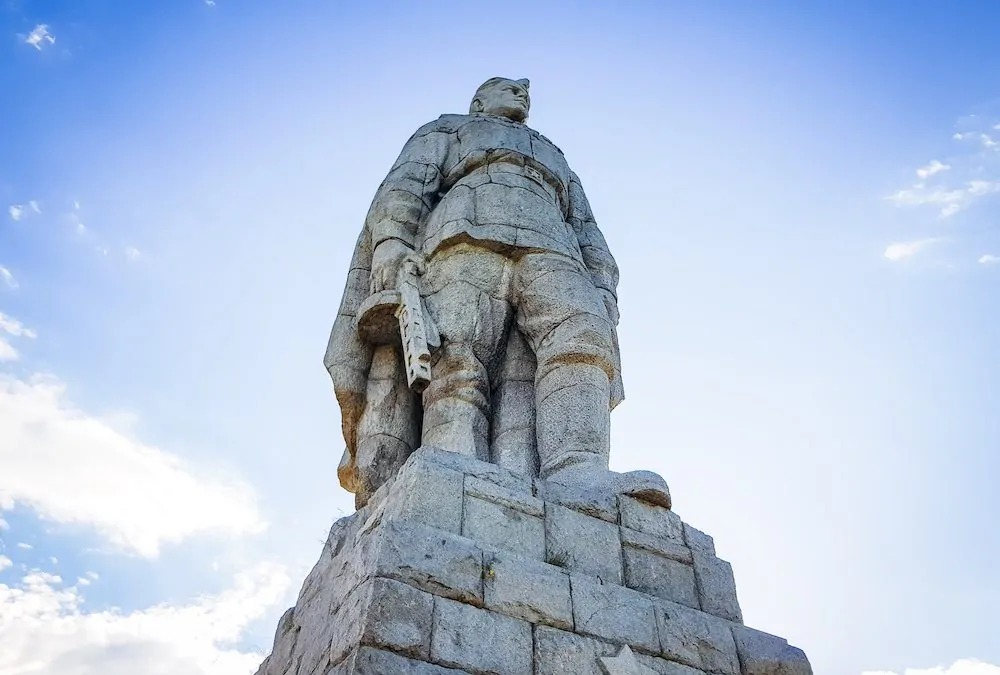

A group of citizens of Bulgaria’s Plovdiv region assembled in front of Plovdiv’s Municipal Council building on Wednesday to voice their strong opposition to a controversial proposal that has ignited a fierce debate about preserving historical monuments.
The contentious initiative, put forth by municipal councillors Vladimir Slavenski and Yono Chepilski of “Democrats for Strong Bulgaria” (DSB), advocates for the relocation of the iconic “Alyosha” Monument to the Soviet Army, situated atop Bunardzhik Hill.
The proposal recommends dismantling the 10.5-meter granite statue, unveiled in 1957, and transferring it to Sofia’s Museum of Socialist Art by the end of 2024.
Slavenski and Chepilski argue that the move constitutes a moral gesture honouring Bulgarian history, national dignity, and the victims of the communist regime.
However, the suggestion has sparked conflicting responses within the Municipal Council, laying bare the deep-seated divisions over the interpretation and commemoration of Bulgaria’s complex past.
Last week, the “There Is Such a People” (TISP) group injected another layer into the ongoing discussion by proposing a local referendum on the monument’s fate. This move has only intensified the already heated public discourse.

Protesters at the demonstration brandished signs bearing powerful slogans such as “Those who have built nothing are destroying everything” and “You can’t protect history with a referendum.”
The controversy has permeated local politics and garnered support from Members of Parliament, particularly from the Bulgarian Socialist Party (BSP).
Notable figures such as Kristian Vigenin, Georgi Svilenski, Manol Genov, Ivan Petkov, and Ivan Chenchev have expressed solidarity with the protesters. Chenchev, in particular, emphasized the importance of respecting every monument and ensuring its rightful place in history.
He staunchly advocated against attempts to rewrite history or engage in what he termed a “war with memory and monuments.”
The “Alyosha” Monument, a towering granite statue depicting a Soviet soldier holding a Shpagin submachine gun, stands as a historical symbol that has long been etched into the cultural fabric of Plovdiv.
Modelled after Russian soldier Aleksei Ivanovich Skourlatov, the monument serves as a poignant reminder of a bygone era. The proposed relocation has prompted a resounding public outcry, with residents expressing a profound attachment to the monument and its historical significance.
As the debate rages on, Plovdiv finds itself at a crossroads between preserving historical artefacts and redefining its cultural narrative.
The proposed relocation of the “Alyosha” Monument has become emblematic of the broader struggle to reconcile Bulgaria’s complex history and the divergent perspectives on its commemoration.
The fate of the monument now hangs in the balance, with the citizens of Plovdiv anxiously awaiting the resolution of a debate that transcends mere physical relocation—it is a battle over the very soul of their city and its historical identity.
This article was created using automation technology and was thoroughly edited and fact-checked by one of our editorial staff members