



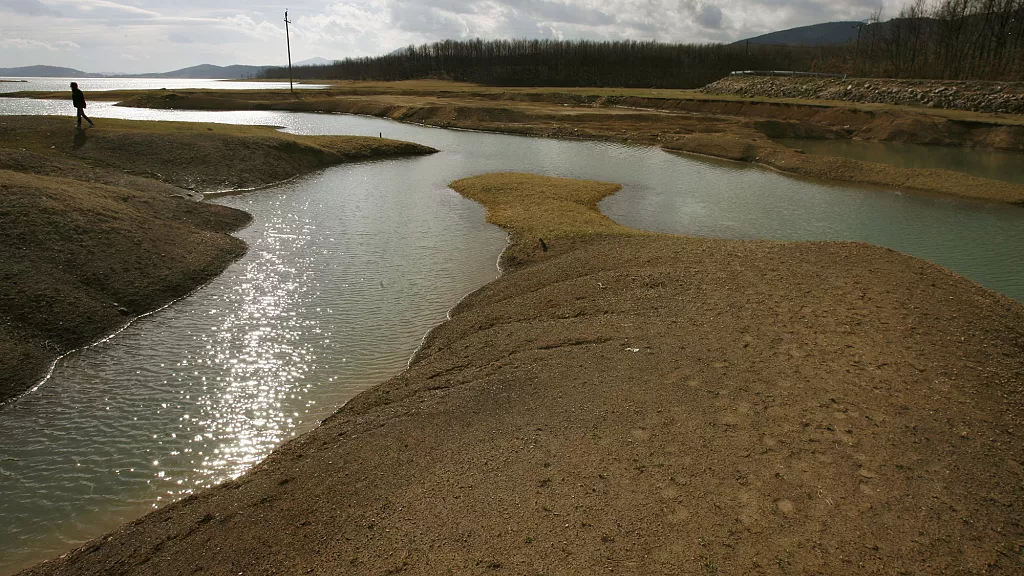

ATHENS, GREECE – Athens is facing an intensifying water crisis as new satellite data reveals that the city’s primary reservoirs are nearing historic lows, according to a comprehensive analysis released by the FloodHUB service of the BEYOND Operational Unit of IADET/EEA.
The report warns that the prolonged drought conditions of recent years have placed immense pressure on the Attica region’s water supply system, with urgent intervention now required to prevent possible scarcity.
The Attica water system, which serves the greater Athens metropolitan area, relies heavily on four key reservoirs: Mornos, Evinos, Yliki, and Marathon. Among these, Mornos is the principal supplier, with Evinos acting as a backup via an interconnecting tunnel, while Yliki and Marathon play supportive roles.
Alarming Satellite Data
Using medium- and high-resolution satellite imagery from Landsat (1984–2021) and Sentinel-2 (2017–2025), scientists tracked the seasonal surface variations of the two main reservoirs — Mornos and Evinos — and found signs of critical hydrological stress.
In May 2025, the surface area of Lake Mornos was measured at just 11.64 km², representing only 65 per cent of its historically recorded maximum for that time of year. This marks the second-lowest level recorded in the last 20 years, with the lowest occurring in 2008 when the lake shrank to under 10 km².
Similarly, Lake Evinos, which supplements Mornos, registered just 2.30 km² in surface area in May 2025, far below its overflow benchmark of 3.6 km². This decline is particularly worrisome due to the lake’s relatively smaller capacity and key role as a backup.
Drought and Climate Pressures
Researchers attributed the ongoing water depletion to a combination of low snow cover, high heat stress, and below-average precipitation — all indicators of severe hydrological drought.
In 2024, the Mornos basin experienced less than 10 per cent snow cover and extremely high temperatures, leading to significant evaporation losses. Although conditions in early 2025 have slightly improved with a snow cover of about 20 per cent and reduced heat stress, the improvement was not sufficient to halt the downward trend.
“The slight rebound in climatic indicators hasn’t translated into a meaningful recovery in water levels,” noted one expert from the FloodHUB team. “In fact, Mornos has seen an additional 10 per cent decline in stored water compared to last year.”
The situation at Evinos is even more dire. Unlike Mornos, which has a more substantial storage volume, Evinos is more vulnerable to fluctuations. The recent data shows no statistically significant increase in precipitation or improvement in drought indices for the lake.
A System Under Pressure
Together, the Mornos and Evinos reservoirs account for a substantial portion of Athens’ drinking water. The study estimates that both lakes are currently filled to only about 60 per cent of their effective capacity — a dangerously low level for a system that supplies a densely populated capital city.
“The present hydrological status shows that we are very close to the thresholds experienced during the worst year, 2008,” the FloodHUB report states. “If current conditions persist or worsen, water availability in Athens could be seriously impacted.”
This scenario poses a serious threat, not just to households and urban services, but also to agriculture, public health, and economic activity in the wider Attica region.
Historical Comparisons and Urgent Warnings
Historical data comparisons using satellite archives dating back to 1984 confirm that May 2025 represents an alarming low point for Mornos. Only the crisis year of 2008 saw a smaller water surface area at this time of year.
Despite moderate improvements in the Standardised Precipitation Index (SPI-3) and snow cover levels in 2025, the net storage continues to decline, suggesting that climatic recovery alone is not enough to counteract the multi-year drought impact.
The Evinos reservoir’s recent performance is particularly concerning. Between 2023 and 2025, the lake has shown a steady decline, with the May 2025 level being the lowest recorded in the last five years.
Call for Immediate Action
The authors of the study call for swift policy measures and strategic planning by Greek authorities to address the escalating crisis. This includes enhancing public awareness on water conservation, improving the monitoring of water resources, and possibly seeking alternative water sourcing technologies such as desalination.
Environmental advocacy groups are also urging the government to prioritise investments in climate resilience infrastructure.
“This is a wake-up call,” said a spokesperson for the Greek Climate Resilience Network. “Athens cannot afford to wait for another emergency year like 2008. This is the time for decisive action.”
Regional Implications
Greece is not alone in facing the consequences of prolonged drought. Other Mediterranean countries, including Spain, Morocco, and Türkiye, have recently issued similar warnings, pointing to increasingly strained water systems amid soaring summer temperatures and declining rainfall.
In the Western Balkans, some nations have already introduced water restrictions to cope with the impact of extreme heatwaves. The broader trend signals a growing climate emergency for the region.
What Lies Ahead?
If no corrective actions are taken, experts warn that Athens could face water rationing or emergency sourcing as early as late 2025 or early 2026, especially if the upcoming winter fails to deliver adequate rainfall and snow accumulation.
In the meantime, the BEYOND/IAADET/EEA team will continue its real-time monitoring of the reservoirs using satellite data and climate models, issuing regular updates to support decision-making and public awareness campaigns.
With temperatures rising and rainfall becoming increasingly erratic, the long-term sustainability of Athens’ water supply now hinges on urgent reforms, technological innovation, and a collective shift towards conservation.
This article was created using automation technology and was thoroughly edited and fact-checked by one of our editorial staff members