



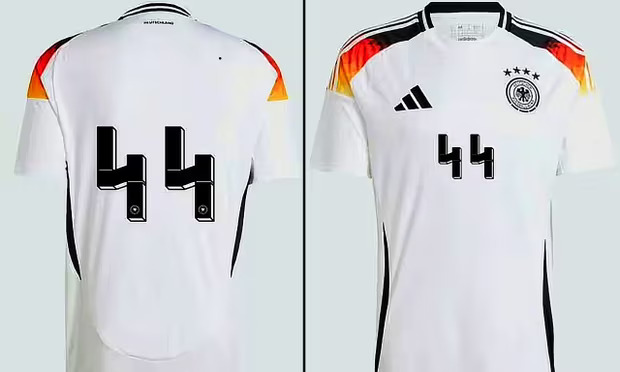

Berlin, Germany: In the lead-up to the highly anticipated European Football Championship, controversy has erupted over the design of the German national team’s jerseys, prompting Adidas to take action and ban fans from customizing their shirts with the number 44.
The decision comes amid concerns over the perceived resemblance of the number to the symbol used by Nazi SS units during World War II.
Historian Michael König was among the first to raise concerns about the design of the kit, labelling it as “very questionable.”
The SS rune, designed in 1929, has become synonymous with some of the most heinous crimes committed by the Nazis, including the industrialized genocide of Jewish people across Europe.
The paramilitary organization, tasked with carrying out Adolf Hitler’s agenda, was responsible for guarding concentration camps and running extermination camps such as Auschwitz, where over a million people were murdered.
Adidas spokesperson Oliver Brüggen denied any intentional resemblance to Nazi symbols, emphasizing the company’s commitment to opposing xenophobia, antisemitism, violence, and hatred in every form.
“We will block personalization of the jerseys,” Brüggen stated unequivocally. This is not the only controversy surrounding the German team’s attire, as the away kit’s pink colour has also stirred debate.
While supporters argue that it symbolizes Germany’s diversity, critics claim it is untraditional and merely a cash grab orchestrated by the German Football Association (DFB).
The European Championship, set to take place in Germany, has also seen controversy beyond jersey designs. Just weeks ago, fans of the England national team criticized alterations made to the St George’s cross on the team’s shirt collar.
Nike, the manufacturer, defended the use of purple and navy alongside the traditional red, stating it was meant to represent inclusivity. However, critics labelled it as disrespectful and accused it of being an act of “virtue signalling.”
Even Labour leader Keir Starmer joined the chorus of voices calling for the design to be scrapped. Despite these controversies, anticipation for the European Championship remains high.
The tournament will kick off on June 14th, with hosts Germany facing off against Scotland. Matches will take place in 10 different cities across the country, promising a spectacle of football that transcends borders and cultures.
As fans eagerly await the tournament’s start, the controversies surrounding the German and English national team kits serve as a reminder of the power of symbolism in sports and the importance of addressing historical sensitivities with care and respect.
With the eyes of the world on Germany, both on and off the pitch, the stage is set for a memorable and potentially transformative European Championship.
This article was created using automation and was thoroughly edited and fact-checked by one of our editorial staff members